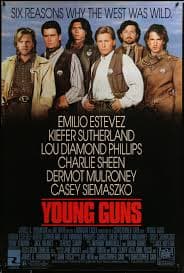
The setup
Young Guns isn't a museum piece of the Old West. It's a late-1980s take on that old story—boyhood turned lethal by loyalty—framed around William H. Bonney and a single act of violence that detonates everything. Directed by Christopher Cain and released in 1988, it trades strict history for propulsive storytelling and a very specific kind of youthful energy.
THE MOVIE
William H. Bonney (Billy the Kid) is still the reason this movie works
Put simply: Young Guns is a movie built around a young outlaw and the choices loyalty forces on him. The story follows William H. Bonney after an English rancher, John Tunstall, hires a band of wayward gunmen—the Regulators—to work on and protect his ranch in Lincoln County, New Mexico.
Then someone kills Tunstall. That ambush is the film’s engine. The Regulators’ campaign of revenge escalates an already rotten situation and drags the group from hired hands into outlaw politics and bloodshed.
At the centre of the push is Billy the Kid: a quick-drawing, charismatic young figure whose devotion to Tunstall and the Regulators propels the action. Christopher Cain directs with an eye for momentum; the film, released in 1988, clocks in at a tight 106 minutes and rarely lets the energy sag.
THE SETUP
The idea that sets Young Guns in motion
The film keeps its idea economical. A rancher hires a motley crew of young guns to work for him. That simple arrangement provides the social glue: employment, protection and a boss worth defending.
When Tunstall is murdered, everything shifts. The Regulators are pushed from paid hands into avengers. The plot then traces how that single act of violence spirals into a larger conflict—the Lincoln County War—by pitting the Regulators against the Murphy–Dolan faction and the corruption around it.
Young Guns deliberately compresses history. It focuses on the Regulators’ immediate response to Tunstall’s death and the way personal loyalty becomes public violence, rather than trying to catalogue every real-world detail of the conflict.
That compression keeps the movie moving. The setup is less about documentary accuracy and more about what one killing does to a handful of young men who suddenly have something to fight for.
THE CHARACTER
Why William H. Bonney (Billy the Kid) matters
Emilio Estevez is cast as William H. Bonney, but this section is less about an actor bio and more about the way the story is built to make Billy central. The screenplay’s research and shape funnel several strands of the Lincoln County War into a tighter personal narrative.
John Fusco spent months researching the period and then chose compression and composite characters as storytelling tools. That choice means the film lines up events to emphasise Billy’s loyalty, his choices and the consequences that follow.
As a result, the movie reads like a portrait of a turning point: a young man pushed into leadership by circumstance. Whether you come for the legend or the revenge plot, the script makes Billy the axis the rest of the movie spins on.
So Billy matters because the story is arranged around him—his loyalties give the plot direction, and the condensation of events makes his path cleaner and more immediate than a fuller historical account would allow.
THE PERFORMANCE
Why Jack Palance's performance matters
Contemporary reviews made a point of calling out some of the older actors among the adult cast. Jack Palance’s name comes up repeatedly in that reporting alongside Terry O'Quinn.
Those notices suggest the film’s balance between a youthful core and a recognisable older presence mattered to critics at the time. Palance, credited as L. G. Murphy, was one of the figures reviewers singled out when describing how the film handled the adult side of the conflict.
In short: the contemporary critical conversation noted Palance as a notable adult performer among the supporting cast, giving the movie a counterweight to the younger Regulators.
That balance—young guns front and centre, seasoned actors in the wings—helped the film read as both energetic and grounded in a recognisable Old West framework.
UNDER THE SURFACE
Young Guns has more on its mind than the plot suggests
On the surface Young Guns is a revenge picture: someone is killed, the young men sworn to protect their employer set out to settle scores, and violence builds on itself. That straightforward throughline is how the film keeps its head down and moves fast.
Beneath that is something like a study in camaraderie. The Regulators arrive as a group of wayward young men; the script tightens their bonds into loyalty. Friendship and group identity are the engines that make revenge feel personal rather than purely political.
Mentorship is the quiet hinge. John Tunstall’s role—his hiring of the boys—makes him the pivot that moves them from aimless youths into a crew with purpose. His death therefore carries both moral and organisational weight.
And because the story concentrates so narrowly on these men, the film also becomes a story about legend formation: how a handful of actions, told loudly enough, begin to harden into the sort of outlaw myth that sticks in history.
THE FILMMAKING
How Young Guns was put together
The film lists Dean Semler as director of photography, Jack Hofstra as editor and Jane Musky as production designer—names that anchor the production side of the movie.
Contemporary critics noticed something else, too: the editing felt brisk and influenced by then-current MTV-style pace, and the score leaned on modern pop/rock-inflected elements rather than strict period pastiche.
Those choices—crisper cutting, modern scoring and a stylised production design—were deliberate. They let the picture wear its 1980s personality on its sleeve while still telling a Western story.
So Young Guns is less a dusty archival recreation than a late-’80s reworking of the Western, assembled by credited craftspeople but shaped by contemporary editing and music choices noted in the period press.
PURE 80S
Young Guns could not belong to any other decade
The movie is unabashedly an ’80s product in one key way: the casting. It assembled young stars who were recognisable from late-1980s youth cinema, and that was part of its commercial hook at the time.
More than casting, contemporary coverage put the film in a small late-1980s resurgence of mainstream Westerns that deliberately mixed modern music and editing approaches with historical settings.
Critics of the day picked up on that stylised, late-1980s production design and the youthful energy the film rode. Those elements mark Young Guns as a film of its era—one that borrows present-day techniques to make the past feel immediate.
If you find the movie anachronistic at times, that’s the point: it isn’t trying to be a period museum piece, but an ’80s action-Western with a historical backdrop.
WATCHING IT NOW
What has aged — and what hasn't
Some of what the film leans on still works. The condensation of events and composite characters—choices made during John Fusco’s research and scripting—give the movie a clear throughline, which helps it remain watchable today.
The youthful energy contemporary reviewers praised remains a selling point: the film moves with purpose and never wallows in its own mythology.
What feels more dated are the stylised late-1980s production touches. Critics at the time already flagged the film’s tendency to simplify history and apply a modern gloss; that approach can now read as a deliberate stylistic choice rather than fidelity to the past.
In short: the story’s focus and momentum survive, but the way the film dresses history is very much of its moment—and viewers should expect a version of events shaped for impact rather than accuracy.
THE LEGACY
Why Young Guns still matters
Part of Young Guns’ afterlife is straightforward: its youth-driven casting and commercial approach were cited at the time as factors that produced a sequel two years later.
Several of the film's principal young actors returned for Young Guns II, which underlines how the movie was positioned—both as a vehicle for its cast and as a commercial property with more story to tell.
The film is often remembered for that mix: a handful of young stars, a rousing revenge plot and the production choices that gave it an ’80s spin.
If Young Guns still turns up in conversations, it's because it packaged those elements into a compact, audience-friendly Western rather than because it set out to be a definitive historical account.
THE VERDICT
Does Young Guns still hold up?
Yes—if you want a lean, energetic ride with a clear throughline. The film follows William H. Bonney after John Tunstall hires a group of young Regulators; Tunstall’s murder propels those men into a campaign of revenge against the Murphy–Dolan faction and the corruption around it. That narrative simplicity is the movie’s strength.
Be upfront about what you’re getting: the screenplay condenses and simplifies historical events, using composite characters and even a voice-over epilogue to summarise later fates instead of dramatising every outcome. That’s a storytelling choice, not a failing—unless you came for exhaustive history.
Contemporary reviews also noted that some supporting adult performances stood out among the older cast, which helps balance the youthful core led by Emilio Estevez as Billy. The themes—revenge, camaraderie, mentorship and how legends are made—are clear and sustained throughout.
If you’re watching now, treat Young Guns as a character-driven, late-1980s Western: it’s brisk, occasionally stylised, and centred on a young man whose loyalties turn friendship into legend. It still works because it keeps the stakes personal and the action moving—and sometimes that’s precisely what a Western should do.
Share this movie
Keep watching
More movies from the 80s
1986
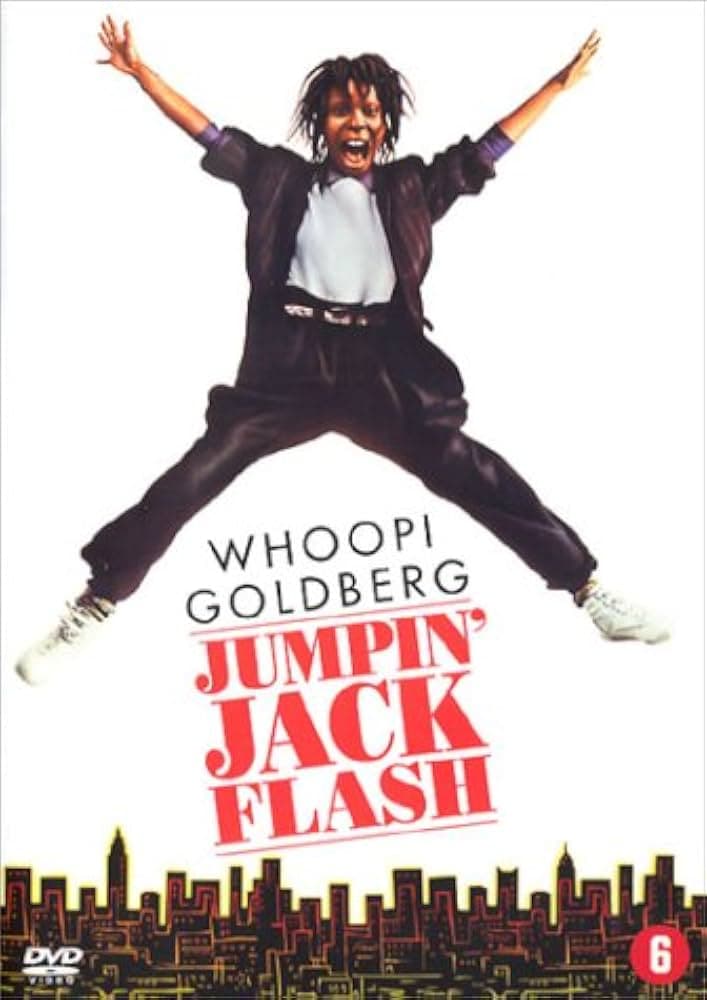
Jumpin' Jack Flash
Jumpin' Jack Flash: our relationship with technology and freedom, and why this 1986 movie still matters.
Read our take →
1987
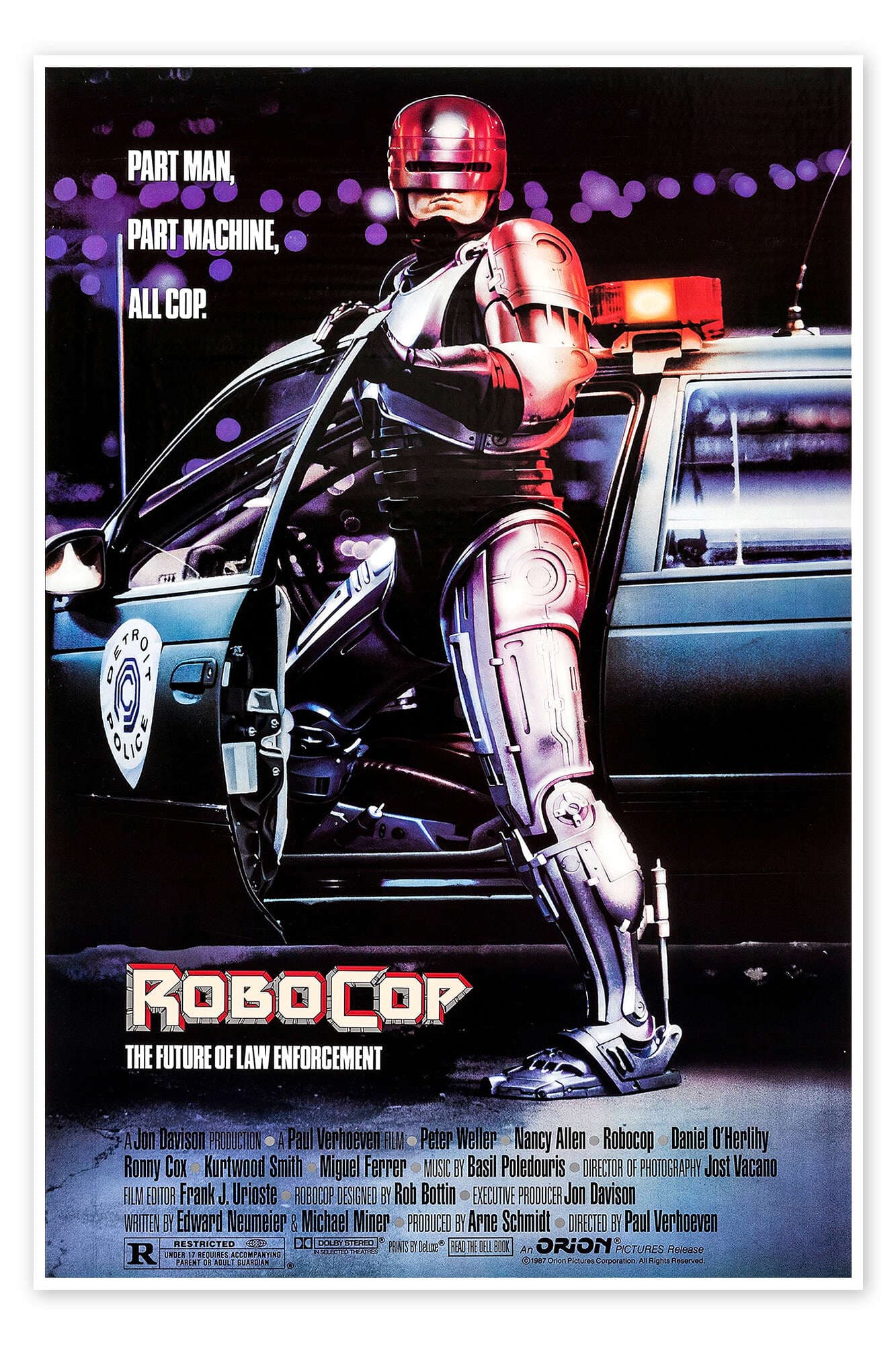
RoboCop
A murdered cop rebuilt as a product — RoboCop still asks who gets to sell justice.
Read our take →
1983
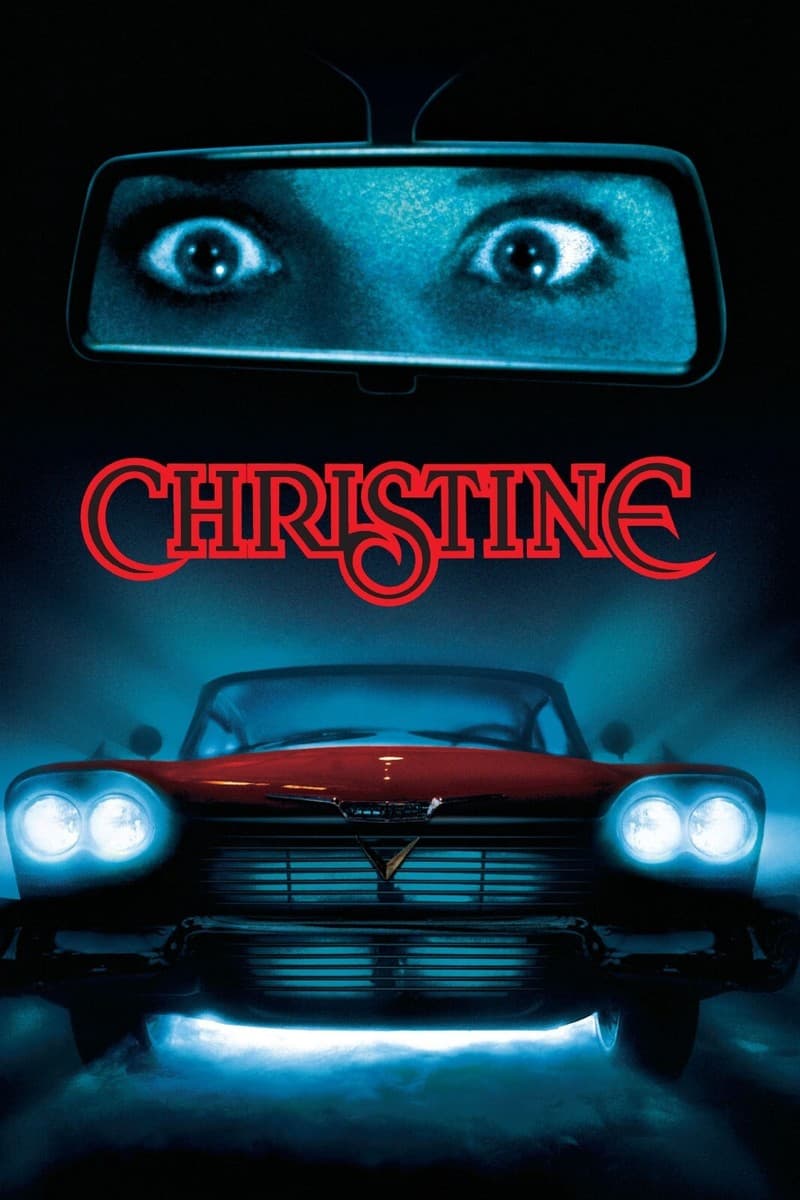
Christine
Obsession, adolescence and a car that won't let go.
Read our take →