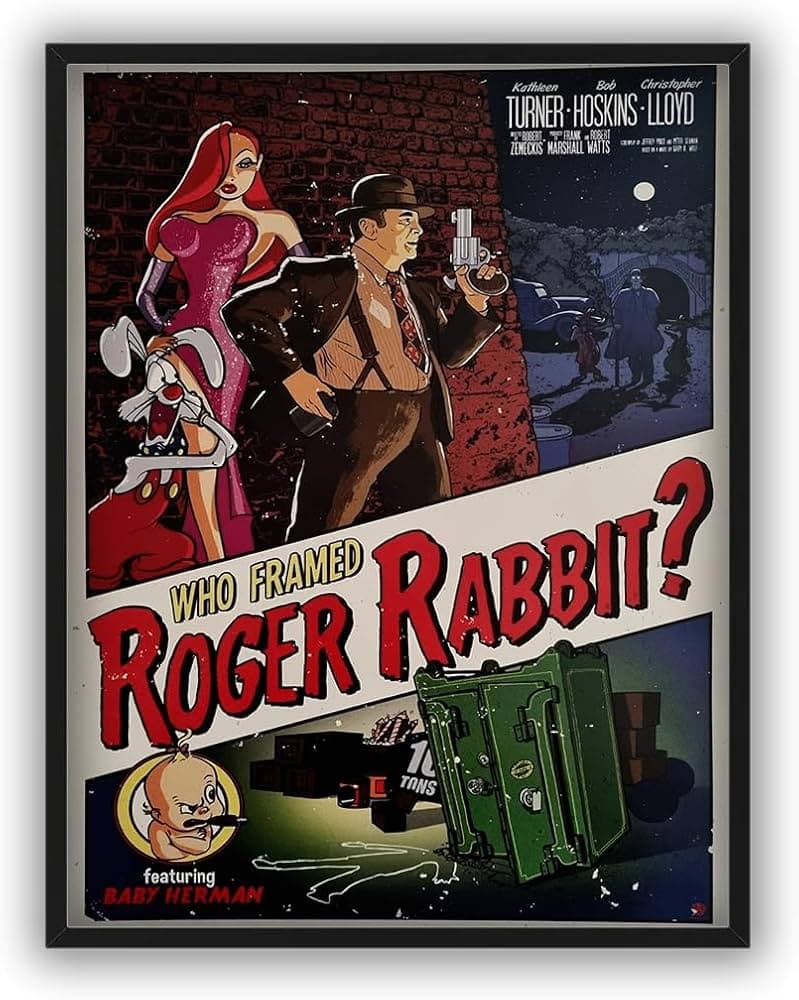
The setup
Who Framed Roger Rabbit still gets talked about because it stitches two very different kinds of cinema together and somehow makes the seam look like choreography. Robert Zemeckis took a private-eye story, dropped a manic cartoon into it and let the strange chemistry do the rest. The joke — and the heart — is that the movie only works because Eddie Valiant cares enough to see the toons as people worth saving.
THE MOVIE
Eddie Valiant is still the reason this movie works
Set in an alternative 1947 Hollywood where people and cartoons share streets and studio lots, the whole movie hinges on a burned-out private eye being dragged back into a case he never wanted. It’s a nifty trick: drop an upbeat toon into a noir plot and see which one changes shape.
The inciting push is simple — gag magnate Marvin Acme is killed and Roger Rabbit, a cartoon celebrity, looks like the obvious fall guy. That setup gives the plot some old-fashioned stakes (a framed suspect, a missing will) while letting the film play with the absurdity of cartoons inside a hardboiled world.
Eddie Valiant is introduced with a personal grudge against toons, which makes his journey credible: what starts as professional curiosity becomes a moral commitment to someone he at first wants nothing to do with. And yes, Bob Hoskins plays Eddie; Director Robert Zemeckis is steering the whole enterprise so the film can be both a pastiche and, oddly, a tender rescue mission.
THE SETUP
The idea that sets Who Framed Roger Rabbit in motion
At its centre is a tidy narrative lever: ownership of Toontown — the place where the cartoons live and work — hinges on Marvin Acme’s will. Finding that will becomes more than paperwork; it’s about who gets to stay and who gets bulldozed for progress.
Complicating everything is an in-world chemical capable of destroying toons: the so-called 'dip'. It’s a dark, specific device that raises the stakes beyond reputation or jobs — for cartoon characters it’s literally life and death, and that sharpens the noir tension.
All these beats sit beneath the film’s technical bravado. Contemporary observers singled out the mixing of live-action and classical cel animation as a breakthrough — the story works because the gimmick isn’t just spectacle; it matters to the plot and the peril.
Also worth a quick note: the production blended several live techniques to make animated characters feel present on set, including a live-action model and separate speaking and singing contributions for Jessica Rabbit — little practical details that keep the premise convincing.
THE CHARACTER
Why Eddie Valiant matters
Eddie Valiant isn’t just a grudging detective thrown into a cartoon caper. He’s a man who’s been hurt, and that hurt gives the whole film its emotional ballast. The plot needs someone who doesn’t instinctively like toons; otherwise the moral puzzle — why protect them? — has no force.
His arc is plain and effective: introduced with a personal grudge tied to past trauma, Eddie moves from cynical distance to a commitment that makes the movie feel like a rescue rather than a rescue gag. That shift is what turns the film into more than a novelty.
Bob Hoskins plays Eddie, and the character anchors the film’s fusion of genres. The screenplay takes only a handful of elements from Gary K. Wolf’s original novel and refashions them, but Eddie remains the film’s human centre — the flatline that the cartoons help revive.
THE PERFORMANCE
Why Charles Fleischer's performance matters
Charles Fleischer supplies the voices of Roger Rabbit and several other animated figures, but his role extended beyond the recording booth. Production accounts note Fleischer sometimes worked on set as a timing reference, helping actors react to the rhythms of characters that weren’t physically there.
That technique — bringing a vocal and physical presence onto the soundstage — matters because it kept interactions believable. Voice casting alone can feel remote; doing both on-set reference and vocal performance narrows the gap between human and cartoon.
Fleischer’s multiple voice credits (Roger Rabbit, Benny the Cab, Greasy, Psycho) mean one performer helps stitch the cartoon world together, which in turn supports the film’s seamless cross-talk between forms.
UNDER THE SURFACE
Who Framed Roger Rabbit has more on its mind than the plot suggests
On the surface it’s a whodunnit and a buddy picture. Underneath it plays like a film-noir pastiche about redemption: a hard-boiled man learns to laugh again because a cartoon won’t let him be small-hearted.
It’s also a film obsessed with borders — literal and metaphorical. The boundary between 'real' people and toons is constantly tested, and the movie delights in the friction where those worlds meet.
There’s a civic argument, too: corporate progress threatens Toontown’s future. The story puts development and profit up against cultural and personal preservation, so the mystery becomes a debate about what’s worth saving.
Finally, the film is an affectionate homage to Golden Age animation, emphasising inter-studio crossover and the joy of seeing classic cartoon sensibilities turned into a live-action conversation piece.
THE FILMMAKING
How Who Framed Roger Rabbit was put together
Robert Zemeckis directed a film that needed an old-Hollywood look and cutting-edge integration. The credited crew includes Dean Cundey as director of photography and Arthur Schmidt as editor, with production design by Elliot Scott and Roger Cain — a team assembled to marry period style with technical complexity.
Richard Williams was brought in as animation director to recreate the Golden Age cartoon sensibility, while ensuring the drawn characters picked up live-action lighting cues through careful shading and highlights. That choice kept the animated figures visually honest in a live world.
The industry recognised the achievement: the film collected awards that pointed to its technical success in blending disciplines, and Williams received special notice for overseeing the animation work.
Put bluntly: the movie’s identity depends on confident coordination between director, animation department and the production crew. It’s a big juggling act, and the credits show they hired people to do every one of those jobs properly.
PRACTICAL EFFECTS
The effects work that gives Who Framed Roger Rabbit its physical personality
On set the crew used puppetry, mannequins and practical rigging so live actors had something physical to push or react to — visible supports were later removed in compositing. Those on-set tricks kept performances grounded.
The animated characters were drawn on traditional cel animation, with extra attention to painted shading and highlights so they read under live lighting and camera moves. The intention was always to make cartoons feel like real, tangible presences.
Industrial Light & Magic handled extensive optical compositing, layering hand-drawn cels over live-action plates rather than leaning on CGI. The result is a craft-forward patchwork that pays attention to frame-by-frame detail.
All of these methods are practical in the old-fashioned sense: solutions you can point to and explain, rather than a black-box of invisible effects.
PURE 80S
Who Framed Roger Rabbit could not belong to any other decade
Released in 1988, the film arrived at a moment when studios were willing to negotiate unusual rights deals. The ability to include characters from multiple animation houses was a late-80s industry achievement tied to key producers and their clout.
That cross-studio cameo ambition is a very 1980s sort of gamble: big, slightly sentimental, and technically demanding. The movie’s whole premise — an industry-minded nod to cartoon history — is inseparable from that era’s studio diplomacy.
The screenplay itself is officially adapted from Gary K. Wolf’s 1981 novel, but the script substantially alters the source beyond a few core characters; the result is very much a product of late-80s filmmaking sensibilities, not a faithful period pastiche.
Put another way: the film’s mix of heritage reverence and modern studio muscle feels like a conversation only that decade could have brokered.
WATCHING IT NOW
What has aged — and what hasn't
Many retrospective accounts point to the film’s technical integration, its fondness for Golden Age cartoons and its period production design as elements that have aged well. Those are the things that still catch the eye and hold up when you rewatch.
Not everything survived unscathed. Some jokes, background images and tonal choices were later revised or censored for home media and subsequent screenings; those changes are documented and reflect shifting audience sensitivities.
Small production details also remain evident today: the way Jessica Rabbit was assembled from multiple contributions (a speaking voice, a singing voice and a live-action performance model) still reads as clever, practical filmmaking.
Overall, what endures is a balance: the technical craft and the affectionate nods to animation history still charm, even when a handful of lines or images feel dated.
THE LEGACY
Why Who Framed Roger Rabbit still matters
The film’s awards and institutional recognition underline why it’s still discussed: it won multiple Academy Awards for editing, sound effects editing and visual effects, and Richard Williams received a Special Achievement Award for animation direction.
Beyond trophies, the Library of Congress added the film to the National Film Registry in 2016, pointing to a lasting cultural and aesthetic significance that goes beyond momentary novelty.
The movie also spawned direct spin-offs — three theatrical Roger Rabbit shorts — and even a theme-park attraction, which shows the story’s appeal extended into other entertainment forms.
Put together, the honours, the ancillary productions and the Registry selection explain why filmmakers and institutions keep returning to the film as an example of technical ambition married to affectionate nostalgia.
THE VERDICT
Does Who Framed Roger Rabbit still hold up?
Yes — and not just as a nostalgia trick. The movie’s setup is clear and functional: a 1947 Hollywood where a private eye is pulled into a murder case that threatens Toontown, and the stakes are made concrete by the will’s importance and the existence of a lethal solvent that can actually annihilate cartoons.
Those story mechanics matter because they keep the emotional through-line honest. Eddie Valiant’s transformation from someone nursing a grudge into a person willing to risk everything for a cartoon is the real engine here, and Bob Hoskins provides that anchor.
Technically, the film still impresses. Contemporary critics highlighted both the performances and the technical integration of animation and live action; production choices such as on-set voice references and large-scale optical compositing were practical answers to a tricky problem, and they pay off on screen.
If you’re wondering whether to watch it now: if you care about inventive filmmaking, a clever fusion of genres, and a story that asks you to care about imagination as an endangered thing, this one still works. It’s a film that stages grief in a trench coat and lets a cartoon be the ridiculous, loud medicine.
Share this movie
Keep watching
More movies from the 80s
1986
Jumpin' Jack Flash
Jumpin' Jack Flash: our relationship with technology and freedom, and why this 1986 movie still matters.
Read our take →
1987
RoboCop
A murdered cop rebuilt as a product — RoboCop still asks who gets to sell justice.
Read our take →
1983
Christine
Obsession, adolescence and a car that won't let go.
Read our take →