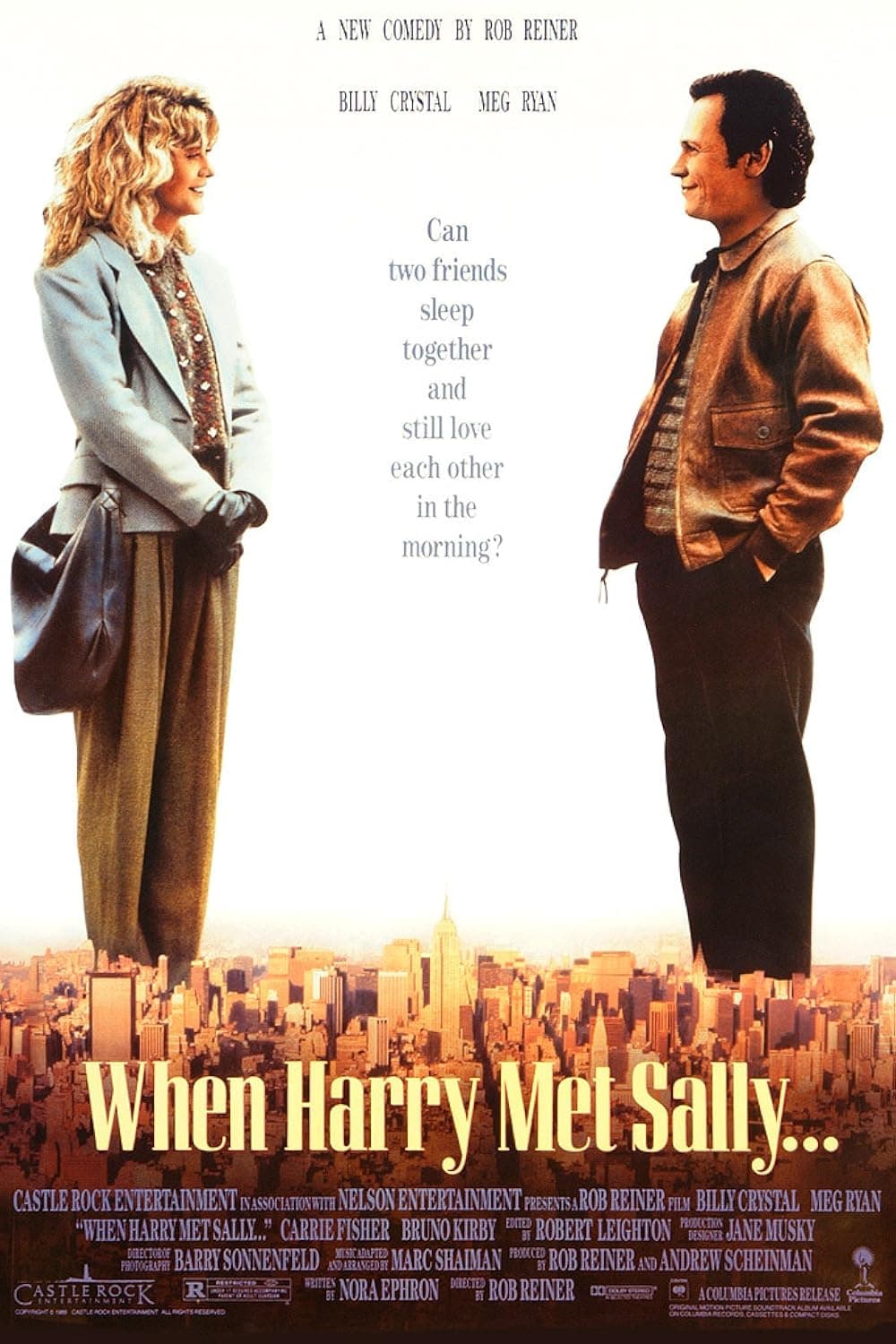
When Harry Met Sally
Cynicism, chemistry and a very public argument about friendship — still funny, still persuasive.
The setup
When Harry Met Sally settles on a single domestic question — can a man and a woman just be friends? — and spends the next ninety-six minutes having the most entertaining argument you’ll see about it. Rob Reiner’s film is less about plot fireworks than about two people testing, irritating and eventually understanding each other across years of New York life.
THE MOVIE
Harry Burns is still the reason this movie works
People keep returning to When Harry Met Sally because it makes an argument feel like entertainment. The film follows Harry Burns and Sally Albright across a string of chance encounters in New York, and the question they keep bumping up against is simple and stubborn: can men and women be friends without sex wrecking the arrangement?
That argument is introduced in a perfectly ordinary way — a drive from Chicago to New York right after college — and it’s Harry’s sour, argumentative take that keeps the film moving. Billy Crystal’s Harry is the character who plants the flag on the central debate, and the whole screenplay circles back to his point of view again and again.
Rob Reiner directs a compact, talky comedy that clocks in at ninety-six minutes and trusts its two leads to carry the load. Meg Ryan plays Sally; Crystal plays Harry; Carrie Fisher and Bruno Kirby orbit them as close friends who help nudge both toward awkward truths.
THE SETUP
The idea that sets When Harry Met Sally in motion
At heart the film is built on a single conceit: two people meet, disagree about friendship and sex, then keep running into each other over the next decade. Those collisions — awkward, funny and sometimes rueful — let the script show both characters changing their minds (and their lives) without ever turning the story into a soap opera.
The inciting moment is beautifully low-key: a road trip from Chicago to New York after college where Harry and Sally argue the big question about male–female friendship. It’s a small scene with a big idea, and the rest of the film treats that sparring as a blueprint.
Rather than a continuous plot, the screenplay traces them at key moments over roughly twelve years. That jump-cut structure lets chance and timing become characters of their own, so decisions and missed chances feel like the work of time as much as temperament.
THE CHARACTER
Why Harry Burns matters
Harry matters because he’s the film’s contrarian engine. Presented early as a cynical, argumentative figure about relationships, his take on whether men and women can be friends becomes the movie’s guiding irritant and conversation starter.
That cynicism isn’t just posture; it’s the lens through which the central debate gets restaged at different ages and in different emotional states. Harry forces the film to test its own premise instead of just accepting a rom-com shorthand.
His friendships — especially with Jess — and Sally’s with Marie operate as useful counterpoints. Those supporting relationships give texture and pressure: they show alternate paths and the cost of decisions, so Harry isn’t an isolated theologian of love but someone in a social world that challenges him.
Billy Crystal plays Harry, and the script keeps returning to him because his opinions turn private quarrels into public theatre; without that argumentative pull, the film’s talky magic would lose its focus.
THE PERFORMANCE
Why Billy Crystal's performance matters
Contemporary reviewers noticed what felt obvious: the film hinges on the chemistry between its leads. The pairing of Billy Crystal and Meg Ryan is constantly in the frame — not just sharing jokes but pushing one another into sharper truths.
Crystal’s Harry is the argument made flesh; as the film returns to him at different life stages, that argumentative core gives the character continuity. The back-and-forth with Ryan is what sells the idea that two people might move from annoyance to friendship to something more.
So even when the plot is simple, the movie’s pleasure rides on the way the two performers bounce off each other. Their rapport is the mechanism that turns talk into momentum.
UNDER THE SURFACE
When Harry Met Sally has more on its mind than the plot suggests
On the surface it’s a romantic comedy about two people who keep meeting. Underneath it’s a study in a few neat ideas: whether platonic friendship can survive desire; how timing and missed opportunities shape lives; and what living in a city like New York does to expectations about love.
There’s also a self-aware conversation about cinema-shaped romance — the movie knows it’s commenting on rom-com myths even as it participates in them. That reflexivity lets it be playful and honest at the same time.
Because those themes come out in small, recurring choices rather than grand pronouncements, the film stays nimble. It’s less interested in proving a theory than in watching characters try one on and see how it fits.
THE FILMMAKING
How When Harry Met Sally was put together
The credits tell part of the story: Barry Sonnenfeld is the director of photography, Robert Leighton edited the film and Jane Musky handled production design. Those names anchor a production that favours clear, conversational staging over showy technique.
Rob Reiner’s direction keeps the focus on the script and the actors, and the crew credits underline that this is a movie assembled by people whose job was to make talk feel cinematic rather than theatrical.
In short, the film’s identity comes as much from those craft choices as from its jokes: it’s a tight, spoken-word comedy comfortably dressed for cinema.
PURE 80S
When Harry Met Sally could not belong to any other decade
Released in 1989, the film sits at the end of the 1980s and helped nudge romantic comedies toward a late-80s/early-90s template where talk and relationship detail come first. It’s a product of a moment when audiences were open to smarter, more conversational love stories.
The movie’s platform release — opening in select cities and expanding as word spread — also speaks to how it found an audience: slowly, by relying on word of mouth rather than splashy studio positioning. That method felt very of its time and suited a film that trades on conversation for momentum.
WATCHING IT NOW
What has aged — and what hasn't
The central argument — whether men and women can be friends — remains surprisingly tidy and watchable. The way the screenplay returns to that question across twelve years still works as a dramatic motor; timing and missed opportunities are baked into the structure.
What feels more fragile is how the debate plays out against contemporary expectations about relationships. The film’s conversations assume certain social rules and shorthand that modern viewers may notice more readily. But because the questions are grounded in character rather than statement, the film still invites genuine engagement.
THE LEGACY
Why When Harry Met Sally still matters
The film’s screenplay earned clear recognition: Nora Ephron won a BAFTA for Best Original Screenplay and received an Academy Award nomination. That’s a useful reminder that the movie’s strengths are primarily written, not accidental.
Musically it also left a trace: Harry Connick Jr.’s album of standards recorded for the film did well enough to win him a Grammy. Even pockets of the film’s sound and mood made an afterlife beyond the screen.
Institutional recognition arrived too: the Library of Congress selected the movie for preservation in the National Film Registry in 2022, and it appears on several AFI lists of notable comedies and romantic films. Those honours underline that the film has continued to matter in conversations about the genre.
THE VERDICT
Does When Harry Met Sally still hold up?
Yes — mostly. The movie’s set-up (that Chicago–New York argument and the handful of key encounters that follow) still makes for a compelling structure: time jumps, recurring set pieces like Katz’s and New Year’s parties, and those documentary-style interviews keep the story brisk and sharp without padding.
What keeps it watchable now is how the screenplay keeps the debate alive rather than settling it quickly. Harry’s cynicism and Sally’s steadiness are repeated against different circumstances, and the presence of friends and past relationships constantly tests them. That ongoing pressure is the source of the film’s emotional logic.
If you come back for laughs, the Katz’s Delicatessen sequence and a certain final interview beat remain memorable. If you come back for conversation, the film’s lines of argument still provoke thought — and argument — about timing, choice and whether friendship can survive desire.
So yes: worth watching. It’s smart, economical and staged so the talk feels like action. And after all this time the movie still makes a simple claim with conviction: people change, timing matters, and a good argument can be the start of something.
Share this movie
Keep watching
More movies from the 80s
1986
Jumpin' Jack Flash
Jumpin' Jack Flash: our relationship with technology and freedom, and why this 1986 movie still matters.
Read our take →
1987
RoboCop
A murdered cop rebuilt as a product — RoboCop still asks who gets to sell justice.
Read our take →
1983
Christine
Obsession, adolescence and a car that won't let go.
Read our take →