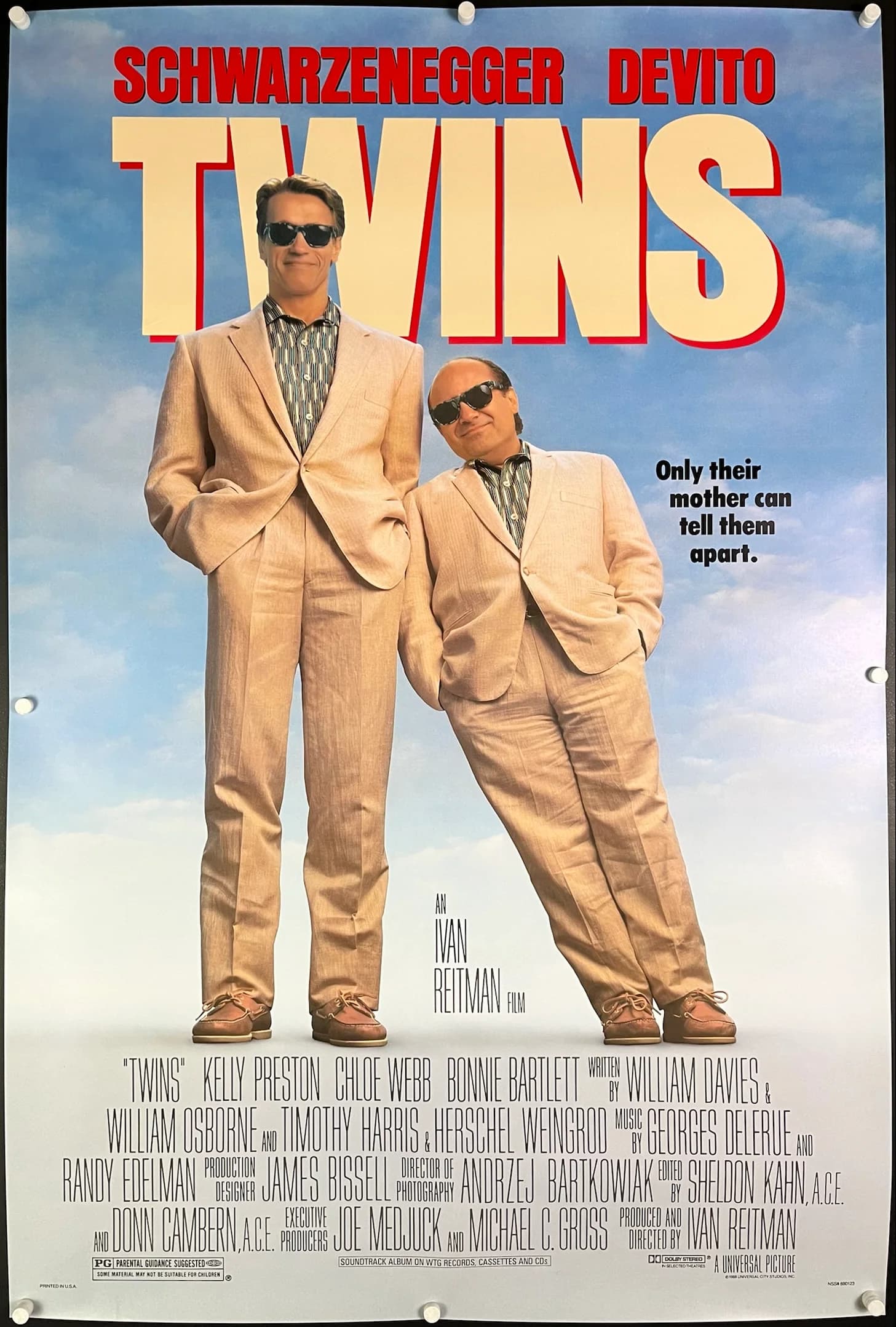
The setup
Twins still turns heads because it builds its whole joke — and its heart — around one improbable idea: what happens when you take two men engineered to be opposites and shove them into the same life. Ivan Reitman leaned on that contrast, and Julius Benedict is the character who carries the film from gag to genuine feeling.
THE MOVIE
Julius Benedict is still the reason this movie works
Twins opens with a premise that sounds like a late‑80s high‑concept pitch: two boys are the result of a secret genetic experiment and, because their bodies turn out very differently, they are separated at birth. That difference is the engine of the whole film.
As adults, one brother — Julius — arrives on the mainland as a picture of cultivated innocence: highly educated, morally steady and almost hilariously out of step with ordinary social life. The other, Vincent, is small, streetwise and living with the consequences of small‑time bad choices. The contrast drives the comedy, but Julius is the one who gives the film shape.
Directed by Ivan Reitman and clocking in at roughly 107 minutes, Twins hangs its marketing and much of its storytelling on that visual and behavioural mismatch. It’s an obvious hook, yes, but the movie keeps returning to the human side of the joke — the question of nature versus nurture, and what brotherhood actually looks like.
THE SETUP
The idea that sets Twins in motion
After discovering he has a twin, Julius leaves the island where he was raised and reunites with Vincent. That reunion is the start of a cross‑country search for their estranged mother — the quest that keeps the story moving rather than letting it collapse into endless sketches.
Around that central search sits a secondary, grubbier thread: Vincent’s debts and the stolen goods he’s mixed up with. Those dangerous little entanglements pull Julius into trouble he never imagined, so the film has a reason to keep the brothers together beyond the initial punchline.
Structurally, it’s a road‑movie setup dressed in odd‑couple clothing. The journey gives space for repeated fish‑out‑of‑water moments while still nudging the characters toward something like reconciliation.
That balance between a family quest and low‑level criminal peril is what lets Twins be both sentimental and jocular without becoming all one thing.
THE CHARACTER
Why Julius Benedict matters
Arnold Schwarzenegger plays Julius Benedict, but this isn’t a part that asks you to treat the actor as a musclebound archetype. Julius is presented as cultivated, softly moral and naïve about ordinary social life — the perfect foil for Vincent’s streetwise cynicism.
That naïvety is where the comedy lives: Julius doesn’t just look different, he thinks differently. The fish‑out‑of‑water beats are clear because Julius’s worldview is deliberately narrow and principled, which makes his reactions to Vincent’s messes and the world’s nastier corners genuinely funny and oddly moving.
Importantly, Julius also anchors the film’s emotional throughline. Their search for a mother isn’t just plot logistics; it’s what lets Julius and Vincent stop being a gag and start being brothers.
So while the marketing sells the physical contrast, the character keeps the audience invested. Julius is the steady hand that turns a one‑line joke into a story you can watch to the end.
UNDER THE SURFACE
Twins has more on its mind than the plot suggests
On the surface Twins is an odd‑couple comedy that trades in visual contrast. Underneath that, the film keeps circling a few straightforward questions: what comes from genes, and what comes from upbringing? The movie makes that debate literal by opening with a genetic experiment and then showing the brothers’ wildly different lives.
Family matters, too. The cross‑country hunt for their mother turns the payoffs from gags into something warmer — two men who are strangers to each other learning how to be brothers. That reconciliation is what gives the film emotional weight when it chooses to stop for it.
Appearance versus identity is another recurring note. The joke relies on how differently the world reads Julius and Vincent, but the story also nudges us to recognise that surface impressions don’t tell the full story of a person.
Finally, Twins is a textbook example of a high‑concept star pairing: the picture sells itself on one neat idea — the extreme physical contrast between its leads — and then uses that setup to explore, within a mainstream comedy frame, those slightly bigger human questions.
THE FILMMAKING
How Twins was put together
Twins lists Andrzej Bartkowiak as director of photography, which is a tidy way of saying the production assembled an experienced camera department to handle the film’s look. Credits also name Sheldon Kahn and Donn Cambern as editors and James D. Bissell as production designer — the usual roster of professionals that turns a studio comedy into something that feels properly staged.
Those names matter in a practical way: this is a commercial comedy that relies on timing, clear geography and readable setups. Having experienced hands in the cutting room and on production design helps the film deliver its recurring visual joke without losing the plot.
Ivan Reitman directed and produced the picture, which places Twins in a familiar late‑80s studio context where a director’s role often includes shepherding a concept from pitch to the finished film.
In short, the crew credits show a film built the conventional way: solid craftsmen on board to make sure the high‑concept idea translates cleanly to screen.
PRACTICAL EFFECTS
The effects work that gives Twins its physical personality
The film’s production credits record visual effects work by Boss Film Corporation and list Michael Lantieri as special effects coordinator. Those credits place Twins in the practical, studio‑scale effects ecosystem of the time.
Mentioning the companies and coordinators matters because it reminds you this wasn’t a throwaway picture: specialists were hired to manage the sequences that needed optical or practical support, even when the movie’s heart is a character comedy rather than a visual‑effects showcase.
So while Twins sells itself on a single visual gag — the extreme contrast between its leads — the production matched that idea with a crew capable of making the various tricks on screen read smoothly.
That’s a sensible, workmanlike approach: hire the right people for the bits that need them, then let the characters do the heavy lifting.
PURE 80S
Twins could not belong to any other decade
Released in 1988, Twins is a late‑80s specimen of studio comedy that sells itself on one neat premise and the star power attached to it. That era loved a tidy high‑concept hook paired with a marquee name or two — and Twins is almost a case study.
The film uses the extreme physical contrast between its leads as both a creative anchor and a marketing line. That single idea — sell the pairing, deliver the jokes around the mismatch — was very much of its moment.
It’s also part of a pattern where studios leaned on odd pairings and clear, easily explainable premises to guarantee audience interest. Twins fits that pattern neatly without pretending to be anything else.
Put simply: the movie’s structure and its sales pitch are pure late‑80s studio thinking, and it wears that belonging plainly.
WATCHING IT NOW
What has aged — and what hasn't
One small practical point: different home‑video and international cuts mean you might see the film listed around 107 minutes or slightly shorter on some releases. It’s a minor technical quirk, not an interpretive one.
Substantively, the brotherhood at the film’s centre remains the clearest element that survives time. The search for a mother and the repeated attempts at reconciliation give the comedy a human spine that doesn’t rely on now‑dated gags.
Conversely, the film’s very reliance on a single visual contrast as its running joke can feel thin if you expect narrative complexity. The screenplay deliberately stretches the antagonism and differences between the brothers to keep the physical comedy working, and that choice is still evident.
So watching Twins today is like revisiting a familiar joke: the punchline still lands if you’re in the mood, and the family thread keeps it from feeling entirely disposable.
THE LEGACY
Why Twins still matters
Twins was a commercial success for Universal, reported to have cleared $100 million domestically in its original run — a concrete reminder that the film did what it set out to do: sell a simple idea to a wide audience.
Beyond box office, the project kept bubbling in the back pages of trade coverage for years in the form of a proposed follow‑up titled Triplets. Various reports linked names to that concept in the 2010s and early 2020s, showing the idea’s persistent appeal.
Those sequel plans never reached the screen. Public comments and industry coverage indicate Triplets stalled after the original director’s death and that the project was not completed.
Taken together, the film’s commercial success and the recurring sequel chatter explain why Twins hasn’t completely faded — it left a clear, sellable premise in the industry’s memory even if it didn’t become a franchise machine.
THE VERDICT
Does Twins still hold up?
Yes — with a caveat. Twins is exactly what it sells itself as: a late‑80s high‑concept buddy comedy built around the extreme contrast between two men who are, narratively speaking, made to collide. If that premise appeals, the film delivers the expected pleasures.
Julius’s innocence and Vincent’s hustler savvy are the two poles the screenplay deliberately stretches to squeeze jokes from the difference. That strategy means the film can feel predictable; contemporary reviewers noticed the screenplay’s limits even as they credited the leads’ on‑screen contrast and chemistry with delivering the comic payoff.
What keeps the movie watchable today is the family thread — the cross‑country search for a mother and the moments of reconciliation that make the brothers more than a visual gag. Those beats give the picture a small but steady emotional centre.
So watch Twins if you want a tidy, warm odd‑couple outing where the premise is the point. Watch it for Julius: he’s the reason the joke becomes a movie worth returning to.
Share this movie
Keep watching
More movies from the 80s
1986
Jumpin' Jack Flash
Jumpin' Jack Flash: our relationship with technology and freedom, and why this 1986 movie still matters.
Read our take →
1987
RoboCop
A murdered cop rebuilt as a product — RoboCop still asks who gets to sell justice.
Read our take →
1983
Christine
Obsession, adolescence and a car that won't let go.
Read our take →