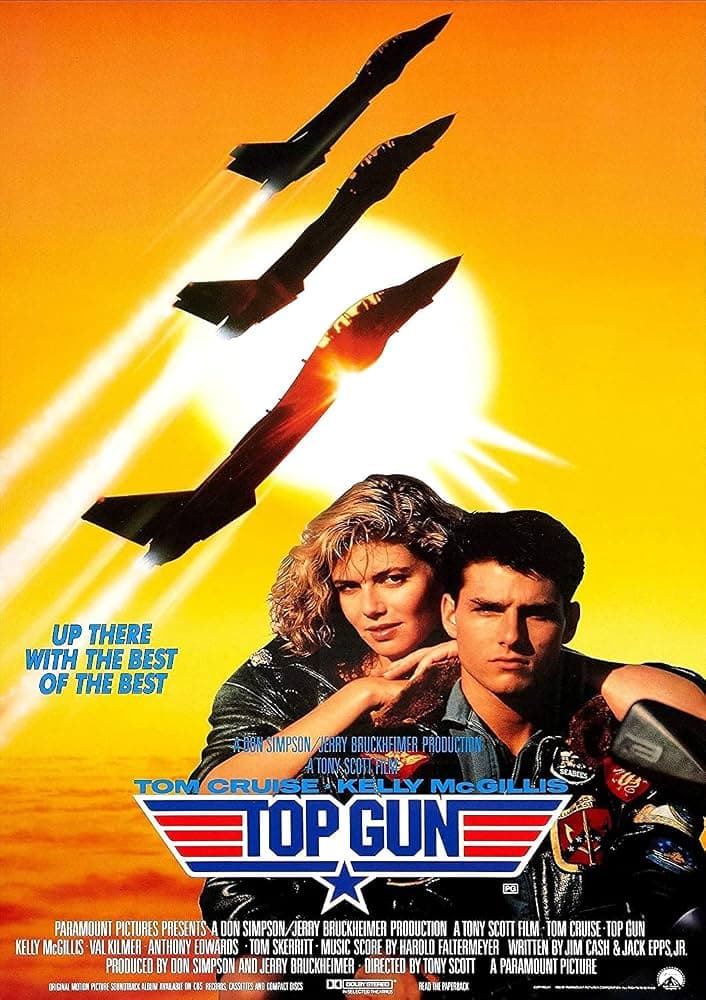
The setup
Top Gun feels like a movie built around a particular kind of swagger: fast jets, louder music and a lead who refuses to sit still. Tony Scott’s 1986 aerial drama pairs that swagger with an obvious emotional engine — a pilot trying to prove himself at the Navy’s elite school — and the result still makes for a good, loud evening at the movies.
THE MOVIE
Lt. Pete "Maverick" Mitchell is still the reason this movie works
Top Gun is the sort of film that announces itself in cockpit rhythm — a pilot who won’t be hemmed in and a school that exists to sort the daredevils from the team players. It follows Lieutenant Pete “Maverick” Mitchell, a hotshot F-14 pilot sent to the Navy Fighter Weapons School to spar with the service’s best pilots and, crucially, to find out what kind of pilot he really is.
That setup carries the film. Maverick is motivated by a need to prove himself; his competitive, risk-taking approach to flying keeps bumping against formal naval discipline. The inciting move — a reprimand for dangerous behaviour that leads to his selection for TOPGUN — is tidy, obvious and extremely practical: it gives the movie a natural place to stage rivalry, training and escalation.
All of this arrives through Tony Scott’s direction. Scott brings a commercials-trained eye that gives the film a music‑video speed and sheen, and Paramount framed the picture as a major summer action release in 1986. The glossy presentation and compact runtime make the film feel like something engineered to be immediate and entertaining — and, for better or worse, very watchable.
THE SETUP
The idea that sets Top Gun in motion
Top Gun’s basic move is simple and elegant: drop a rule‑bending pilot into a programme designed to punish rule‑bending and see what happens. Maverick arrives at TOPGUN, where classroom and simulation work are constantly checked against staged air‑to‑air dogfights to rank the pilots.
That training/competition format gives the film an engine. Classroom and simulation sequences alternate with dogfight footage so the stakes feel immediate — it’s not just about learning; it’s about being measured, compared and judged by peers who want the same slot on the roster.
What gives the story bite is Maverick’s personal struggle. He’s chasing proof of his skill while trying to keep a lid on reckless impulses; that tension plays out as ongoing antagonism with Tom “Iceman” Kazansky, who represents a different, colder brand of competence.
Then the film turns sharper: an in‑training accident affecting Maverick’s radar intercept officer becomes a pivotal event, forcing him to deal with responsibility, risk and grief. It’s the moment the movie stops being only about bragging rights and becomes about what you owe other people when you fly.
THE CHARACTER
Why Lt. Pete "Maverick" Mitchell matters
Maverick isn’t interesting because he’s mysterious; he’s interesting because he’s obvious and stubbornly, usefully human. The movie lays out his wiring early: he wants to prove himself, he flies on instinct, and he keeps running headfirst at authority until it stops him.
That wiring needs emotional ballast. Nick “Goose” Bradshaw provides it — Maverick’s closest friend, an emotional anchor and the bloke who tempers him when the flightdeck heat rises. Without that friendship, Maverick would read as a one‑note adrenaline junkie. With it, he becomes someone the audience can both admire and exasperate.
On the edges of the flying drama is Charlotte “Charlie” Blackwood, a civilian instructor and scientist. Her relationship with Maverick is a conventional romantic throughline, certainly, but it also nudges at his choices: she’s a reminder that he exists outside the cockpit and that other people’s assessments matter.
Put simply: the film gives us a pilot defined by daring, and then surrounds him with people who show why that daring has consequences. The story isn’t just a parade of tricks; it’s a character trying to learn how to fly in a way that leaves others safe as well as impressed.
UNDER THE SURFACE
Top Gun has more on its mind than the plot suggests
If you look past the roar of engines, Top Gun is organising itself around a set of oppositions: masculinity and competition against discipline; risk against responsibility; the seductive spectacle of military life against the institutional demand to control that spectacle.
Masculinity and competition come through in the constant measuring: who’s fastest, who’s cleverest, who’s tougher under pressure. The school’s whole point is to turn individual bravado into something that can be ranked and acted upon by command.
Closely linked is the risk-versus-responsibility axis. Maverick’s instinct is to push aircraft to their limit; the programme exists to show where pushing becomes endangering. The in‑training accident is the narrative hinge that forces the film to ask whether personal edge is worth the cost.
Finally there’s mentorship and discipline. The school is an institution built to channel youthful daring into team reliability. That tension — between a pilot’s private recklessness and the Navy’s need for predictability — is where the movie’s quieter drama lives.
THE FILMMAKING
How Top Gun was put together
The film’s personality comes as much from how it’s assembled as from what it shows. Tony Scott brought a commercial and video sensibility to Top Gun, which explains the kinetic editing and a glossy, music‑video slant in how sequences are cut together.
That visual approach depends on editing that stitches very different elements: classroom and cockpit close‑ups, carrier deck activity and extended air‑to‑air footage. Editors Chris Lebenzon and Billy Weber are credited with integrating those strands so the picture reads as a single, high‑speed piece rather than a collection of showreel moments.
Crucially, the production worked with the U.S. Navy to get real access for carrier and jet shots. The film uses large amounts of air‑to‑air footage shot from camera aircraft, and that cooperation is why the airborne material has a convincing physical presence.
Put another way: Top Gun’s look is deliberate. The commercial-trained director, careful cutting and real flight photography combine to give the movie a polished, theatrical sense of speed — which is exactly the package the producers wanted in a mid‑80s summer release.
PRACTICAL EFFECTS
The effects work that gives Top Gun its physical personality
Top Gun’s flight scenes aren’t fabrications in miniature; they rely on air‑to‑air photography with real F‑14 aircraft. That raw material gives the movie an elemental authority: you’re watching genuine jets move through real sky.
For the closer, human moments the production used cockpit‑recreation rigs — gimbaled setups that allowed actors to be filmed as if in flight. Those close‑ups were then matched in the edit to actual flying footage so faces and aircraft read as continuous.
The scale of the aerial shooting matters. Production logged substantial hours of footage and used multiple aerial units and camera aircraft to capture dogfights from different angles. The volume of material is part of why the editing can be so rhythmic and convincing.
In short: the film’s physical personality rests on actual flying and careful matching of studio cockpit shots to airborne plates, which keeps the film feeling tactile even when it’s at its most stylised.
PURE 80S
Top Gun could not belong to any other decade
Top Gun wears its era on its sleeve without needing a fashion montage to prove it. Released in 1986, the film sits squarely in the mid‑80s moment of renewed public interest in U.S. military capability and a broadly pro‑defence cultural mood.
The film’s aesthetic — fast cuts, a rock‑pop soundtrack and stylised montages — is part of the MTV‑era cross‑marketing model that Don Simpson and Jerry Bruckheimer were exploiting at the time. It’s a movie built around sonic and visual hooks as much as narrative ones.
There’s also a practical origin that feels of a piece with the decade: the screenplay grew from a 1983 California magazine article about Navy aviators and the Fighter Weapons School. That short‑form journalism to Hollywood pipeline was a familiar 80s pattern — bite‑sized real life turned into big, slick spectacle.
All of which makes Top Gun feel like an 80s product in both form and source: a glossy, muscular entertainment packaged to be immediate, loud and easily pitched to a summer audience.
THE LEGACY
Why Top Gun still matters
Part of Top Gun’s afterlife comes from its soundtrack: the original album enjoyed strong chart positions and sustained sales, and the film’s love theme 'Take My Breath Away' won the Academy Award for Best Original Song. The music helped the movie travel beyond the cinema.
Paramount and later outlets have treated the original as the origin point for a multi‑film franchise that eventually produced a direct sequel in 2022. The existence of that follow‑up underlines how the story and its central figure had staying power for the studio and audience alike.
There’s also a tangible civic echo: contemporary accounts linked the picture to an uptick in public interest in naval aviation and to the Navy’s use of the film as a recruiting aid. The exact magnitude of recruitment figures has been disputed, but the connection between image and real‑world attention is part of the movie’s footprint.
So: soundtrack success, studio interest in continuing the story, and a measurable if debated public response to the film’s presentation of naval life are the concrete pieces that explain why Top Gun remains talked about.
THE VERDICT
Does Top Gun still hold up?
Yes — if you know what you’re coming for. Top Gun is not trying to be subtle. It’s a compact, 110‑minute thrill picture built around one pilot’s need to prove himself inside a competitive, highly disciplined school. If that sounds like a good night in, the film delivers.
Where it works best is in the collision of character and mechanics: Maverick’s reckless drive set against Iceman’s steadier professionalism, the training and dogfight format that constantly measures and ranks pilots, and the pivotal in‑training accident that forces a shift in priorities. The film stages those tensions clearly and with purpose.
It also helps that the movie gives Maverick relationships that matter — Goose as the emotional anchor and Charlie as a reminder of life outside the cockpit — so the aerial spectacle doesn’t float free of human stakes. Tony Scott’s direction and the film’s soundtrack make the whole package sing in a way that was clearly calibrated for 1986 audiences.
If you watch expecting a clever deconstruction of military life you’ll be disappointed. If you watch for tight, loud entertainment that mixes macho competition with a recognisable emotional throughline, Top Gun still does its job. Put simply: it remains a very good example of what 80s summer action aimed to be — bold, noisy and, every so often, surprisingly sincere.
Featured in
Explore more about Top Gun
Share this movie
Keep watching
More movies from the 80s
1986
Jumpin' Jack Flash
Jumpin' Jack Flash: our relationship with technology and freedom, and why this 1986 movie still matters.
Read our take →
1987
RoboCop
A murdered cop rebuilt as a product — RoboCop still asks who gets to sell justice.
Read our take →
1983
Christine
Obsession, adolescence and a car that won't let go.
Read our take →