The setup
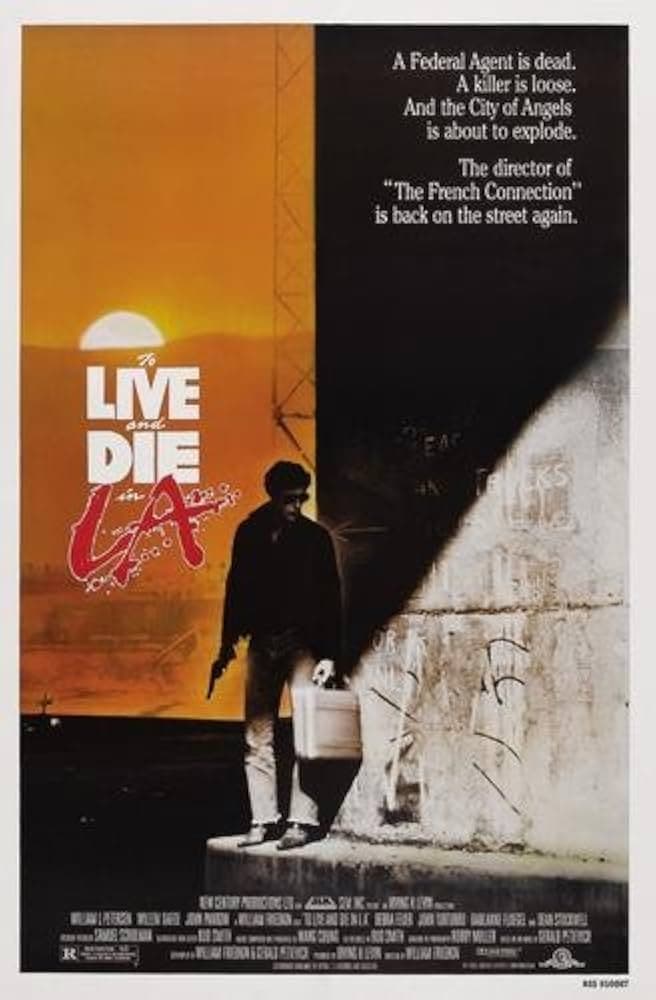
To Live and Die in L.A. is the kind of 1980s crime movie that feels keyed to a particular temper: ruthless, impatient and hooked on risk. William Friedkin directs a story about a Secret Service agent so single-minded that his pursuit of a counterfeiter becomes the whole picture. If you remember one thing, make it Richard Chance—he's the engine that keeps the film moving, and the reason it still grabs attention.
THE MOVIE
Richard Chance is still the reason this movie works
To Live and Die in L.A. pins itself to a simple, combustible idea: a Secret Service agent chasing an elusive counterfeiter through the underbelly of Los Angeles. That chase is personal from the off—the death of Chance’s colleague turns professional duty into something closer to obsession.
William Friedkin steers the film with a brittle energy. The whole thing is built around extremes: a protagonist who routinely sidesteps procedure, a criminal who operates like an artist, and set-pieces that escalate in danger as the story tightens.
Put another way: you come for the crime-thriller mechanics, you stay because Richard Chance won’t let you look away. William L. Petersen plays Chance; Willem Dafoe is the calm, cultured counterfeiter Eric 'Rick' Masters. Between them the movie stakes out its moral friction.
THE SETUP
The idea that sets To Live and Die in L.A. in motion
The film’s engine is straightforward: a Secret Service agent—Richard Chance—hunts Eric 'Rick' Masters, a meticulous counterfeiter who keeps slipping through official nets. The pursuit gives the plot a clean spine and a clear opponent.
The movie makes the mechanics of the crime matter. Counterfeiting, coded ledgers and the laundering of money are shown as procedural puzzles rather than background noise, which keeps the stakes feeling tangible rather than abstract.
That attention to detail turns the film into something like a chess match: moves and countermoves, with surveillance and sting work setting the clock. But the set-up also works because the chase is personal—what began as a job after a colleague’s killing quickly becomes Chance’s private business.
THE CHARACTER
Why Richard Chance matters
Richard Chance isn't written as a soothing lead. He's aggressive, risk-taking and the sort of agent who treats rules as suggestions. That temperament is what turns a routine investigation into the film’s relentless momentum.
Because Chance prioritises the catch over process, his decisions ripple outward. His pursuit is as much about satisfying a need to win as it is about stopping a criminal, and that internal pressure is what keeps scenes taut.
Chance also carries private ties that complicate him. Ruth Lanier appears as an informant who connects to his personal life, so the film never lets his obsession sit purely in professional terms—there are intimacies at stake.
So why is he memorable? He’s not the happiest hero. He’s combustible. And in a movie about counterfeits and authenticity, Chance’s certainty about who’s on the right side of the law becomes one of the story’s clearest—and nastiest—questions.
UNDER THE SURFACE
To Live and Die in L.A. has more on its mind than the plot suggests
At face value the film is a cat-and-mouse crime thriller. Underneath it’s chewing on obsession and revenge: what someone is prepared to sacrifice when catching another person turns into a personal crusade.
It’s also unafraid to look at the moral ambiguity of law enforcement. Chance’s willingness to bend or break rules forces you to ask whether the men on the side of the law can be as compromised as the crooks they chase.
There’s a neat, darker echo in the movie’s interest in authenticity versus counterfeit. The counterfeit money plotline isn’t just plot mechanics; it’s a mirror for identity—who is genuine, who is copying, and what we value as real.
Finally, the film sits comfortably in a view of the city where corruption and decay are accepted facts. Los Angeles here is a landscape where professional facades and criminal enterprises live cheek by jowl.
THE FILMMAKING
How To Live and Die in L.A. was put together
On paper the credits point to a collaborative team: Scott Smith as film editor and Lilly Kilvert as production designer are named alongside William Friedkin as director. Those credits matter because the movie trusts craft to make its world believable.
Robby Müller is credited as director of photography, and that connection explains a lot about the film’s willingness to let images carry tone. Lighting, location choices and assembly of sequences are used to keep the city feeling immediate rather than staged.
Friedkin’s involvement extended beyond direction; he selected Wang Chung to create the soundtrack and famously edited major sequences to their music. That means pace and music were stitched together from the start, not added as an afterthought.
PRACTICAL EFFECTS
The effects work that gives To Live and Die in L.A. its physical personality
This is a movie that prefers doing things for real where possible. Several sequences used practical stunts shot on location, including freeway driving and a stunt in which William Petersen runs along a divider at Los Angeles International Airport.
The car-chase set pieces were filmed practically on Los Angeles freeways and deliberately include segments of driving against oncoming traffic. That decision pushes the sequences into a nerve-raw zone—danger staged, but palpably present.
There’s also a smaller, less glamorous piece of craft: a counterfeiting montage that used actual hands and material supplied with help from a real-life counterfeiter to sell the illusion. Little choices like that keep the film’s world feeling tangible.
PURE 80S
To Live and Die in L.A. could not belong to any other decade
Released in 1985, the film sits squarely in mid-80s neo-noir and crime-thriller trends that liked to mix stylised surfaces with fairly ruthless subject matter. It’s a product of its moment without being a period costume.
Its production choices reinforce that placement: principal photography began in late 1984 and the film was assembled as a contemporary Los Angeles picture, shot on location rather than backlot gloss.
That timing also matters because the movie’s appetite for danger—practical stunts, on-road chaos and a director willing to push sequences to an edge—feels like a particular strand of 1980s filmmaking confidence.
THE LEGACY
Why To Live and Die in L.A. still matters
A small, vivid detail of the movie’s afterlife is musical: the title song by Wang Chung made a dent on the US Billboard Hot 100, reaching No. 41. It’s the sort of 80s footnote that keeps the film in people’s heads for reasons beyond plot.
More importantly for film viewers, the movie has been the subject of home-video restorations and boutique 4K/Ultra HD releases. Those reissues made the picture more widely available again and supported fresh critical reappraisal.
Between soundtrack memory and restored prints, To Live and Die in L.A. has remained present enough for new audiences to discover it and for critics to revisit its tougher, less comfortable corners.
THE VERDICT
Does To Live and Die in L.A. still hold up?
Yes—with a caveat. If you respond to movies that put a single-minded character under a moral microscope, this one remains gripping. The story of Secret Service agent Richard Chance pursuing Eric 'Rick' Masters is a tight premise, and the personal cost that follows—the killing that launches Chance’s campaign and his willingness to escalate—keeps the plot honest and dangerous.
The practical set-pieces still land as narrative events rather than spectacle for spectacle’s sake: the extended freeway pursuit, including moments of driving against traffic, isn’t throwaway action. It’s escalation that forces both characters and plot into a new register.
The film also benefits from the supporting architecture: John Vukovich exists as Chance’s partner and a kind of conscience who struggles with the methods used to ensnare Masters, while Ruth Lanier provides a personal tie that complicates the chase. Meanwhile, Eric 'Rick' Masters reads as a professional counterpoint—a cultured criminal whose calm contrasts with Chance’s volatility.
So should you watch it? If you like crime dramas that don’t shy away from moral messiness, Friedkin’s film is still worth your time. It isn’t sentimental. It asks difficult questions about how far lawmen should go, and it gives you the messy answer rather than papering over it.
Share this movie
Keep watching
More movies from the 80s
1986
Jumpin' Jack Flash
Jumpin' Jack Flash: our relationship with technology and freedom, and why this 1986 movie still matters.
Read our take →
1987
RoboCop
A murdered cop rebuilt as a product — RoboCop still asks who gets to sell justice.
Read our take →
1983
Christine
Obsession, adolescence and a car that won't let go.
Read our take →