The setup
They Live is the sort of film that announces itself with a pair of sunglasses and refuses to be subtle. John Carpenter wrote and directed this 1988 genre mash‑up around an outrageously simple trick: let a down‑at‑heel drifter see a hidden layer of reality and then watch the world rearrange itself. Stick around for the fight—then stay for the film’s teeth.
THE MOVIE
Nada (credited as 'Nada' / often referred to as John Nada) is still the reason this movie works
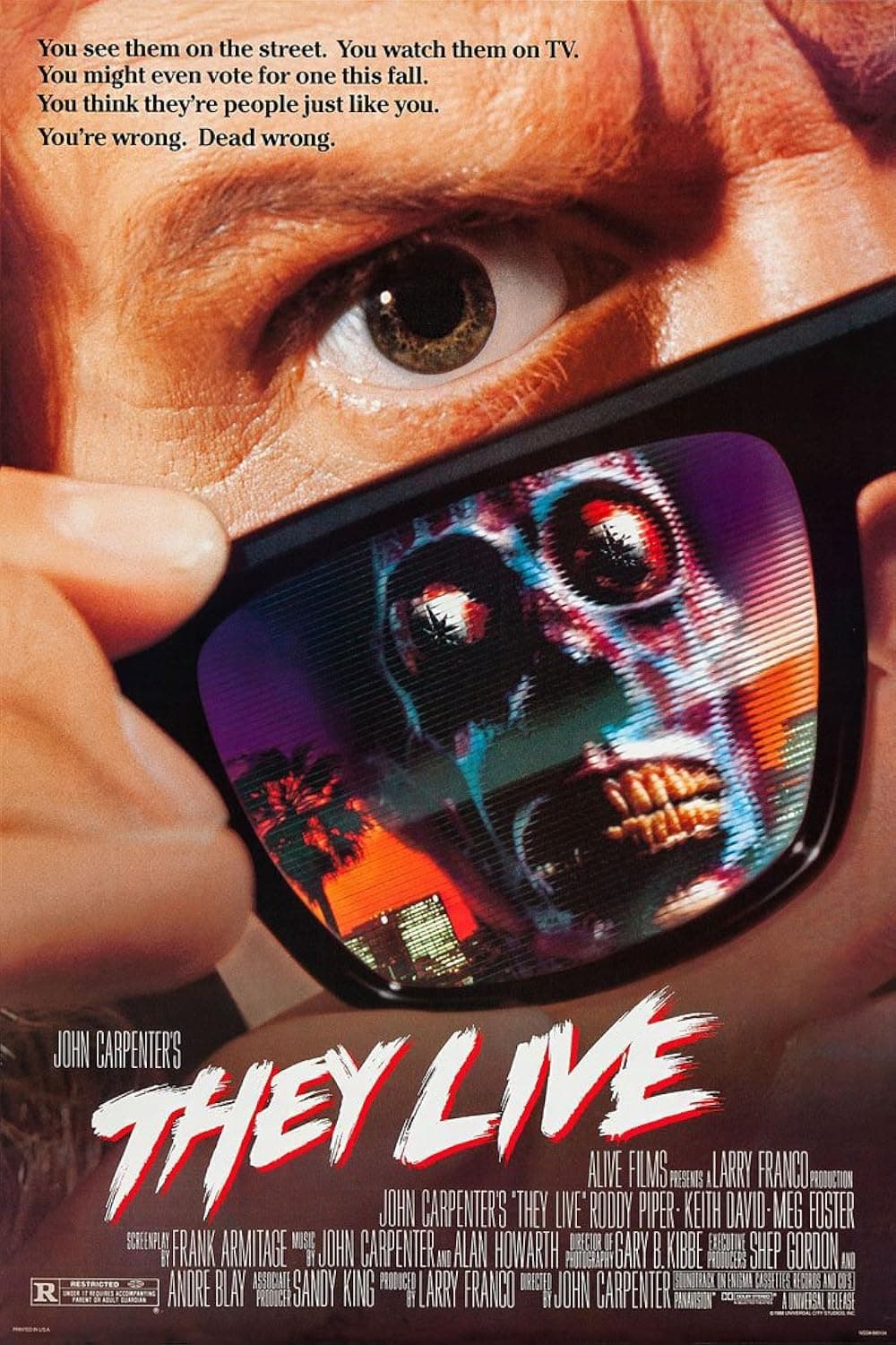
If you remember one image from They Live it’s not a skyline or a slogan but a man putting on sunglasses and seeing the world snap into a harder, meaner truth. The film gives us that beat early and makes it the whole point: Roddy Piper’s down‑at‑heel drifter finds a pair of special lenses that expose grotesque, non‑human faces and turn glossy advertising into blunt commands.
What follows is not just a chase but a personal crusade. Once Nada realises what those glasses show him, survival becomes something larger — an urge to expose the control being exercised over ordinary people and to stop it. It’s a tidy engine: a single discovered object flips a private problem into a public fight.
John Carpenter built a short, punchy 94‑minute science‑fiction action film around that flip. The conceit is cartoonish, direct and a little angry — and that bluntness is exactly why so many viewers keep going back to it.
THE SETUP
The idea that sets They Live in motion
They Live doesn’t bury its premise in exposition. The inciting event is straightforward: Nada gets hold of those sunglasses and discovers that members of the establishment are literally not human. Once he can see the truth, everything that looked normal becomes suspect.
That revelation frames the story as a hunt. Nada and his allies join a human resistance to locate the hidden broadcast source transmitting the signal that lets the aliens manipulate perception. Find the transmitter, cut the signal — that’s the plan, and the tension comes from the film treating this like a practical mission rather than a metaphysical debate.
Beneath the mission is a cultural argument. The movie literalises class conflict by showing the elite as the visible faces of an exploitative order; the sunglasses simply let the rest of us read the labels the powerful have been hiding.
It’s a setup that keeps things brisk: plain, direct stakes and a single device that makes metaphor function as plot.
THE CHARACTER
Why Nada (credited as 'Nada' / often referred to as John Nada) matters
Nada is uncomplicated in the best way. He’s a man who turns up, sees something grotesque and refuses to act like it’s Tuesday. That refusal — the blunt refusal to accept an arranged reality — carries the film.
His relationships help sell him. Frank Armitage starts off sceptical, and that scepticism is useful: it gives the film somewhere to show the difficulty of persuasion, and it gives Nada a tangible test when he has to prove what he’s seen.
Holly Thompson’s introduction as an outsider who doubts the conspiracy does the same job from a different angle; her reactions show how hard it is to move ordinary people from comfortable disbelief into action.
Put simply: the movie needs a protagonist who will not let the audience look away, and Nada, played by Roddy Piper, is written to do exactly that.
THE PERFORMANCE
Why Roddy Piper's performance matters
Piper’s casting was never meant to be invisible. Contemporary reviewers noticed that his background made him a very non‑traditional lead and picked up on a delivery that felt tied to his wrestling persona.
That nontraditional presence is useful for the part. Nada is written as a blunt instrument against a dishonest world; a conventional, polished leading man would have softened some of the film’s edges.
Critics at the time were mixed about whether that worked neatly. But the movie plays its hand: it needs someone who reads as raw and unfiltered, and Piper’s screen presence supplied that in a way that was hard to ignore.
UNDER THE SURFACE
They Live has more on its mind than the plot suggests
At face value it’s a sci‑fi action film with a gimmick. But that gimmick is a surface to write on: billboards and magazines literally read as commands when seen through Nada’s sunglasses, and that visual trick turns the movie into a satire of consumerism and commodification.
The film also imagines media as a weapon. Its premise is that mass communication can condition populations — a literal device for media control. Once you accept that conceit, small things add up into a political picture of how images and words can domesticate dissent.
There’s a class argument too. By depicting powerful, establishment figures as the outward faces of an exploitative order, the film foregrounds class conflict without needing long speeches.
Underneath it all is a mood of political alienation: the movie channels the feeling that economic and political shifts have left ordinary people exposed and disempowered, and its story is, in part, about waking up and choosing to fight back.
PRACTICAL EFFECTS
The effects work that gives They Live its physical personality
They Live leans on old‑school physical techniques and it shows — in a good way. The alien faces are realised with on‑set makeup and prosthetics, so when the glasses reveal a monstrous countenance it reads as something tactile rather than a computer trick.
That same practical approach extends to the way the film handles the slogans. Billboards and magazines were dressed and shot so they could literally flip into stark, imperative text when viewed through the sunglasses device; it’s a neat in‑camera solution to a visual gag that also sells the theme.
And then there’s the set‑piece brawl. The prolonged alley fight between Nada and Frank was staged with stunt choreography and real physical contact across multiple days — it’s rehearsed, athletic and intentionally physical rather than assembled out of quick cuts.
PURE 80S
They Live could not belong to any other decade
Carpenter himself framed the film as a reaction to the political and economic mood of the late 1970s into the 1980s, pointing at Reagan‑era policies and the rise of yuppie consumer culture. That makes the movie feel like a direct comment on its moment rather than a period piece that happens to look dated.
It also sits beside a clutch of late‑80s genre films that used sci‑fi and action to interrogate corporate power and commodification — stories that dressed political unease in genre clothing so the cinema‑going public could take it home in a popcorn tub.
Even the casting choices belong to the decade. Putting a professional wrestler in the lead reflects an age when popular forms crossed over in the marketable, slightly scrappy way that low‑budget genre cinema loved.
All of that is to say: They Live isn’t an accidental product of the 80s. It’s stitched to its decade’s anxieties and to the noisy, hybrid culture that produced it.
THE LEGACY
Why They Live still matters
They Live built a serious cult following after its mixed initial reception. It’s the sort of film that grows in conversation: people quote its beats, riff on its imagery and pass it on to newcomers who enjoy how blunt the whole thing is.
That long brawl between Nada and Frank gets mentioned a lot — it’s been singled out in roundups of memorable cinematic fights and even parodied in later pop‑culture moments. It’s the textbook example of a set‑piece that keeps turning up in discussions about the film.
Its visual slogans — the stark imperatives like 'OBEY' and 'CONSUME' — left a trace outside cinema too: an artist explicitly cited those images as an influence on a well‑known early street‑art campaign, which is an unusual afterlife for a genre movie prop.
Finally, the film has been picked over in more formal spaces as well: scholarly and critical reappraisals and festival retrospectives have kept it in circulation long after its release, showing that its ideas still provoke attention.
THE VERDICT
Does They Live still hold up?
Yes — if you accept what the film is trying to do. They Live is not coy: it uses a single, visible device (the sunglasses) to translate advertising and political imagery into literal commands, then asks a scrappy, practical question — can a small band of people find the hidden broadcast and cut the signal? If that setup appeals, the film delivers.
Roddy Piper’s Nada is the engine here: a simple, blunt protagonist whose refusal to live with the lie turns the movie’s political anger into action. That dynamic, and the way the film stages doubt through Frank and Holly, keeps the stakes readable and immediate.
Technically modest and narratively direct, the film wears its influences on its sleeve. It runs short, hits its beats — including the notorious multi‑minute fight — and keeps the metaphor working without turning it into a lecture.
So should you watch it today? Absolutely, if you want a propulsive little genre picture that mixes political grievance with physical fun. It’s not subtle, but it still hits where Carpenter aimed: a noisy, watchable query about who’s really making the rules.
Share this movie
Keep watching
More movies from the 80s
1986
Jumpin' Jack Flash
Jumpin' Jack Flash: our relationship with technology and freedom, and why this 1986 movie still matters.
Read our take →
1987
RoboCop
A murdered cop rebuilt as a product — RoboCop still asks who gets to sell justice.
Read our take →
1983
Christine
Obsession, adolescence and a car that won't let go.
Read our take →