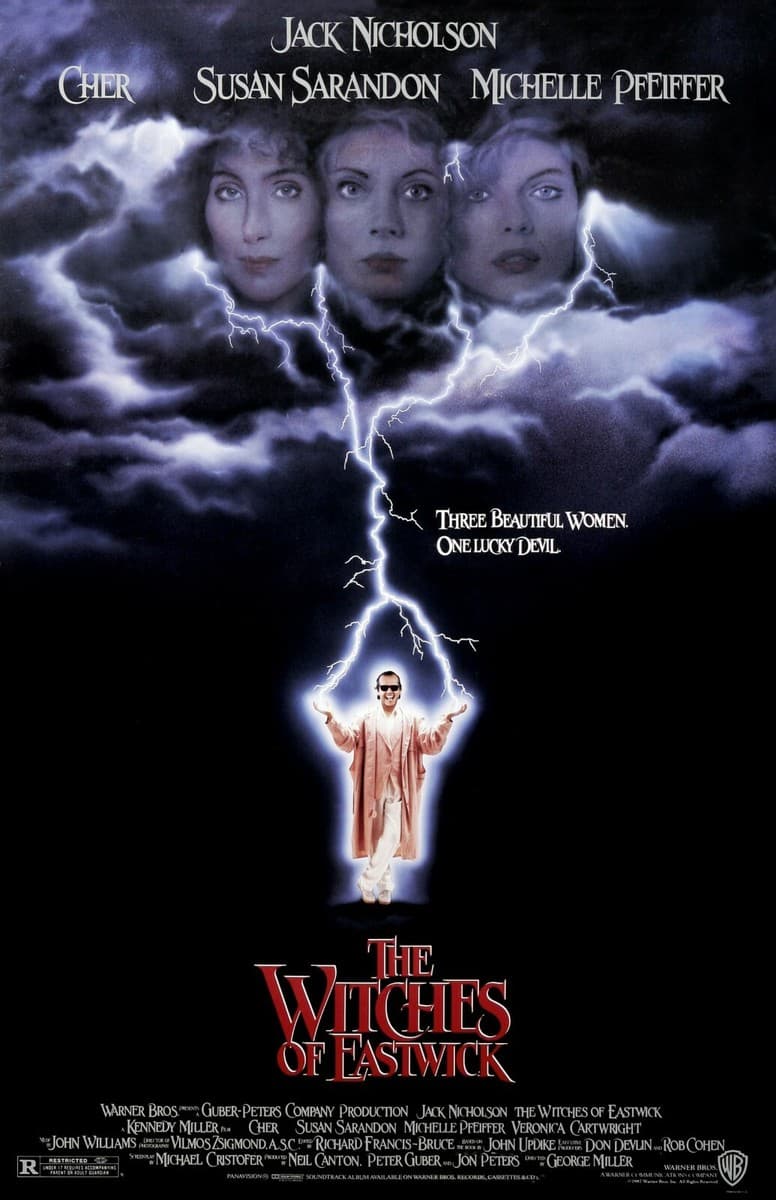
The Witches of Eastwick
Seduction, sisterhood and a very inconvenient devil — and yes, it's still worth the trouble.
The setup
There are films where one character hogs the room. The Witches of Eastwick is one of those films — but the show is never only about him. George Miller funnels the chaos through a stranger who arrives and upends three women's lives, and watching how friendship, desire and small-town rules scramble around that disruption is what keeps the picture interesting.
THE MOVIE
Daryl Van Horne is still the reason this movie works
The basic image sticks: a charismatic outsider blows into a sleepy New England town and, before you can say 'mischief,' three dissatisfied women find their private lives upended. It's a neat engine — disruption, temptation and the slow unravelling of polite small-town arrangements.
This is a screen adaptation that reshapes John Updike's book into something blunter and more visual, trading interior monologue for a star-led narrative. That choice makes the stranger at the centre feel larger-than-life — less a mystery to be parsed, more a force to be reckoned with.
All of which matters because the film is not only a dark fantasy or a horror-comedy gag; it's a story about friendship tested by desire. George Miller directs the whole thing, and Jack Nicholson plays the man who makes those tests unavoidable.
THE SETUP
The idea that sets The Witches of Eastwick in motion
The picture gets moving the instant Daryl Van Horne arrives and courts each of the three women. That single act — his deliberate, unsettling attention — is the film's inciting incident.
Where it goes from there is less about tricksy plotting and more about consequences: the women increasingly recognise they have a supernatural influence, and the moral choices about using it become the engine of conflict.
The seductions and retaliations build on each other, and the movie stages a sequence of escalating set-pieces that lead to a technically ambitious, effects-heavy climax.
It’s worth noting the story proved durable: the premise later returned in television and stage adaptations, which is a tidy sign that the idea itself still intrigues storytellers.
THE CHARACTER
Why Daryl Van Horne matters
Daryl isn't just a plot device; he's the wedge that forces the other parts of the movie apart and back together. He's presented as a seductive outsider who provokes, indulges and tests the town — and, crucially, the three women at the film's heart.
That provocation is exactly what makes him memorable: he isn't anonymous evil. He's self-indulgent, curious and deliberately provocative, the kind of stranger whose presence demands a response from everyone he meets.
Because Alexandra is a sculptor and a widowed mother with her own resentments, she becomes particularly vulnerable to his attention. That personal detail matters: it gives the seduction stakes that are both emotional and social.
And the central tragedy — and strength — of the story is that the three women begin as longtime friends whose rituals and solidarity form the film's emotional core until Daryl arrives to disrupt their balance.
THE PERFORMANCE
Why Jack Nicholson's performance matters
Contemporary critics consistently pointed to Jack Nicholson's portrayal of Daryl Van Horne as the dominant performance in the film. It’s the performance the movie orbits around.
That centrality matters because the picture reorganises John Updike's more interior story into a star-fuelled, visible narrative — and Nicholson is the obvious fulcrum for that change.
Put simply: when the film leans on its showpiece character, it leans on the actor playing him. The contemporary response shows that audiences and reviewers noticed that dynamic at the time.
UNDER THE SURFACE
The Witches of Eastwick has more on its mind than the plot suggests
At surface level it's a fantasy-comedy about seduction and supernatural mischief. Underneath, the film constantly returns to the way female friendship and solidarity stand up — or don't — when desire and betrayal enter the room.
Temptation and seduction are not treated as mere larks; they're political, altering who has power in the town and exposing the sexual politics that govern everyday life.
That outsider-versus-small-town morality theme gives the picture its friction. Daryl's presence interrogates local codes of behaviour as much as he challenges individual hearts.
So while the film delights in dark fantasy moments, its real throughline is how relationships change when social and sexual power get redistributed, however briefly.
THE FILMMAKING
How The Witches of Eastwick was put together
On paper it's a mid‑'80s studio picture: a director with a clear personality, a production designer shaping the town, and both location and studio work combining to make a believable New England setting.
Polly Platt is credited as production designer, and the film mixed on-location shoots in several Massachusetts towns with studio work in Burbank. That mix helps the film feel like a lived-in community rather than a generic set.
Vilmos Zsigmond shot the picture, and editing credits name Richard Francis-Bruce and Hubert C. De La Bouillerie — all the ingredients of a picture aiming for polish and scale.
The production did not unfold quietly: George Miller's direction and the producers' involvement created publicised tensions during the shoot, which is one way of saying the film arrived in cinemas as a properly fought-over studio project.
PRACTICAL EFFECTS
The effects work that gives The Witches of Eastwick its physical personality
The film leans on large special-effects work in its late sequences and finale, and those sequences were a major talking point when the film first arrived.
Because the climax is effects-heavy, the production placed serious emphasis on creating convincing physical and optical moments for that showdown.
The effects weren't ignored by awards bodies: the production's special-effects work later received formal recognition from the British Academy.
All of which underlines that the movie isn't purely a domestic drama — it treats spectacle as part of its storytelling hand.
PURE 80S
The Witches of Eastwick could not belong to any other decade
This is a mid‑1980s studio picture in the way it pairs star casting with a high-profile composer and sizeable effects work to adapt a recent bestseller — the sort of production the studios were chasing at the time.
Production invested in location shooting in New England during 1986, which reflected the industry's appetite for on-location realism alongside studio control.
The decision to simplify and rework the novel into a more external, star-driven narrative also feels of its moment: the movie trades interior subtlety for broad, visible storytelling that relied on recognisable performers.
Released in 1987, it therefore looks and behaves like a film trying to be both a conversation piece and a crowd-pleaser — the classic '80s studio balancing act.
WATCHING IT NOW
What has aged — and what hasn't
One part of the film that still clicks is the portrayal of the three women's friendship; the rituals and solidarity that bind them remain a clear throughline and give the film something emotional to return to.
That core relationship keeps the movie grounded even when the plot indulges in spectacle or mischief.
The fact that the premise later inspired a television series suggests the central idea — women pushed to the edge of social acceptability by desire and power — continues to have narrative traction.
So while certain production choices feel of their era, the emotional stake in friendship and how it is tested still reads for a modern viewer.
THE LEGACY
Why The Witches of Eastwick still matters
Part of the film's continuing presence comes from the soundtrack: John Williams's original orchestral score was released separately and continues to be a positive note in later music-focused coverage.
The property’s afterlife — a stage musical and a television series among other projects — shows that the central idea kept drawing creators back.
And the special-effects work received formal recognition from BAFTA, which is a reminder the movie aimed for technical ambition as well as narrative cheek.
All three threads — music, adaptations and recognised effects — combine to explain why the film still turns up in conversations, even if people disagree about exactly what they like or dislike about it.
THE VERDICT
Does The Witches of Eastwick still hold up?
Yes — but with a caveat. If you come for a tight, faithful adaptation of Updike's interior novel, you’ll find the film blunt; it reshapes the source into something bigger and more star-driven. That was an intentional trade-off.
If you’re interested in watching how temptation, sexual politics and the dynamics of power fling friends into chaos, the movie remains striking because it keeps those human strands visible beneath the spectacle.
Jack Nicholson’s Daryl Van Horne is the motor that turns the story. Contemporary reviewers made clear his portrayal dominated the film, and the picture leans on that presence throughout.
So watch it for the chemistry of disruption: three women whose friendship is tested by desire, a seductive outsider who forces choices, and enough technical ambition — score, locations and effects — to make the collision feel like an event.
Share this movie
Keep watching
More movies from the 80s
1986
Jumpin' Jack Flash
Jumpin' Jack Flash: our relationship with technology and freedom, and why this 1986 movie still matters.
Read our take →
1987
RoboCop
A murdered cop rebuilt as a product — RoboCop still asks who gets to sell justice.
Read our take →
1983
Christine
Obsession, adolescence and a car that won't let go.
Read our take →