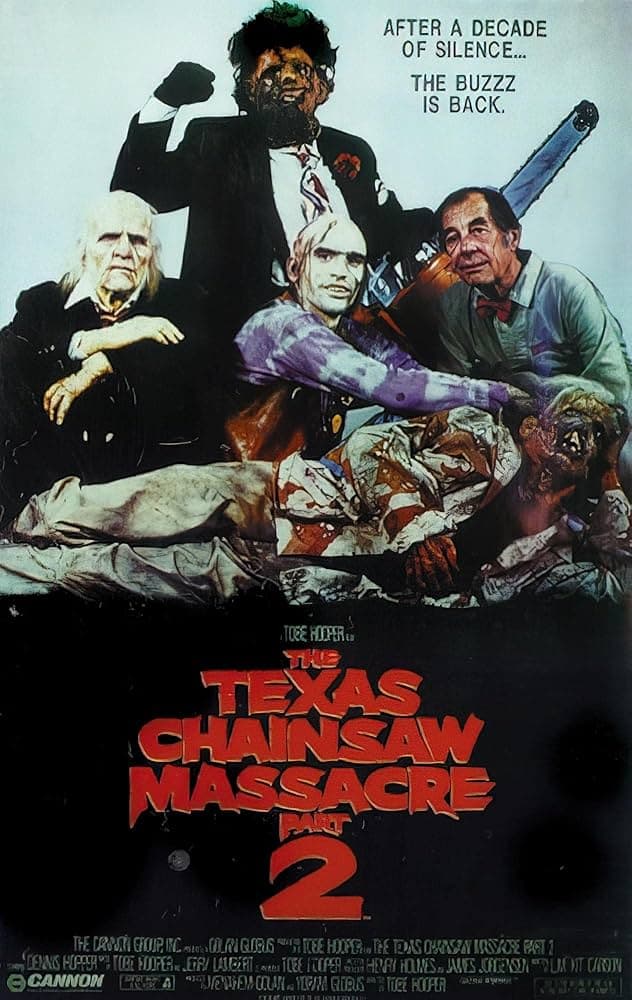
The setup
Tobe Hooper’s The Texas Chainsaw Massacre 2 isn’t the grim, fly‑on‑the‑wall nightmare of the original. It’s louder, meaner and openly scheming to make you laugh while it shocks you — and it gives us Lieutenant "Lefty" Enright, the single-minded ex‑Ranger who drags the whole film forward. If you remember the sequel at all, you remember the appetite for revenge and the film’s gleeful, grotesque poke at 1980s consumer culture.
THE MOVIE
Lieutenant "Lefty" Enright is still the reason this movie works
The film opens by reminding you that the earlier massacre exists only as a story on paper — a written prologue that sets up a world where official records refuse to admit the Sawyer family did what everyone whispers. It’s a blunt way of saying: this sequel knows exactly what it is and what it isn’t.
From there the picture kicks into a late‑night grind: a surviving car‑phone recording pulls a radio DJ into the Sawyer orbit and, crucially, gives the movie someone to panic for. That panic matters because the engine underneath it all is Lieutenant "Lefty" Enright — a man on a long, very personal hunt for the family, driven by revenge and the need for closure.
Tobe Hooper directs, the film was released in 1986, and Hooper hands the whole thing a different taste from 1974’s original: this is horror leaning into black comedy and satire, deliberately skewering mid‑80s yuppie and consumer culture even as it pours on the gore and spectacle. It’s a loud, sharp‑elbowed sequel, and Lefty is the tether that keeps the chaos rooted in purpose.
THE SETUP
The idea that sets The Texas Chainsaw Massacre 2 in motion
At its simplest the movie sets up a classic chase: former Texas Ranger "Lefty" Enright is after the Sawyer cannibal clan, and the film makes that pursuit feel personal — not just professional. Lefty’s a man who has already lost family to these people, and he’s bent on settling accounts.
Opposite him is Vanita "Stretch" Brock, a radio DJ who becomes uncomfortably close to the family when a gruesome recording draws her investigatively — and later physically — into their world. That switch from voyeurism to victimhood gives the film someone to worry about as Lefty closes in.
Mechanically, the movie keeps returning to the same brutal toys: chainsaw confrontations are constant and the plot builds toward a proper chainsaw duel. If you want scale and a repeated, escalating threat, the film makes that its heartbeat.
It’s also worth noting the film didn’t arrive in a neat studio‑approved box: after running into trouble with the MPAA the production opened in the U.S. unrated, which underlines how determined it was to keep the material intact rather than tone down the nastier set pieces.
THE CHARACTER
Why Lieutenant "Lefty" Enright matters
Dennis Hopper plays Lieutenant "Lefty" Enright — a detail you can state plainly without pretending his presence explains everything. What matters is what Lefty brings: motive. He’s been hunting the Sawyers for years and he’s not here for paperwork.
That long, personal hunt gives the film a steady spine. Lefty isn’t a one‑note avenger; he’s the player who insists the game has rules. The need for revenge and, crucially, for closure for earlier victims is what keeps scenes from simply tipping into gratuitous splatter.
Because this film is a direct sequel, Lefty’s pursuit carries emotional baggage from the 1974 picture — the storyline continues, old wounds reopen, and the hunt becomes less about duty and more about settling a family ledger.
Even production details underline that hunt: the film spent time shooting in the Austin area and places like the shuttered Matterhorn amusement park double as the Sawyer family’s lair, the sort of setting that lets Lefty’s pursuit feel theatrical and inevitable.
UNDER THE SURFACE
The Texas Chainsaw Massacre 2 has more on its mind than the plot suggests
On the surface it’s a chainsaw movie; under the surface it’s sizing up a particular strain of 1980s America. Writer L. M. Kit Carson explicitly imagined the victims as a response to mid‑80s yuppie culture, and that sting of satire threads through the film’s choices.
Alongside the satire sits a frank interest in revenge and generational trauma. Lefty’s search is framed as justice for family members taken earlier, so the movie keeps snapping back from broad social commentary to intimate, personal grievance.
Then there’s the film’s willingness to treat violence as spectacle. The Sawyer family’s behaviour and the way the film stages certain set pieces turn brutality into a commodity — the spectacle itself becomes a theme the film is interrogating by indulging it.
Put together, these elements make the sequel less a simple follow‑up and more a loud, grotesque commentary: it wants you to laugh uneasily at the consumer culture it satirises while watching a revenge story play out in exaggerated, almost performative violence.
PRACTICAL EFFECTS
The effects work that gives The Texas Chainsaw Massacre 2 its physical personality
Tom Savini and a special‑effects crew are credited on the production, and their involvement helps explain why the film is so insistently physical. The picture leans on tangible make‑up and prosthetic work rather than clever suggestion.
Mitch Devane (sometimes credited Mitchel/Mitchell Devane) is identified alongside Savini as responsible for Leatherface’s mask and several prosthetic pieces. Those are the sorts of crafted objects that give the family its lived‑in grotesqueness.
Even material that didn’t make the final cut is part of the film’s afterlife: the deleted slaughter sequence and other set pieces are documented in home‑video extras and production reports as involving elaborate practical make‑up and gore effects, which is why later releases treat the effects work as worthy of commentary.
PURE 80S
The Texas Chainsaw Massacre 2 could not belong to any other decade
This was a film born of its moment. After the original had enjoyed a profitable re‑release, Cannon financed a sequel amid its mid‑80s slate of exploitation and genre pictures, so the project carries the company’s appetite for quick, attention‑grabbing movies.
The sequel’s timing also explains some of the critical heat it took: in 1986 horror franchises were already heading toward formulas built around bigger effects and recurring set pieces, and Hooper’s decision to emphasise gore and black comedy produced a split reception.
The marketing leaned into that era’s reflexes too — promotional materials even parodied mainstream imagery, with the final poster echoing contemporary pop culture in a way that married high‑school iconography to exploitation hooks.
And the film’s targets are of their time: the victims were conceived as a direct reaction to mid‑80s yuppie culture, so the satire sits squarely in the decade’s anxieties about consumption, status and spectacle.
WATCHING IT NOW
What has aged — and what hasn't
The sequel continues the Sawyer‑family story, which means it leans on continuity the original audiences carried with them; that connective tissue still rewards viewers who know where Lefty’s anger comes from.
Production choices that were practical in 1986 now function as identifying traits: shooting around Austin and using the shuttered Matterhorn amusement park as the Sawyer family’s lair gives the film a recognisable primary set‑piece that modern viewers tend to remember.
The film’s practical make‑up and prosthetic work remain a big part of its appeal in retrospectives, and material assembled for later home‑video releases has helped preserve and explain those elements to new audiences.
All of which adds up to a movie that wears its period on its sleeve but still courts curiosity: it’s loud, specific and has found a second life through reissues and the sort of archival extras that encourage reevaluation.
THE LEGACY
Why The Texas Chainsaw Massacre 2 still matters
The film hasn’t vanished into obscurity. It acquired a persistent cult following and regularly turns up in retrospectives that reappraise Hooper’s career and the era’s horror output.
Within the franchise it was followed by Leatherface: The Texas Chainsaw Massacre III in 1990, and Hooper’s sequel remained the last feature he directed in that original timeline — a fact that makes the 1986 piece a kind of closing chapter for that strand of the series.
Home‑video interest has kept the movie alive: a 2006 'Gruesome Edition' DVD and later Blu‑ray treatments pulled together archival material and commentary, showing there’s enough appetite for deeper looks at how the film was made.
All of which means it survives as something people talk about: not because it conquered the mainstream, but because it kept enough personality and oddness to reward repeat viewings and historical curiosity.
THE VERDICT
Does The Texas Chainsaw Massacre 2 still hold up?
Short answer: yes — if you know what you’re signing up for. The movie opens with a prologue that re‑establishes the 1973 events as contested, then sets Lefty on a personal hunt while a radio DJ, Stretch, is pulled into the Sawyer family’s orbit. That set of commitments — revenge, abduction and an escalating chainsaw showdown — doesn’t pretend to be subtle.
If your patience for horror leans toward spectacle and black comedy, the film delivers: the Sawyer family’s subterranean lair is staged as an over‑the‑top amusement‑park environment and the movie repeatedly foregrounds chainsaw confrontations, culminating in a chainsaw duel that’s designed to be seen and felt.
Fair warning: the tonal leap from the original’s vérité dread to overt gore and satire split critics at the time — Roger Ebert notably called out Hopper’s role as problematic — and the film opened unrated after run‑ins with the MPAA. So while the picture has a definite audience today, it won’t satisfy someone expecting the 1974 film’s restraint.
But if you’re in the market for a gory, knowingly loud 95‑minute slice of 1986 horror that treats violence as spectacle, keeps a singleminded avenger at its centre, and offers memorable grotesques like Chop Top alongside Leatherface, then it’s absolutely worth watching. It still feels like a movie that decided on a gimmick — satire plus chainsaws — and committed to it with everything it had.
Share this movie
Keep watching
More movies from the 80s
1986
Jumpin' Jack Flash
Jumpin' Jack Flash: our relationship with technology and freedom, and why this 1986 movie still matters.
Read our take →
1987
RoboCop
A murdered cop rebuilt as a product — RoboCop still asks who gets to sell justice.
Read our take →
1983
Christine
Obsession, adolescence and a car that won't let go.
Read our take →