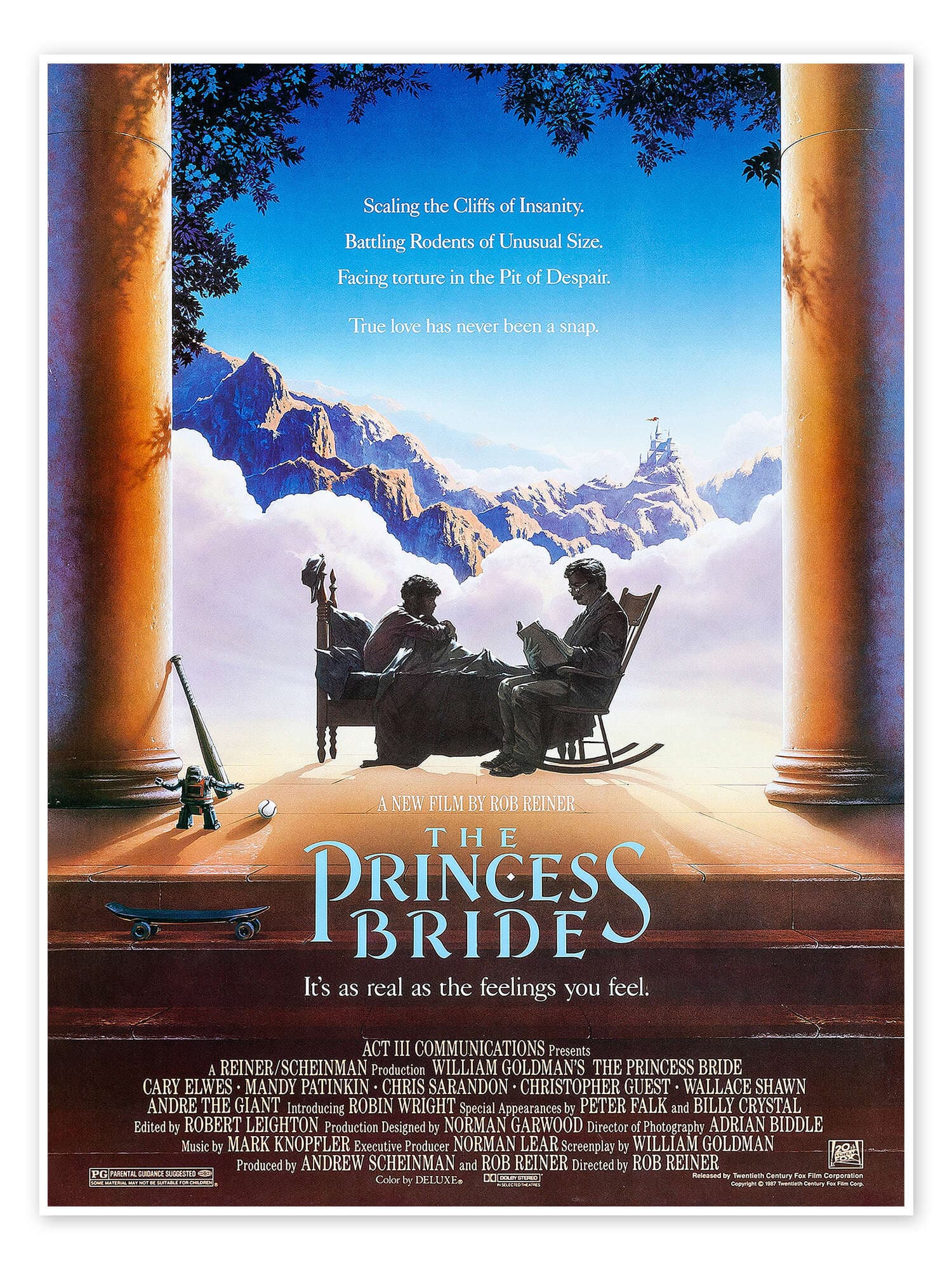
The Princess Bride
A swashbuckling love story told like a bedtime tale — and still disarmingly good company.
The setup
There are films that charm you because they’re clever, and there are films that charm you because they simply refuse to be ashamed of being lovable. The Princess Bride does both. Rob Reiner’s 1987 take on William Goldman’s fable pairs tight, playful plotting with a visible frame — a grandfather reading to his sick grandson — and a central quest driven by one man’s determination to win back the woman he loves.
THE MOVIE
Westley (the Man in Black / the Dread Pirate Roberts) is still the reason this movie works
What keeps people returning to The Princess Bride isn’t a single gag or a single set-piece. It’s the engine at the centre: Westley, who turns an ordinary farmhand into a man who will take on the world — and the name Dread Pirate Roberts — to get the person he loves back. That refusal to let love be a passive fate gives the whole story its forward shove.
Reiner frames that push as a story inside a story: Peter Falk’s grandfather reads the book to his sick grandson, and Goldman’s screenplay keeps that self-aware wrapper visible throughout. It’s neat: the fairy-tale pleasures are heightened because someone in the film is choosing to tell them.
The result is a compact 98-minute confection — romantic, fantastical, swashbuckling — carried by Cary Elwes as Westley and Robin Wright as Buttercup, and populated with memorably specific players such as Mandy Patinkin’s Inigo and André the Giant’s Fezzik. It looks, sounds and behaves like a fable that has been allowed to be funny and sincere at the same time.
THE SETUP
The idea that sets The Princess Bride in motion
At its simplest, the film is a tidy set of promises. A grandfather reads a story — the frame is obvious from the start — and that book contains a conventional-sounding romance: Buttercup is promised to a prince but still loves Westley, a farmhand who disappears and later returns wearing a different name and purpose.
That premise gives the film obvious stakes: it’s about rescue, but also about choices. Westley’s return as the Dread Pirate Roberts isn’t just a costume change; it represents an active attempt to win back what he lost.
Parallel to that central quest is another steady beat: Inigo Montoya’s long hunt for the man with six fingers who killed his father. It’s revenge rendered as slow, determined work — a personal mission that intersects with the lovers’ story and raises the emotional pay-off.
All of this sits comfortably inside the visible frame story — the reading grandfather and his grandson — which keeps the film aware of itself as a tale being chosen and passed on.
THE CHARACTER
Why Westley (the Man in Black / the Dread Pirate Roberts) matters
Westley matters because he’s not content with romantic nostalgia; his story is a set of deliberate acts. He disappears, he reappears under a new identity, and all of that movement is driven by a single motivation: to reclaim and protect his love for Buttercup.
That motivation turns the familiar princess-and-prince framework into something active. Westley isn’t waiting for destiny to sort things out; he makes choices that change other characters’ lives, and the film’s momentum follows him.
His presence also helps knit the film’s tone. Where other characters personify quests — Inigo’s patient vengeance, Fezzik’s loyalty — Westley is the centre of the romantic quest. The frame story further emphasises him as a character deliberately placed in the line between fairy tale and bedtime story.
THE PERFORMANCE
Why Cary Elwes's performance matters
Contemporary and later coverage regularly points to Cary Elwes as one of the performances that helps give the film its distinctive flavour. That’s not a vanity metric — it’s a reflection of how his Westley anchors the romance and allows the movie’s other, odder characters to orbit comfortably.
Saying his presence matters isn’t the same as turning the section into an actor’s CV. The key point is simple: Elwes provides a steady centre that lets the screenplay’s jokes and the supporting players’ passions land without the whole thing feeling scattershot.
In short, the film’s mixture of sincerity and satire needs someone who can make the romance believable, and contemporary commentary singles out Elwes’s Westley among the performances that achieve that balance.
UNDER THE SURFACE
The Princess Bride has more on its mind than the plot suggests
On the surface it’s a romp: romance, sword fights, kidnappings and rescues. But the film keeps nudging the audience toward a few consistent ideas — most obviously that true love is not a sleepy fate but an active quest. The lovers’ story is work as much as it is destiny.
Revenge occupies another steady lane. Inigo Montoya’s search for the six-fingered man is methodical and patient; it treats justice as something that takes persistence, not a sudden burst of drama.
Then there’s the frame: the movie never lets you forget you’re watching a story being told. That choice matters because it encourages you to view events as deliberately constructed — which makes the affectionate parody of fairy-tale and swashbuckling conventions feel intentional rather than merely jokey.
Finally, friendship and loyalty run through the film like a supporting chord: the alliances between characters — whether forged by necessity or affection — give many of the emotional beats their weight.
THE FILMMAKING
How The Princess Bride was put together
The film’s look and practical choices were the product of a clear crew: Adrian Biddle is credited as director of photography and Norman Garwood as production designer. Those named roles anchor the movie’s visual and physical identity.
Swordplay is also an explicit filmmaking element: Bob Anderson served as the sword master and staged the principal fencing sequences, which helps make the swashbuckling passages feel purposeful rather than incidental.
If you enjoy knowing how things were built, the Criterion release does the heavy lifting: its extras discuss on-set practices, production design and props — even the apparatus used for the Pit of Despair — so the construction of the film is well documented for interested viewers.
Taken together, those credits remind you this is a made thing: costume, set and staged action combine to keep the fairy-tale world tactile and coherent.
PRACTICAL EFFECTS
The effects work that gives The Princess Bride its physical personality
The film’s antagonists and creatures were realised in-camera: the R.O.U.S. (Rodents Of Unusual Size) and similar threats were created with in-costume performers and puppetry rather than digital wizardry.
Small scripted details were also handled materially — Count Rugen’s six-fingered hand is a filmed plot device, used explicitly in Inigo Montoya’s story of revenge.
Even the film’s most grotesque instrument — the life-sucking machine in the Pit of Despair — was physically constructed for use on set, and that construction is discussed in the film’s art-department extras.
All of which keeps the movie feeling tactile; it’s a film in which the oddness is physically present rather than implied by off-screen effects.
PURE 80S
The Princess Bride could not belong to any other decade
There’s something very 1987 about the film’s appetite for mixing tones and genres: it lands halfway between family fantasy and sharp romantic comedy, a blend that fits comfortably with Reiner’s late-80s output and with the era’s willingness to mash up audiences.
Its release pattern is instructive too: opening in New York and Los Angeles on 25 September 1987 before expanding wider was a standard studio route of the time, the kind of roll-out that let a picture find its audience by word of mouth.
Rob Reiner’s presence matters as well. The Princess Bride sits alongside his other 1980s work and helps show the director’s range across different kinds of films — from tender drama to playful fantasy.
All told, the movie feels of its moment because it treats genre like a toybox: it borrows happily from swashbucklers, fairy tales and romantic comedy and assembles them into something audience-friendly without apology.
THE LEGACY
Why The Princess Bride still matters
There are tidy, traceable reasons the film has endured. Its song 'Storybook Love' — arranged in association with Mark Knopfler and performed by Willy DeVille — gained an Academy Award nomination, which helped keep the movie in conversation at the time of release.
Beyond awards talk, the film has been carefully kept in circulation: multiple home-video restorations and a Criterion edition with new interviews and commentary mean the picture has been preserved, contextualised and made available to fresh audiences.
Perhaps the firmest institutional recognition came later: in 2016 the Library of Congress selected The Princess Bride for preservation in the United States National Film Registry, citing its cultural, historical or aesthetic significance.
Taken together, these facts don’t turn the film into a sermon — they simply explain why people still have the chance to discover and re-discover it.
THE VERDICT
Does The Princess Bride still hold up?
Yes. The Princess Bride still works because it keeps its promises. The visible frame — a grandfather reading to his grandson — reminds the viewer that this is a chosen story, which lets the film be deliberately playful while still committing to its emotional beats.
The screenplay, adapted by William Goldman from his own 1973 novel, preserves that metafictional shape and much of the sharp dialogue that gives the film its pace. At heart the plot follows familiar lines — Buttercup is promised to Prince Humperdinck but remains in love with Westley, who comes back as the Dread Pirate Roberts to set things right — but the way the film stages those promises is what makes them feel earned.
It helps that the supporting quests are clear and consequential: Inigo’s slow-burning pursuit of the six-fingered man, Buttercup’s emotional choices around grief and duty, and Humperdinck’s secret plan to manipulate events so he can start a war all give the story real gravity beneath the jokes.
If you’ve never seen it, watch it. If it’s been a while, watch it again. The Princess Bride is a compact, well-constructed fable — romantic, funny and occasionally dark — and it still has the nerve to be both affectionate pastiche and sincere love story at once.
Share this movie
Keep watching
More movies from the 80s
1986
Jumpin' Jack Flash
Jumpin' Jack Flash: our relationship with technology and freedom, and why this 1986 movie still matters.
Read our take →
1987
RoboCop
A murdered cop rebuilt as a product — RoboCop still asks who gets to sell justice.
Read our take →
1983
Christine
Obsession, adolescence and a car that won't let go.
Read our take →