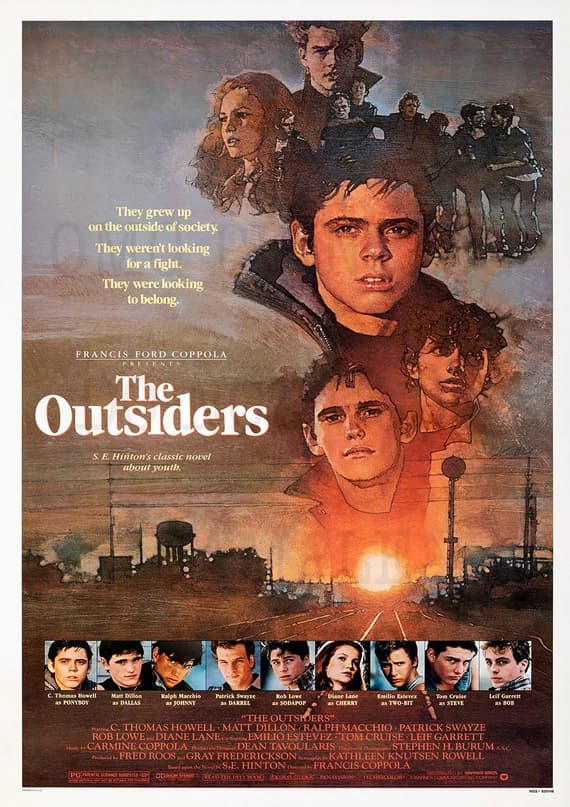
The setup
If you remember The Outsiders at all, you probably remember a boy with a book and a line about staying gold. Francis Ford Coppola's 1983 take on S. E. Hinton's novel still hangs on that intimate centre: Ponyboy Curtis as narrator, reader and reluctant witness to violence that forces a gang of kids into grown-up choices. This is a film worth revisiting because it trusts a teenager's point of view to carry a story about class, loss and loyalty.
THE MOVIE
Ponyboy Curtis is still the reason this movie works
Walk into The Outsiders and you step straight into Ponyboy Curtis's head. The film opens the same way the novel does — with Ponyboy telling his own story as an English assignment — and that narration isn't a neat framing device so much as the film's heartbeat.
What makes Ponyboy stick in your memory is the little tensions built around him: he's a Greaser but he's also the one who reads Gone with the Wind and quotes Robert Frost. That combination — toughness at the edges, curiosity in the middle — turns him into the group's emotional referee.
All of this matters because the film isn't an abstract lesson about class. It's a short, intense 91-minute drama about working-class 'Greasers' and wealthier 'Socs' in Tulsa, a split that escalates into manslaughter and a climactic rumble. Coppola directs a compact, character-forward picture, and Ponyboy's voice is what keeps the whole thing human.
THE SETUP
The idea that sets The Outsiders in motion
At its simplest, The Outsiders is about a neighbourhood divide that keeps snapping back into violence. Ponyboy and his Greaser friends live under constant pressure from wealthier kids, and that antagonism eventually spirals out of control.
A turning point arrives when Ponyboy and Johnny are forced to flee after a killing in self-defence. Their flight is the plot motor: it pushes the boys into hiding and into a sequence of physical and moral crises that change them.
Those crises include a desperate church fire rescue and serious hospital scenes, and everything funnels back into the rumble. The theatrical cut keeps the film tight at 91 minutes, though Coppola later produced a longer 'Complete Novel' version restoring roughly 22 minutes.
The setup works because the story keeps returning to small, human choices inside a larger, violent world — friendship, protection, and the costs those loyalties demand.
THE CHARACTER
Why Ponyboy Curtis matters
Ponyboy isn't the loudest or toughest Greaser. He's the one who notices things — books, poems, the small cruelties that add up. That attention makes him the film's moral centre; his observations are the lens through which we meet the rest of the gang.
His relationship with Darry — who has become his guardian and, in effect, his parent — gives the picture an emotional friction. Darry's responsibility for the family feeds Ponyboy's sense of being misunderstood, which is where so much of his character drama comes from.
Because Ponyboy narrates, the film is never abstract. Even when violence forces big decisions, we're kept close to a single teenager wrestling with what adulthood might demand of him.
Casting helped sell this: the picture introduced a large young ensemble that supplied the differing pressures and personalities Ponyboy reacts against and relies upon.
THE PERFORMANCE
Why C. Thomas Howell's performance matters
Contemporary coverage noticed the casting as much as the movie itself. Howell’s lead part is widely regarded as his breakout role, and the picture’s ensemble nature meant a lot of attention fell on how the young actors inhabited their characters.
Reviews from the time singled out the group casting and praised many of the performances; Howell’s turn in particular is associated with early-career recognition and industry notice.
Put simply: Howell gave the film a believable inside voice, and that inside voice mattered more than any single scene of action.
That reputation — the film as a launching pad for a new crop of young actors — is part of why people still come back to it.
UNDER THE SURFACE
The Outsiders has more on its mind than the plot suggests
At face value the film looks like a teen drama about turf and fights. Beneath that, it’s a compact study of class — Greasers versus Socs — and how social barriers make ordinary human grief and fear explode into violence.
Coming-of-age sits at the story’s core. The Robert Frost motif — 'Nothing Gold Can Stay' — threads through the film as a reminder that youth is fragile, and the film's 'Stay Gold' throughline is about the suddenness with which innocence can be lost.
Brotherhood and responsibility are constant pressures. Darry’s role as guardian after the parents’ deaths gives the story an adult burden that the other teens don't share, and those differing responsibilities shape how each character reacts to crisis.
There are also moments of cross-class empathy: the film allows Soc characters to recognise vulnerabilities they share with the Greasers, which keeps the drama from becoming a one-note us-versus-them tract.
PRACTICAL EFFECTS
The effects work that gives The Outsiders its physical personality
This isn't a special-effects spectacle, but the film does rely on hands-on stunt work to sell its physical moments. The climactic rumble sequence was shot in a way that left actors physically taxed; production reports note injuries sustained during those scenes.
Similarly, the church fire sequence wasn't an illusion on a screen — it required coordinated practical effects and stunt work to feel immediate and dangerous.
Those elements give the film a physicality that matches its emotional stakes: the danger feels real because people on set were doing the hard, dangerous stuff rather than relying on trickery.
It’s a modest reminder that even smaller dramas can demand serious practical craftsmanship.
PURE 80S
The Outsiders could not belong to any other decade
Released in 1983, The Outsiders sits at an early point in the decade when Hollywood was looking to young-adult literature for screen stories. It’s part of a wave of literary YA adaptations aimed at teen audiences.
The film also reads like a period snapshot of 1980s casting: Coppola assembled a large group of young performers who would go on to become familiar names, and that early-career energy is one reason the movie still attracts attention.
Principal photography took place in Tulsa, Oklahoma in 1982, which helped the picture keep a grounded sense of place rather than feeling studio-constructed.
Put together, the movie feels 80s not because of a glossy aesthetic but because of how it packaged a youth-orientated literary property for the big screen with a cast that marked a new generation.
WATCHING IT NOW
What has aged — and what hasn't
Some parts of The Outsiders are of their moment; it's a teen drama at heart, and that genre label informs its clarity of purpose. If you're looking for nuance in every corner, the film's economy can feel blunt.
But the central strains — brotherhood and the burdens of responsibility — read clearly to a modern viewer. The tension of older siblings forced into parenthood, the small sacrifices made to keep a family together, these elements remain instantly relatable.
Because the story keeps its focus on human relationships rather than period spectacle, those core themes still land. The picture's emotional choices feel straightforward rather than dated.
If you approach it as a short, earnest teen drama about loyalty and loss, it still carries weight.
THE LEGACY
Why The Outsiders still matters
A large part of the film’s afterlife is practical: it launched breakout exposure for a clutch of young performers who later became major names. That casting moment alone makes the film a regular stop on 80s cinema histories.
Coppola later revisited the picture with a lengthened home-video recut, The Outsiders: The Complete Novel (2005), which restored roughly 22 minutes and altered some soundtrack choices — a sign the director saw more material worth showing.
The story also went on to television in 1990, a continuation that proves the characters’ lives, at least for some audiences, were worth continuing beyond the film’s tidy close.
Finally, restorations and Blu-ray/Ultra HD releases, along with local preservation efforts in Tulsa (including a museum dedicated to film locations), have kept the movie visible to new viewers and fans wanting to walk the places the story used.
THE VERDICT
Does The Outsiders still hold up?
Yes — if you go for what the film sets out to do. The Outsiders is a short, focused 91-minute coming-of-age drama that keeps its attention on Ponyboy's point of view: a teenager writing his story, learning what loss and responsibility demand.
The film preserves the novel's key beats — the flight after a killing in self-defence, the church rescue, Johnny's injuries and the rumble — and it uses those events to push Ponyboy's growth rather than as mere plot devices.
Because the emotional core is about loyalty, family burdens and the fragility of youth, those ideas still feel immediate. Johnny's frightened courage and Dally's rough loyalty are the kinds of character notes that hit regardless of decade.
If you're revisiting, try the longer 'Complete Novel' version if you want more of the book's material; otherwise, the theatrical cut remains a compact, affecting portrait of kids forced to grow up. Either way, Ponyboy's voice is the reason to watch—it's the one thing that keeps the film honest.
Share this movie
Keep watching
More movies from the 80s
1986
Jumpin' Jack Flash
Jumpin' Jack Flash: our relationship with technology and freedom, and why this 1986 movie still matters.
Read our take →
1987
RoboCop
A murdered cop rebuilt as a product — RoboCop still asks who gets to sell justice.
Read our take →
1983
Christine
Obsession, adolescence and a car that won't let go.
Read our take →