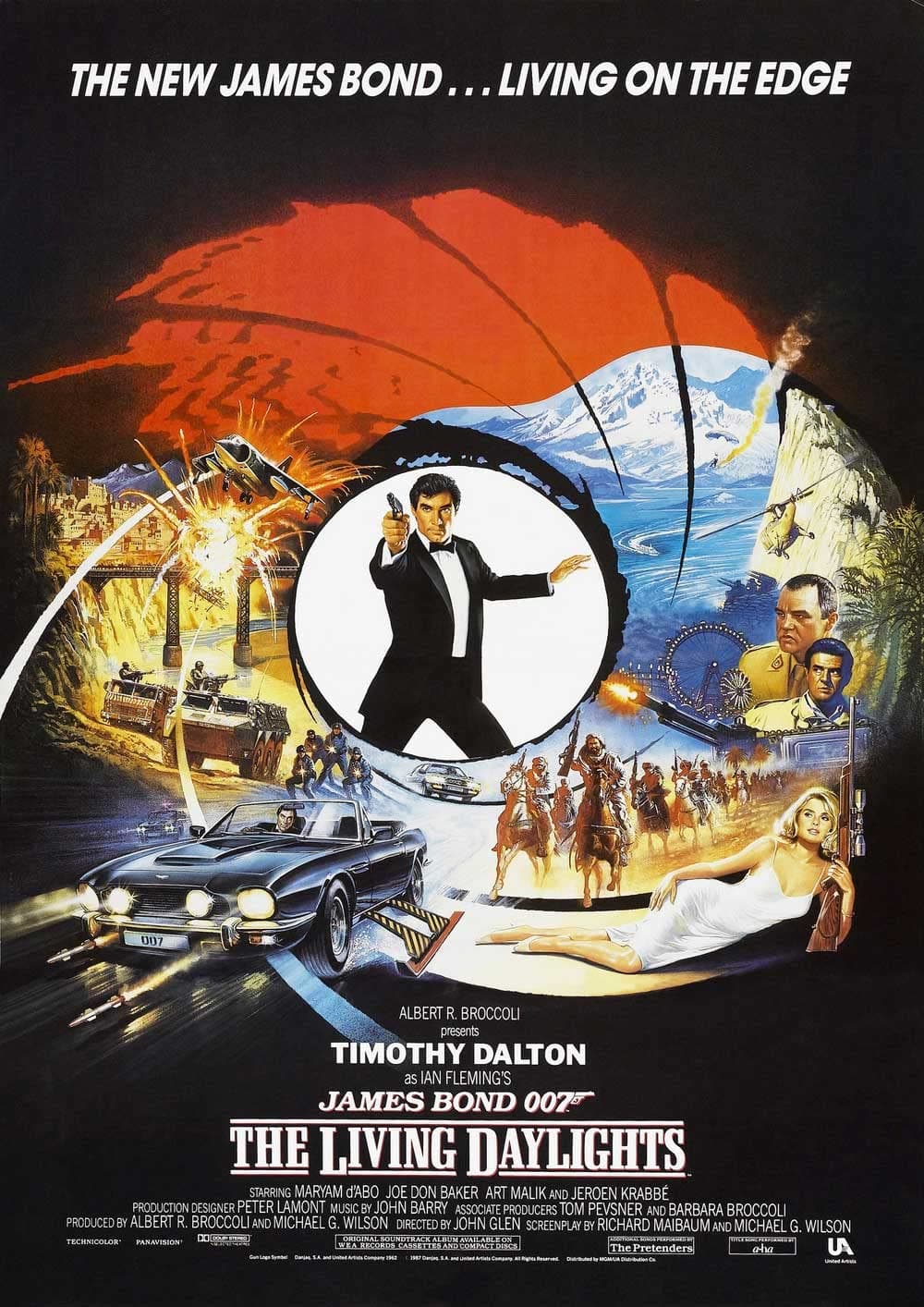
The setup
If you remember The Living Daylights at all it’s probably the opening: a defection that isn’t what it seems and a cello that belongs to the sniper, not the suspect. John Glen’s 1987 entry introduces Timothy Dalton as a harder-edged 007 and quietly nudges the franchise back toward Ian Fleming’s grimmer world.
THE MOVIE
James Bond (Agent 007) is still the reason this movie works
People still talk about The Living Daylights because it announces itself like someone clearing their throat: MI6 arranges an apparent defection and Bond is sent in to shepherd the whole thing. That Bratislava opening — adapted from Fleming and centred on a sniper who turns out to be a concert cellist — gives the film a neat, surprising hook.
What follows is a different-feeling Bond. Timothy Dalton’s 007 is leaner and darker, less given to quips and more willing to carry seriousness across a long, globe-trotting story. The film deliberately nudges the franchise back toward the grittier tone associated with Ian Fleming’s originals.
And it’s a John Glen Bond — directed by Glen, running a full two hours and ten — so it balances a grown-up mood with the series’ appetite for locations, gadgets and showy vehicles. Put simply: the movie wants you to take Bond seriously again.
THE SETUP
The idea that sets The Living Daylights in motion
The film starts with what looks like a straightforward intelligence operation: get Soviet general Georgi Koskov out of Bratislava. But the defection is a set-up — a staged assassination threat that’s hiding a larger con.
Koskov is manipulating British intelligence and is linked to an American arms dealer, Brad Whitaker. The scheme uses the idea of a phoney KGB hit to shift attention while real profiteering goes on behind the scenes.
Bond’s job becomes one of patient, tactical exposure. He can't simply punch through the plot; he has to let the staged events unfold to trace the threads back to Whitaker and the hired killer, Necros.
The structure keeps the action moving across Bratislava/Vienna, England, Tangier and even a Soviet-controlled air base in Afghanistan, so the payoff is both a personal unmasking and a disruption of the arms trafficking at the story’s heart.
THE CHARACTER
Why James Bond (Agent 007) matters
Timothy Dalton’s Bond is the engine of the whole picture. He isn’t there to charm the room; he’s there to see through a deception and make the hard calls it requires. The film frames him as leaner and darker than recent portrayals, which changes how every scene lands.
That seriousness matters because the movie itself tilts toward a Fleming-style realism — less razzle-dazzle, more consequence. When Bond faces moral knots, his choices read as choices, not punchlines.
His relationship with Kara Milovy helps humanise that stance. Kara is a concert cellist revealed to be both Koskov’s protegée and the sniper assigned to stop his defection; her divided loyalties give Bond something to hold on to besides the plot’s machinery.
Across long stretches and a lot of locations, Bond’s steadiness — his willingness to operate without easy swagger — is what keeps the film coherent. He matters because the movie asks him to be the audience’s moral compass as well as its action hero.
THE PERFORMANCE
Why Timothy Dalton's performance matters
At the time of release, American reviewers noticed what the casting signalled: Dalton’s Bond felt closer to Ian Fleming’s model — darker, more serious — and that register shaped how critics read the whole film.
Press attention also singled out Maryam d'Abo as a less stereotypical Bond girl, and writers at the time commented on the on-screen chemistry between Dalton and d'Abo. That pairing gives the movie a quieter emotional throughline amid the spy plotting.
So Dalton’s presence isn’t just a new face in the Aston Martin; it’s a tonal decision that the rest of the movie responds to. The seriousness on screen changes the stakes of even small scenes.
Which is to say: how the role is played matters because it rewires the franchise’s voice for this chapter.
UNDER THE SURFACE
The Living Daylights has more on its mind than the plot suggests
On the surface it’s a spy thriller with neat set pieces. Underneath, the film is deliberately nudging Bond back toward Fleming’s realism — less implausible gadgetry, more espionage and moral complication.
Cold War espionage and betrayal are the story’s beating heart: defections, planted assassinations and the murk of intelligence agencies playing each other are not just plot devices but thematic freight the film carries.
There’s also a critique of private profiteering. The Whitaker subplot — an arms dealer manipulating the conflict for gain — places greed and commerce alongside ideology as a driver of violence.
And then there’s fidelity. Romantic fidelity, specifically: Kara’s divided loyalties and Bond’s responses frame monogamy and trust as deliberate character choices rather than mere background romance.
THE FILMMAKING
How The Living Daylights was put together
The Living Daylights is assembled by a team of experienced Bond craftsmen: Alec Mills is credited as director of photography and Peter Lamont as production designer, with editing handled by John Grover and Peter Davies.
Those names matter because they create a continuity of look and working method across the Glen era: familiar hands, familiar rhythms. The film’s identity is therefore the result of steady, professional collaborators rather than one flashy auteur flourish.
That steadiness helps the movie move between disparate locations and tonal shifts without losing the central throughline — which, for a 130-minute Bond, is no small administrative trick.
In short: the filmmaking crew give the movie a dependable backbone, letting the script and performances do the tonal heavy lifting.
PRACTICAL EFFECTS
The effects work that gives The Living Daylights its physical personality
This Bond relies on physical stunts and real-world trickery. The production employed a substantial stunt and effects team — specialists for aerial stunts and driving coordinators — to stage sequences like the parachute escape and the snow-and-ice car chase.
Visual-effects supervision is credited to John Richardson, while Maurice Binder handled the main-title work; established Bond stunt personnel and arrangers underpinned the action sequences.
There’s also a willingness to let fights breathe: the multi-day sequence involving Necros and a house-security character was shot over several days, which underlines the film’s commitment to extended stunt choreography and physical staging.
Those choices give the film a tactile personality; it feels made rather than assembled on a computer, and that physicality is baked into how scenes are planned and executed.
PURE 80S
The Living Daylights could not belong to any other decade
The film is very much a late-1980s Bond: released in 1987, it arrives at a moment when the Cold War’s late-stage tensions — internal Soviet disputes and the Soviet–Afghan conflict — were headline concerns.
That geopolitical backdrop isn’t window-dressing. The plot engages directly with those issues, using the decade’s real-world conflicts as motivators for defections, arms deals and shadowy manoeuvres.
It also marks a franchise pivot: Dalton’s introduction as Bond in 1987 signals a tonal shift away from the Moore years and toward something harder-edged.
Finally, the production’s international shooting schedule — from Pinewood to locations across Europe, Morocco and beyond — reflects how 1980s spy films staged global politics as a physical geography to be moved across.
WATCHING IT NOW
What has aged — and what hasn't
Some of the film’s strengths are timeless because they’re structural: the theme of romantic fidelity remains clear, and the narrative gives Bond and Kara real moral decisions to make rather than playing everything for laughs.
Dalton’s arrival as Bond still reads as a deliberate tonal switch; that casting choice defined the movie’s identity then and continues to shape how viewers experience it now.
The production scale — a nineteen-week shooting schedule and a budget reported in the tens of millions — is obvious in the film’s ambition; it still feels like a serious, widescreen spy picture rather than a throwaway summer actioner.
So while certain surface elements may date the film to 1987, its focus on motive, consequence and character choice keeps much of the story watchable for modern audiences.
THE LEGACY
Why The Living Daylights still matters
The Living Daylights matters partly because it carried Timothy Dalton back for Licence to Kill, so it anchors the short-lived Dalton chapter in the series’ continuing timeline.
It’s also the last official Bond film to use the title of an Ian Fleming story until Casino Royale resurfaced that practice in 2006 — a small but telling link to Fleming’s original material.
Musically and behind the scenes it closes chapters too: it was John Barry’s final Bond score for the Eon series, marking the end of a long musical partnership.
And in broader histories of the franchise, the casting and tonal choices of this film are frequently treated as a transitional moment — the hinge between the Moore era and later reinventions of the character.
THE VERDICT
Does The Living Daylights still hold up?
Yes — with a qualification. If you want spectacle for spectacle’s sake, there are flashier Bonds. But if you want a 007 who takes the Cold War’s real questions — defections, betrayals, arms trafficking — seriously, this one still lands.
The opening Bratislava operation (the staged defection and the surprising sniper reveal) remains a tidy, clever set-piece that sets the movie’s moral and procedural tone. From there, the staged assassination and counter-scheme give Bond something thoughtful to untangle rather than just a succession of showy set pieces.
Timothy Dalton’s leaner, darker Bond reshapes the film’s voice; paired with Maryam d'Abo’s Kara, the movie carries a quieter emotional throughline that contemporary press noticed at the time. That combination makes the stakes feel earned.
So should you watch it today? Absolutely — if you’re interested in a Bond that prioritises choices over one-liners and plots over pyrotechnics. It’s the kind of Bond that proves the 007 concept can survive a change of tone: durable, a little austere, and still worth the ride.
Share this movie
Keep watching
More movies from the 80s
1986
Jumpin' Jack Flash
Jumpin' Jack Flash: our relationship with technology and freedom, and why this 1986 movie still matters.
Read our take →
1987
RoboCop
A murdered cop rebuilt as a product — RoboCop still asks who gets to sell justice.
Read our take →
1983
Christine
Obsession, adolescence and a car that won't let go.
Read our take →