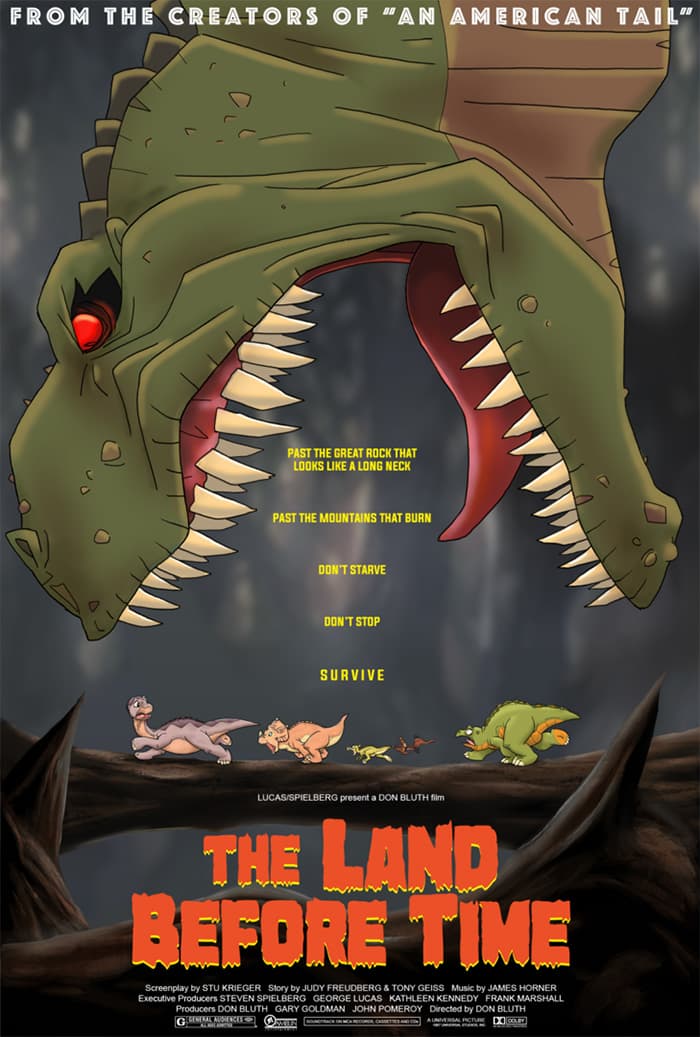
The Land Before Time
A small longneck, a fierce loss and a journey that still finds you where you live.
The setup
Don Bluth's The Land Before Time is the kind of children's film that doesn't shy from sadness. It opens with a child's grief and then trusts that curiosity, friendship and a stubborn map in a mother's last words are enough to carry the rest of the story.
THE MOVIE
Littlefoot is still the reason this movie works
There’s a moment early on when everything changes: Littlefoot, a young 'longneck', is wrenched away from the safe world of his herd by a violent earthshake. The film sets its tone in that snap — adventure arriving out of catastrophe — and it never pretends the stakes are trivial.
What follows is not just a search for a place called the Great Valley. It’s Littlefoot holding onto his mother's final directions and turning them into a purpose. That longing to be reunited — and the decision to lead others toward it — gives the story its forward motion.
At sixty-nine minutes, Don Bluth keeps the film compact and single-minded. There’s no faffing around: grief, determination and a ragged band of young dinosaurs get the screen time they need and little else.
THE SETUP
The idea that sets The Land Before Time in motion
At heart the film is a tidy adventure premise: a young dinosaur separated from his herd must travel toward a promised safe place. That is the plot engine, and it’s simple enough for children to follow but elastic enough to let the characters breathe.
Littlefoot doesn’t travel alone. He winds up with Cera the three-horn, Ducky the swimmer, Petrie the flyer and Spike the spiketail — a proper cross-species travelling party. Their differences matter; they argue, they help, and their odd-couple dynamics keep the journey from becoming merely functional.
The picture builds its world with little language tricks — tree-star for leaves, earthshake for earthquake, bright circle for the sun. Those in-world names are a neat move: they make an unfamiliar past feel like home-made myth, and they help the audience move through the film’s logic quicker than clumsy exposition would.
Even the character movement and design had a research backbone: production work in Dublin referenced major natural history museums to inform how these creatures might move and behave. It gives the action a quietly studied quality beneath the storybook surface.
THE CHARACTER
Why Littlefoot matters
Gabriel Damon voices Littlefoot, but what keeps him memorable is the way the story makes him hold more than a map. He carries his mother's last directions like a promise and turns that grief into action — he becomes the one who pulls the group forward.
That leadership isn’t grandstanding. It’s practical. Littlefoot trusts the directions and trusts the idea of reunion with other longnecks; his motivation gives the film a human pulse wrapped in a dinosaur body.
The movie also leaves room for older, gentler voices to help — the Narrator, Rooter, steps in to tell Littlefoot that his mother's death was not his fault. It’s a small but important consoling moment, the kind of adult reassurance that a kids’ film can give without flattening the pain.
There’s a sense of craft behind the character too: the Dublin-based production referenced museum material when shaping movement and behaviour, which keeps Littlefoot feeling like a realised creature rather than a cartoon label.
UNDER THE SURFACE
The Land Before Time has more on its mind than the plot suggests
On the surface it’s a coming-of-age adventure: kids tossed into a big, dangerous world and forced to grow up a little faster. But the film pairs that with a clear reckoning with loss. The opening death shapes everything that follows; the quest is partly practical, partly an emotional response to bereavement.
Grief here is not grand or sentimentalised. It’s a quiet motor that nudges the characters to rely on one another — which is where the cross-group friendships earn their keep. Cera, Ducky, Petrie and Spike are not simply cute sidekicks; their differences are the reason the group survives several perils.
Survival in this film isn’t grim survivalism. It’s the natural world instructing the youngsters: storms, predators and scarcity force decisions. Those pressures make the coming-of-age beats feel earned because the characters learn by doing, often reluctantly.
There’s also a through-line of intergenerational guidance — the adults’ influence is present (Rooter’s reassurance, Littlefoot’s mother’s last words) even when the youngsters are the ones acting. That balance keeps the film tender rather than bleak.
THE FILMMAKING
How The Land Before Time was put together
Don Bluth wears two hats on this picture: director and production designer. That dual role gives the film a cohesive feeling — what it wants to be narratively and what it looks like were planned hand-in-glove.
Bluth’s production team included John Pomeroy and Gary Goldman as producers, a tidy group who steered the project through the studio arrangements it needed. The film’s compact running time suggests they chose to keep the storytelling lean and focused.
The production pushed for believable motion, in part by consulting natural history collections when studying movement. Those choices make the dinosaurs feel like creatures that occupy space and carry weight, even within a stylised animated world.
The result is a film that reads as a crafted object: economical in its story choices, with design and direction aligned to serve the emotional beats rather than decorative spectacle.
PURE 80S
The Land Before Time could not belong to any other decade
This is late-1980s animation in a production sense: the film was made during Don Bluth’s Sullivan Bluth period and presented through Amblin Entertainment as a Lucas/Spielberg presentation. That combination — an independent animation house working with heavyweight presenters — is very much an 80s industry moment.
Moving part of the studio’s operations to Dublin was another late-80s practicality. The Ireland-based production phase shaped how resources were marshalled and how the film was developed, giving it a different production geometry than a studio-bound cartoon.
The collaboration model (Bluth alongside Amblin names) reflects how independent animation sought big-league backing in the 1980s: creative independence paired with heavyweight presentation to find a wide audience.
So while the story could be timeless, the film’s production story sits comfortably in the decade that made such partnerships routine.
WATCHING IT NOW
What has aged — and what hasn't
As a family film it still does a key job: it treats children as capable of handling sorrow. That frankness about loss is less common in modern mainstream kids' films, so this candidness tends to stand up well.
The cross-group friendship at the movie’s core — different kinds of youngsters learning to rely on what each of them contributes — remains a useful model. The emotional value of that cooperative spirit is simple and clear, and it translates across generations.
Some of the craft choices, like the research-driven approach to movement and design, give the characters a sense of physical truth that helps when you rewatch. Those background decisions quietly support the story, even if they aren't shouted about on the screen.
Taken together, the film’s economy, its willingness to show grief, and its focus on cooperative survival still feel purposeful rather than merely nostalgic.
THE LEGACY
Why The Land Before Time still matters
The original theatrical feature did what it needed to do and then kept working: it launched a long-running franchise of direct-to-video sequels and eventually a television series that debuted in 2007. The story kept finding new homes beyond the cinema.
At the time it opened strongly — trade reports noted a solid first weekend and a later approximate theatrical gross near $46 million — which helped justify the franchise that followed.
The music left a trace too: the theme song 'If We Hold On Together' was released as a single performed by Diana Ross and has been included on soundtrack reissues, so the film’s audio afterlife has its own little footprint.
Put together, these things explain why the film still turns up in conversations: it didn’t vanish after its theatrical life; it kept circulating in ways that kept Littlefoot and his friends present for new audiences.
THE VERDICT
Does The Land Before Time still hold up?
Yes — if you want a compact, emotionally direct family film that treats grief honestly and trusts kids to handle it. The basic premise is tight: Littlefoot separated from his herd after an attack and an earthshake, motivated by his mother’s last directions to reach the Great Valley. That gives the picture a clear spine.
The film’s voice-over narration frames the journey and its prehistoric vocabulary (tree-star, earthshake, bright circle) manages to be charming rather than clumsy. The group dynamic — Littlefoot leading Cera, Ducky, Petrie and Spike — keeps the movie moving and makes the themes of friendship and cooperation feel earned.
At just over an hour long, it doesn’t outstay its welcome. Don Bluth’s direction and the production choices keep the storytelling compact, which helps the emotional beats land without being diluted.
So should you watch it now? If you care for a children’s film that mixes honest sadness with moments of joy and practical bravery, The Land Before Time still works. It’s a short, focused journey where a child’s loss becomes the map — and that remains a quietly brave thing to show any audience.
Share this movie
Keep watching
More movies from the 80s
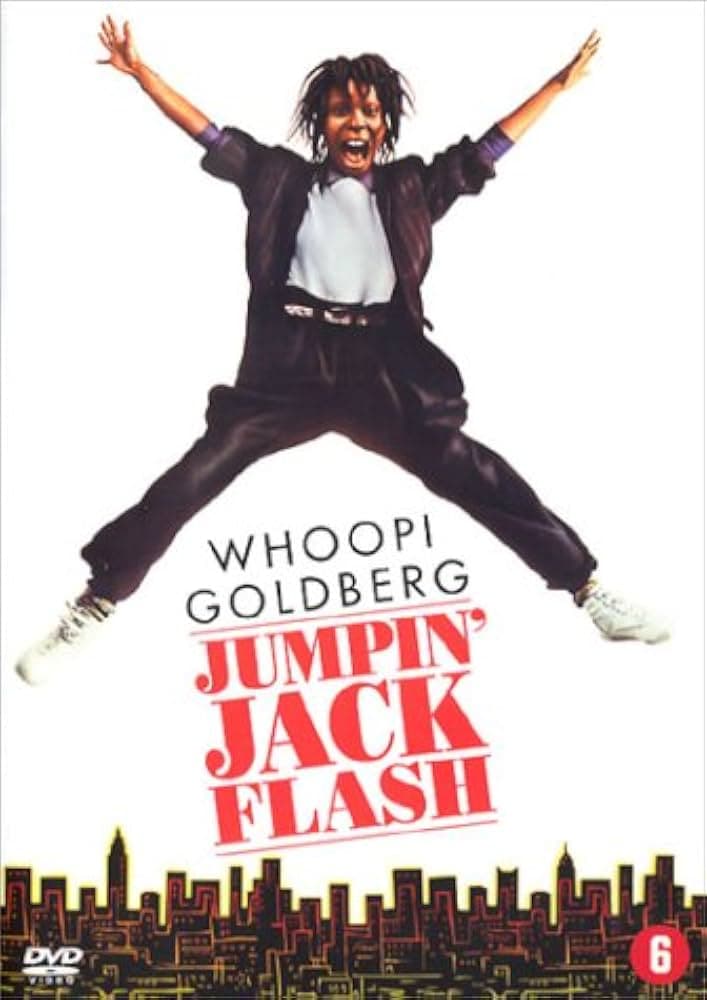
1986
Jumpin' Jack Flash
Jumpin' Jack Flash: our relationship with technology and freedom, and why this 1986 movie still matters.
Read our take →
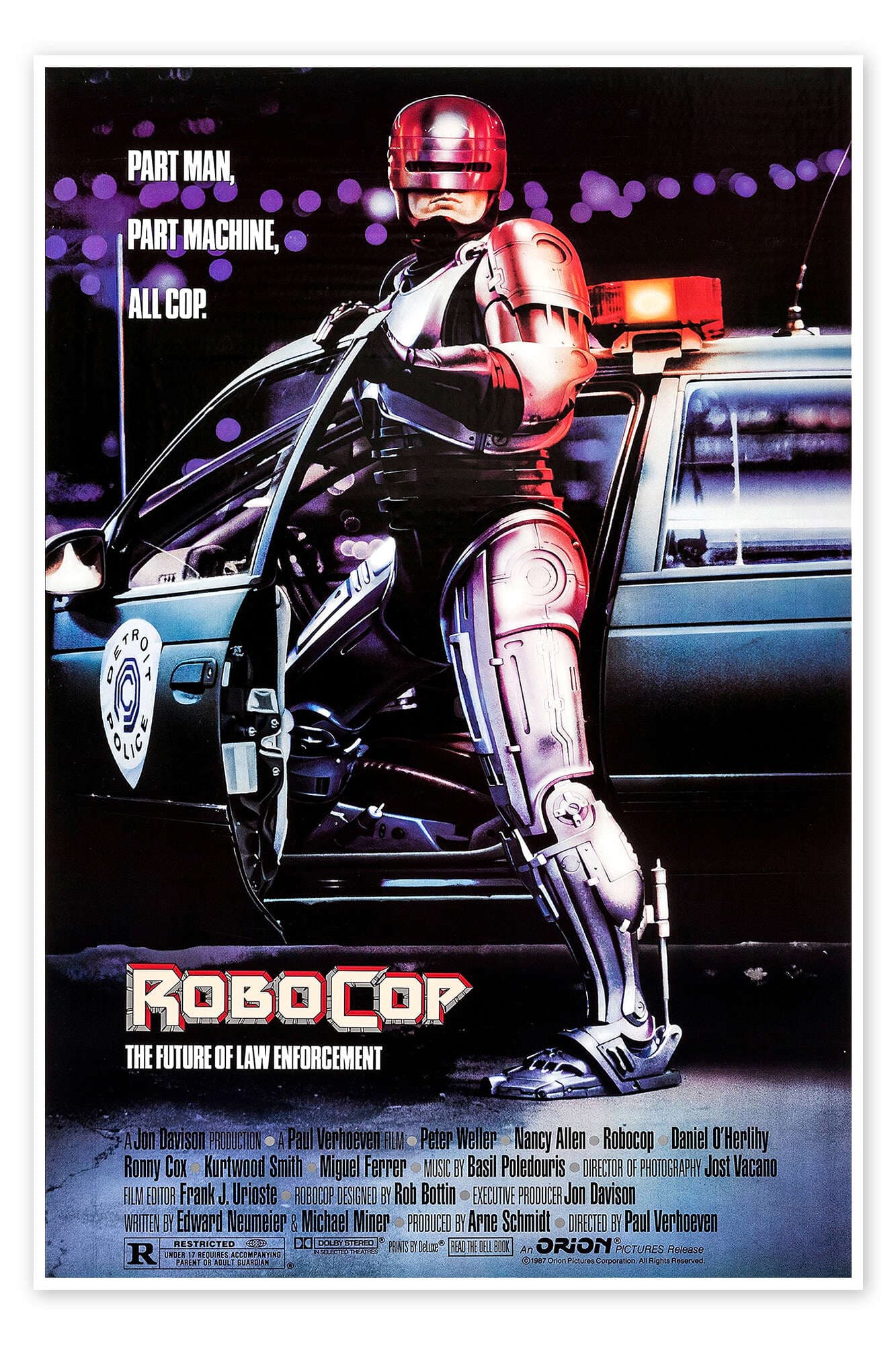
1987
RoboCop
A murdered cop rebuilt as a product — RoboCop still asks who gets to sell justice.
Read our take →
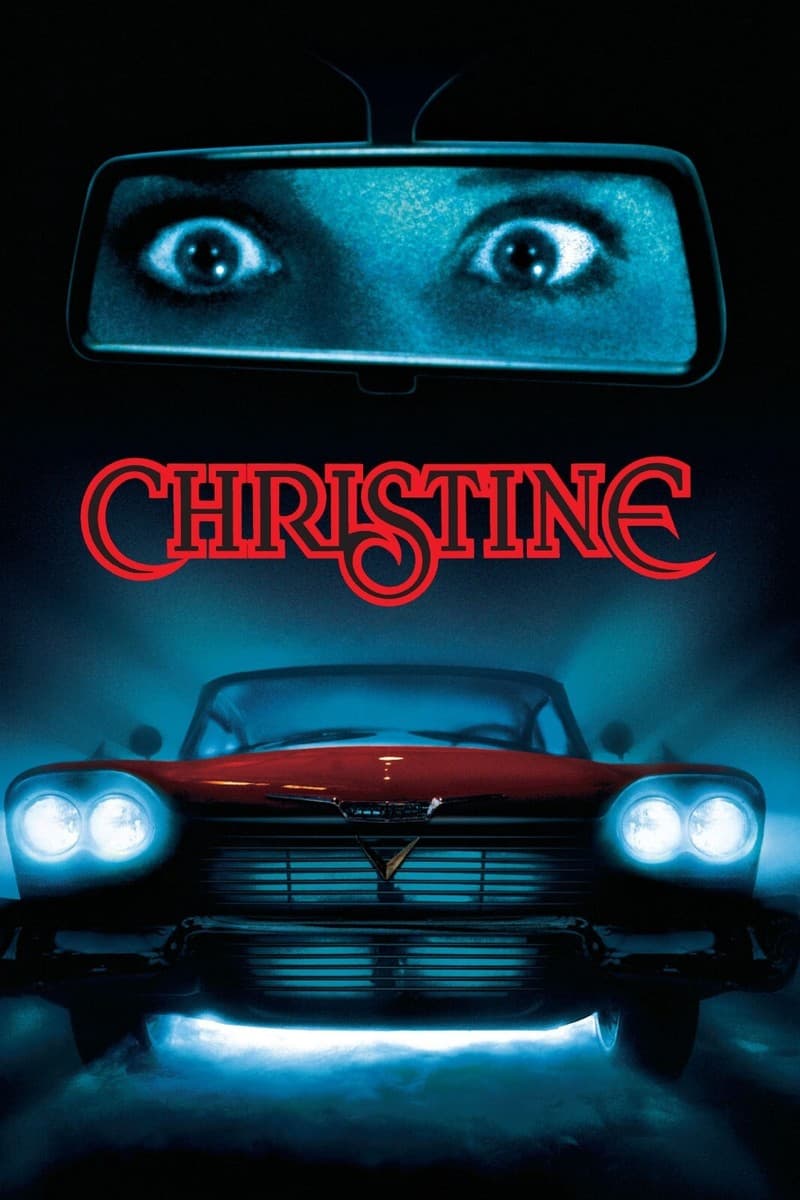
1983
Christine
Obsession, adolescence and a car that won't let go.
Read our take →