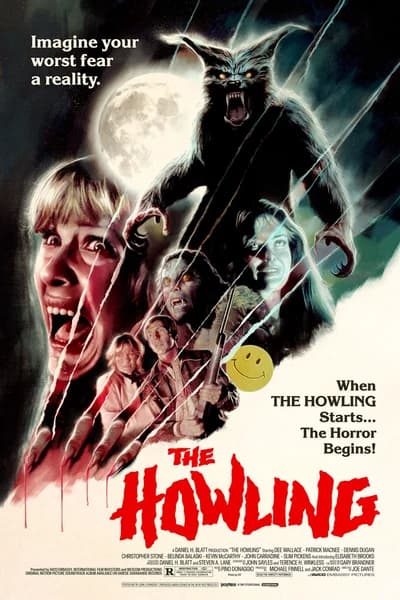
The Howling
A TV reporter, a therapist's retreat and an appetite for practical prosthetics — The Howling still bites.
The setup
Joe Dante’s The Howling centres on a stubborn, frightened television reporter who refuses to let one ugly encounter be the end of the story. It’s a film that pairs tabloid spectacle with quiet trauma, dresses both in horror-movie in-jokes and then decides to get very, very physical about it.
THE MOVIE
Karen White is still the reason this movie works
People still talk about The Howling because it refuses to be only a monster movie. At the centre is Karen White — a working television reporter whose life is rearranged by a terrifying phone-booth encounter with a caller named Eddie Quist. It’s her disturbed, curious energy that keeps the film moving when the story shifts from street-level spectacle into something more private and uncanny.
That phone incident doesn’t feel like a throwaway set-piece; it’s the engine. On the advice of Dr George Waggner, Karen is shipped off to a coastal group-therapy retreat called the Colony — a place that looks helpful and ends up asking questions. That movement, from newsroom to refuge, lets the film fold television’s appetite for drama into a story about personal memory and suspicion.
Joe Dante directs with a clear sense of tone-play: affectionate nods to classic horror are threaded through the cast list and jokes, while the movie’s reputation rests on the physical work that turns people into something else. Rob Bottin’s practical make-up and transformation effects get a lot of the headlines — and contemporaneous critics singled that craftsmanship out even when they were divided on pacing and script. Put simply: the human through-line (Karen) plus the movie’s appetite for gore and homage is why The Howling still hooks people.
THE CHARACTER
Why Karen White matters
Dee Wallace’s Karen White is not there to be a scream-queen set piece; she’s the person who drags us into the plot and keeps us curious. We meet her as a professional — a television reporter whose job already trains her to look and ask questions — and that vocational habit becomes how she survives the film’s escalating oddities.
Her trauma after the obscenity-and-threat phone encounter is what sends her to the Colony. That’s important because it turns a horror setup into something intimate: Karen isn’t chasing monsters for a byline so much as trying to make sense of what happened to her. Her personal stakes make the revelations feel consequential rather than merely sensational.
She’s also tethered to a normal life. Bill Neill — her husband and a fellow TV staffer — is written as her emotional anchor, the person who keeps the domestic world intact even as the woods outside the Colony start to look hungry. That pull between a professional instinct to investigate and the desire for safety gives Karen a believable push-and-pull.
Because the film is only 90 minutes long, Karen’s drive keeps the movie compact: she provides focus. Without that, all the homage, effects and eerie community business would risk floating away on atmosphere alone.
UNDER THE SURFACE
The Howling has more on its mind than the plot suggests
On the surface The Howling gives you werewolves and a retreat in the woods. Underneath, it’s doing a couple of clever things at once. First: the film knowingly winks at horror history — character names and in-jokes are there to remind you that the movie has one eye on the classics even as it crafts its own scares.
Second, it’s interested in media as spectacle. The protagonist is a television reporter and the story keeps circling the collision between private trauma and public broadcast. That tension — what gets shown, what stays hidden, what becomes a headline — is baked into the premise.
Third, trauma and memory are not afterthoughts. Karen’s choice to go to the Colony is rooted in trying to process a violent encounter, and the film treats recollection and the search for confirmation as dramatic drivers rather than mere background.
Finally, the movie stages community against a hidden predator. The Colony looks like a safe network, but the threat in the woods suggests danger can live inside communities and the people we trust. That conflict — togetherness versus betrayal — gives the scares moral weight.
PRACTICAL EFFECTS
The effects work that gives The Howling its physical personality
One of The Howling’s lasting fingerprints comes from the skin-level craftsmanship of its transformations. Rob Bottin is credited as the special-makeup-effects creator, and the credits also list Rick Baker as a consultant — the names alone tell you the filmmakers meant to take the lycanthrope idea seriously.
Contemporaneous accounts and later descriptions point to Bottin’s use of air-bladder systems and prosthetic techniques to pull off in-camera metamorphoses. That wasn’t a digital fix; it was a mechanical and tactile effort built in an effects shop and designed to sit on actors as something physical.
Because the film emphasises bodily change as an event you watch, those prosthetic and air-bladder approaches contribute to the movie’s tone: the horror is stubbornly material, not abstract. You see joints shift, surfaces ripple, and the camera records it as a thing that happened to real flesh.
Whether you find that work gruesome or brilliant, it’s the practical detail beneath the film’s personality. It anchors otherwise playful genre jokes with a sort of unavoidable, messily realised reality.
PURE 80S
The Howling could not belong to any other decade
The Howling arrived in 1981, a year that turned out to be something of a werewolf renaissance. It’s routinely mentioned alongside other 1981 lycanthrope films because that season was oddly obsessed with transformation and bodily spectacle.
The production itself pulled together people who would become a familiar 1980s genre crew: early-career effects and editorial technicians worked on the film — names that would reappear in the decade’s horror and action work. That concentration of practical know-how helps explain why the movies of this moment look the way they do.
Stylistically, the film mixes affectionate homage with practical gore in a way that feels very early-eighties: a self-aware B-movie spirit paired with prosthetic technology that was rapidly improving. It’s an era willing to wink at the audience while also trying to make the shock feel immediate and real.
The Howling also did fine enough on the festival circuit to pick up a critics’ award at Avoriaz, which is a neat encapsulation of its place — it was part genre romp, part technical showcase, and it arrived at a moment when both mattered.
THE LEGACY
Why The Howling still matters
One practical reason The Howling stays in conversations is its festival recognition — it won a critics’ award at the 1981 Festival International d’Avoriaz — which helped frame it as a serious genre piece rather than straight exploitation.
Another reason is lineage: the original film seeded an entire franchise. Beginning with Howling II, multiple sequels followed across theatrical and direct-to-video channels, and the concept was even reimagined in 2011 with The Howling: Reborn. That afterlife keeps the original in circulation.
Finally, the movie occupies a useful spot in critical discussion about the year’s werewolf films. It’s frequently paired with An American Werewolf in London in debates about the practical transformation work and how those effects shaped audience expectations for the monster reveal.
Put together, festival recognition, a continuing franchise and its role in a conversation about transformation effects explain why The Howling still turns up in horror talk; it’s part memory, part material craft and part franchise curiosity.
THE VERDICT
Does The Howling still hold up?
Yes — and with a few caveats. If you’re after tidy logic or an ultra-polished script, the film’s pacing and tone were noted as uneven even on release. But if what you want is a compact 90-minute horror that mixes human stakes with physical menace, The Howling delivers.
Karen White’s role is the deciding factor. Her investigative thread — the obscene calls, the confrontation with Eddie Quist and the decision to accept psychiatric advice and go to the Colony — keeps the film emotionally anchored as odd events escalate. When the story threatens to turn into pure spectacle, she brings it back to a person trying to remember and make sense.
The movie’s show-stopping moments are the transformations: people change on camera into a clearly supernatural explanation for the attacks. That practical, in-camera approach to metamorphosis is central to the film’s personality, and contemporary reviewers singled out those make-up and transformation effects as a reason to watch.
So should you watch it? If you love practical-effect horror, enjoy genre in-jokes, or want a tight early-80s werewolf piece that leans into television spectacle and personal trauma, it’s worth your time. In short: The Howling still howls — sometimes clumsily, often thrillingly — and Karen White drags you along for the outing.
Share this movie
Keep watching
More movies from the 80s
1986
Jumpin' Jack Flash
Jumpin' Jack Flash: our relationship with technology and freedom, and why this 1986 movie still matters.
Read our take →
1987
RoboCop
A murdered cop rebuilt as a product — RoboCop still asks who gets to sell justice.
Read our take →
1983
Christine
Obsession, adolescence and a car that won't let go.
Read our take →