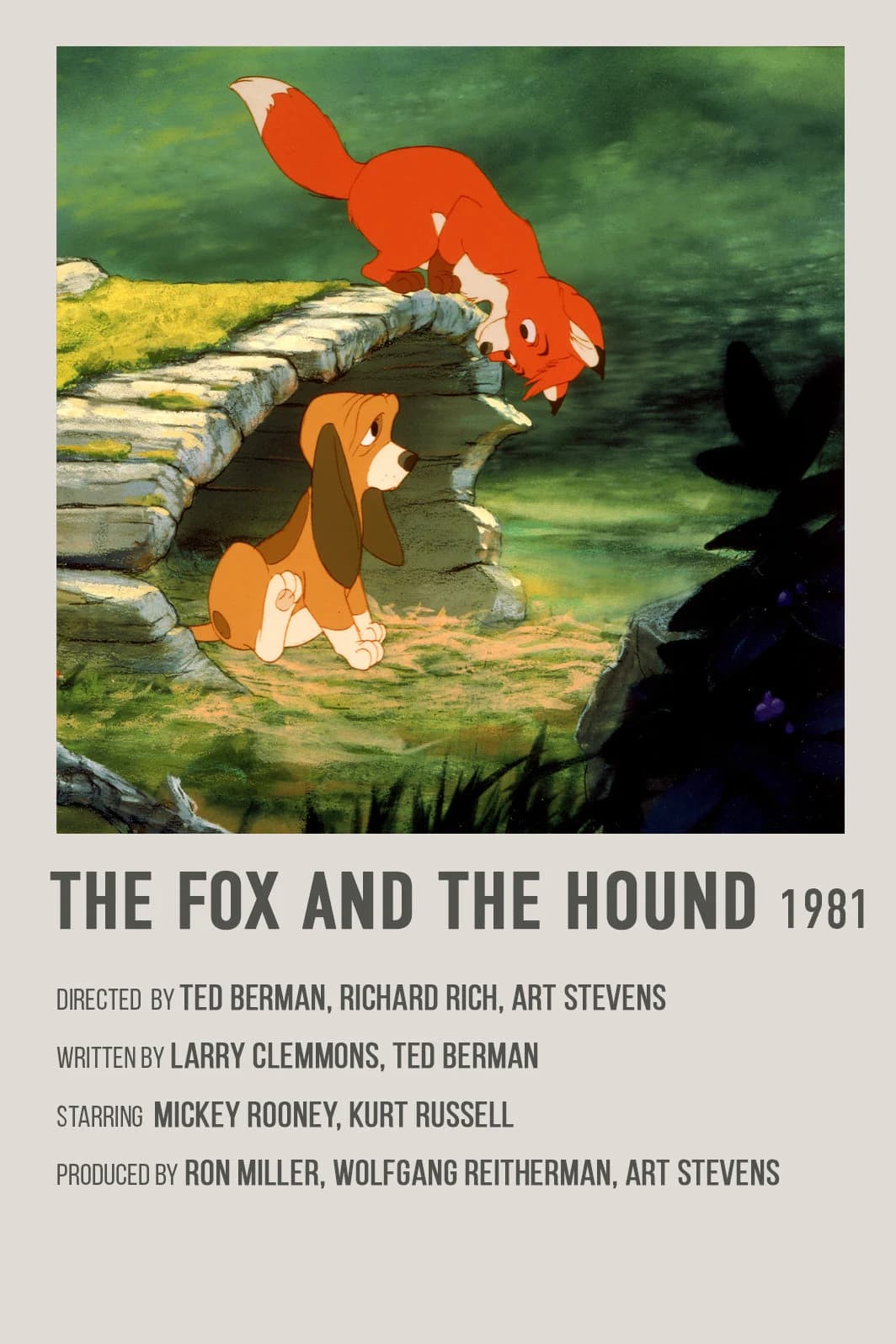
The Fox and the Hound
A childhood friendship that learns the hard way what loyalty and duty actually cost.
The setup
You remember the two of them — a fox cub taken in by a kindly widow and a hound pup who becomes his best mate. That simple start — Tod finding a home, Copper finding a friend — is the engine that keeps The Fox and the Hound humming long after the credits. Directed by Art Stevens, Ted Berman and Richard Rich, it turns an animal fable into a surprisingly sharp study of growing up and divided loyalties.
THE MOVIE
Tod is still the reason this movie works
The opening image you carry away from The Fox and the Hound isn't a set-piece or a gag; it's a relationship. Tod arrives in the world as an orphaned fox cub and is taken in by Widow Tweed. The comfort of that adoption — the idea of belonging — is what makes everything that follows feel vital rather than merely cute.
Against that cosy start is a harsher fact: Tod's mother is killed in an on-screen hunting incident, and that violence is the narrative shove that places Tod in human care and into the orbit of a nearby hound puppy, Copper. Childhood friendship is established quickly, then complicated slowly, and that neat contradiction is the film's heartbeat.
Credit also where credit's due: this is a Walt Disney picture steered by three directors, Art Stevens, Ted Berman and Richard Rich, and built around a compact 83-minute runtime. Mickey Rooney gives voice to Tod and Kurt Russell to Copper, with Pearl Bailey as a protective mentor figure; their names are the shorthand people reach for when they want to describe the movie’s familiar faces.
THE SETUP
The idea that sets The Fox and the Hound in motion
At its most basic, the film sets up two natural opposites and asks what happens when they become friends. Tod — taken in by Widow Tweed — and Copper — the nearby hound pup — grow up together. That childhood bond is uncomplicated, affectionate and believable.
The complication comes when the world around them demands roles. Copper is trained to be a hunting dog; the community expects him to pursue foxes. That training forces the friendship into a ring with social and instinctual rules stacked against it.
Structurally, the film uses a passage-of-time approach: we see both animals as juveniles and then as adults, which lets the movie show how simple affection can erode under pressure rather than inventing fresh reasons for the split. It’s the slow tilt from playmates to adversaries that does most of the heavy lifting.
There’s also a larger confrontation later in the story that raises the stakes without undoing the earlier emotional groundwork. The setup keeps the focus tight: two friends, a change in expectations, and the question of whether loyalty can survive learned duties.
THE CHARACTER
Why Tod matters
Tod is the film’s emotional compass. He arrives as an orphan, which in simple storytelling terms makes him someone who wants — wants a home, wants a friend, wants to belong. That hunger gives his choices weight, because they’re rooted in a genuine need rather than convenience.
His attachment to human caretakers and to Copper feels earned because the film shows the loss that put him there: a traumatic hunting incident that leaves him without a family. That history isn’t waved away; it explains why even small acts of kindness register so strongly for him.
Big Mama exists as a protector and adviser to Tod and the other young animals; she’s the grown-up presence that shields Tod when the world becomes less safe. Her role underlines how Tod’s story is not just about nostalgia for childhood but about trying to find stability in an unstable world.
The casting echoes that intention. Mickey Rooney supplies Tod’s grown voice, and Keith Mitchell plays him as a youngster — a pairing that keeps Tod recognisably the same character as he moves through the film’s time jumps. Put simply: Tod’s emotional needs are the plot’s motor, and the movie never lets his desire for belonging become background noise.
THE PERFORMANCE
Why Mickey Rooney's performance matters
Contemporary response to the film tended to treat the lead voices as straightforward pieces of the machinery rather than headline-stealing turns. The cast anchors the characters without pulling focus away from the story.
That’s useful here because Tod’s sympathy depends less on star wattage and more on clarity: you need to understand what he wants and why, and the vocal choices support that without theatrical excess.
Mickey Rooney’s credit as Tod sits in that middle ground — present and serviceable rather than self-consciously showy. The film’s approach asks the performers to do the emotional plumbing work, and the cast is credited for delivering that reliably.
In short: the voices are functional in the best sense. They keep Tod recognisable, keep the emotional beats readable, and let the screenplay’s dilemmas remain front and centre.
UNDER THE SURFACE
The Fox and the Hound has more on its mind than the plot suggests
At face value this is a family fable about two animals who grow up together. Underneath, it’s quietly interested in how relationships survive when everyone else expects them to fail. Friendship across social boundaries is the obvious theme: a fox and a hound shouldn’t be pals, and the film keeps returning to that impossibility.
It’s also a coming-of-age story. The pair’s friendship is lovely when they’re little, but maturing brings rules, roles and losses. That transition — the slow erosion of innocence — is where the emotional heft lives.
Loyalty versus duty is the moral knot the movie refuses to untie neatly. Copper is shown as torn between affection and the role forced upon him as a hunting dog. The film stages that conflict without pretending there’s an easy resolution.
Finally, the story nudges at the idea of nature versus learned prejudice. It asks whether instinct or instruction is stronger when two creatures are taught to occupy opposing places in the world. That question keeps the film from being a simple animal cartoon.
PURE 80S
The Fox and the Hound could not belong to any other decade
The Fox and the Hound arrived in 1981 at a peculiar moment for Disney animation. Production stretched back into the late 1970s, and the studio had just weathered a major animator exodus — a generational handover that left the picture in the care of newer artists.
That transitional feel is part of its character: the movie wears both a respect for older Disney storytelling and the tentative energy of a studio finding its next voice. It isn’t flashy in a modern sense; it’s quietly trying to balance tradition with change.
Released nationwide in the summer of 1981, the film sits at the start of a decade where Disney would gradually rebuild its animation identity. The Fox and the Hound is one of those titles that shows what the studio looked like in the in-between, neither completely backward nor yet fully forward.
Put another way: the movie’s temperament — earnest, slightly wary, and focused on story over spectacle — feels perfectly anchored to its production moment.
WATCHING IT NOW
What has aged — and what hasn't
Watch it today and the parts that still land are the human-sized feelings at its core. Retrospective writing and family guides point to the film’s capacity to retain emotional resonance — particularly its handling of friendship and loss.
That’s not accidental. The story resists pat answers: it asks the audience to sit with discomfort rather than tidy it away, and that honesty tends to outlive the fashions of any given era.
As a family film, it still works as something you can share with kids while leaving room for adults to notice the tougher moral notes. The themes of cross-boundary friendship and loyalty versus duty remain readable without extra explanation.
That said, some elements now play with a kind of period calm — the film assumes a storytelling patience that modern family fare sometimes eschews — but where emotional moments are genuinely earned, they still carry weight.
THE LEGACY
Why The Fox and the Hound still matters
Part of why the film sticks around is practical: The Fox and the Hound has been reissued over the years, including a 30th Anniversary Blu-ray/DVD collection, which keeps it available to new viewers and families revisiting the title.
There’s also a curiosity factor. The movie sits at a crossroads in Disney’s history — produced through a transitional period and completed by a newer generation of studio artists — and that makes it a useful touchstone when people talk about how Disney animation evolved.
Its afterlife includes a 2006 direct-to-video sequel, which shows the studio regarded the property as worth returning to, even if that follow-up didn’t replace the original in memory.
Mostly, though, it’s the characters — Tod, Copper, Big Mama, Amos Slade — and the compact storytelling that keeps the film in circulation; those elements are what home releases and anniversary editions keep bringing back into view.
THE VERDICT
Does The Fox and the Hound still hold up?
Yes — and for a clear reason: it’s emotionally honest on a small, specific scale. The plot begins with Tod, an orphaned fox cub who is taken in by a kindly widow, and it refuses to paper over the consequences of that opening — the hunting incident that kills Tod’s mother is not treated as a throwaway. That seriousness gives the rest of the story its stakes.
From there the film dramatizes a tight dilemma. Copper is shown as a loyal friend in childhood but later becomes conflicted when training and social expectation push him toward the role of a hunting dog. The passage-of-time structure — the film shows both animals as juveniles and then adults — allows the audience to watch affection harden into duty rather than inventing new motives at the end.
Mickey Rooney’s casting as Tod is part of what keeps the character legible: Tod remains, throughout, an orphaned figure trying to find his place. Big Mama’s protective presence helps frame his choices, and the movie’s straightforward voice casting keeps the emotional machinery readable rather than showy. Contemporary notices found the leads to be solidly drawn rather than scene-stealing, which suits the story’s intentions.
So should you watch it now? If you want a compact, thoughtful family film about friendship across social boundaries and the cost of loyalty, then absolutely. At 83 minutes, the movie doesn’t outstay its welcome, and it still asks the kind of plain, slightly uncomfortable questions that make revisiting it worth your time.
Share this movie
Keep watching
More movies from the 80s
1986
Jumpin' Jack Flash
Jumpin' Jack Flash: our relationship with technology and freedom, and why this 1986 movie still matters.
Read our take →
1987
RoboCop
A murdered cop rebuilt as a product — RoboCop still asks who gets to sell justice.
Read our take →
1983
Christine
Obsession, adolescence and a car that won't let go.
Read our take →