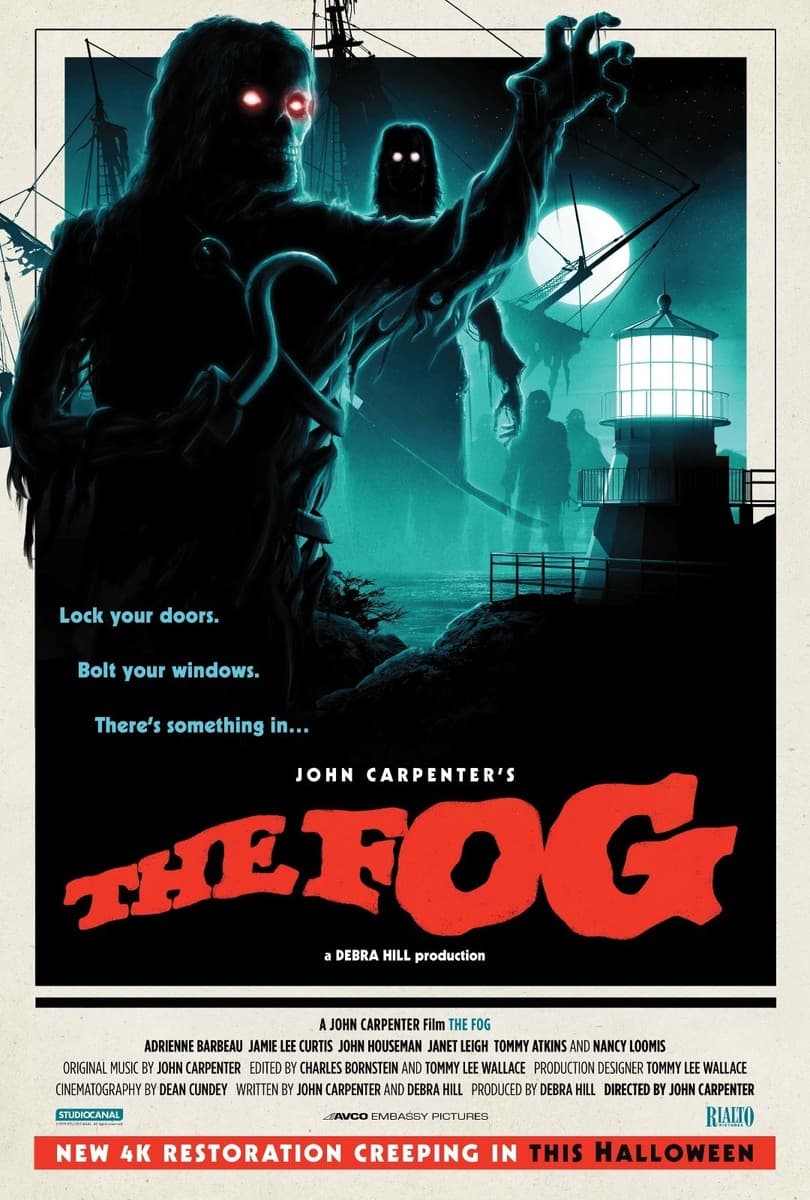
The setup
If you remember one thing about The Fog it’s probably the radio voice that cuts through the silence. John Carpenter’s compact supernatural thriller sets its centre not on a detective or a hero with a gun, but on Stevie Wayne — the deejay in the lighthouse who tries to translate a town’s buried sin into warnings anyone will hear.
THE MOVIE
Stevie Wayne is still the reason this movie works
The Fog opens like a crooked fairy tale: an old man by a campfire laying out a century-old wrong. That prologue gives us the simple, awful ledger the movie will keep — a sunken ship named the Elizabeth Dane, six townsmen who betrayed her crew, and a debt the past intends to collect.
Fast forward a hundred years and the town of Antonio Bay gets its reckoning in the form of a white bank of fog. The mist isn’t just atmosphere; it brings the resurrected seamen back to shore to take revenge for what was done to them and their cargo.
And at the eye of all this is Stevie Wayne — a radio deejay sitting in a lighthouse/radio station whose broadcasts are the film’s lifeline. Carpenter doesn’t centre the story on muscle or investigation; he gives us a communicator, someone whose voice can either stitch the town together or fail it when the fog rolls in.
THE SETUP
The idea that sets The Fog in motion
The basic engine is straightforward and economical. An elder frames the town’s original sin, and the narrative links present-day violence to an explicitly told historical betrayal: the Elizabeth Dane was scuttled and her crew murdered so townsmen could steal the ship’s treasure.
That old crime doesn’t stay on the page. A white fog arrives and acts as the vector — it conceals the dead and delivers them back into Antonio Bay. The supernatural here is simple: the fog carries revenants who want repayment.
Carpenter keeps the mechanics clear so the audience isn’t lost in trickery. There’s practical reporting (a radio DJ pushing information to listeners), discovery (a priest who finds journal evidence about the founders) and the fog itself as the unstoppable, elemental antagonist.
It works because the film keeps us on the same map. We know the debt, we see the method of its collection, and the drama becomes less about figuring out what’s happening and more about who in the town will face what they helped create.
THE CHARACTER
Why Stevie Wayne matters
Stevie Wayne is not an ornament bolted to the plot; she’s the connective tissue. Written for Adrienne Barbeau, Stevie’s job in Antonio Bay is literal and dramatic: she runs the radio from the lighthouse and her voice is how the town hears itself when chaos arrives.
That placement matters. A radio deejay is a public presence with a private booth — someone who translates panic into information, and gossip into something actionable. When the fog comes, Stevie is the conduit between the island of facts and the wider, frightened town.
Because the role was written with Barbeau in mind and cited in production notes as her feature-film debut, Stevie arrives already specific rather than generic. The character anchors the film’s communicative logic: if the town is deaf to its past, Stevie is the person trying to make it listen.
Put simply: remove the radio and you remove the film’s sense of live reportage. Stevie isn’t merely present; she’s the mechanism that keeps the audience oriented in a story about an elemental return and a community that must answer for its ancestors.
THE PERFORMANCE
Why John Houseman's performance matters
John Houseman appears as Mr. Machen in a tightly focused prologue that was shot in a single day. His sequence doesn’t meander: it reads the ledger of guilt out loud and then hands the audience to the rest of the picture.
Because the prologue sits outside the main timeline, Houseman’s presence functions like an authoritative bookend — the voice that frames the story and announces the debt owed by Antonio Bay.
That framing is useful. Starting with an on-screen storyteller means the film can get straight to work: we understand the origin, we know the exact nature of the wrong, and the narrative can treat the fog’s arrival as the inevitable consequence.
In short, Mr. Machen’s role is compact but crucial: a one-day shoot that puts a clear label on the town’s past and sets the moral arithmetic the rest of the film will calculate against.
UNDER THE SURFACE
The Fog has more on its mind than the plot suggests
On the surface, The Fog is a ghost story about a returning crew and a creeping mist. Beneath that, it’s about revenge for past wrongdoing: the revenants are literally cashing in a moral cheque written a century earlier.
That revenge is wrapped in collective guilt. The town’s founders made a choice that bound future generations to responsibility; the story forces Antonio Bay to reckon with the idea that a community can inherit culpability along with its prosperity.
The fog itself operates as a natural or elemental antagonist. It’s not a person with motives so much as weather that carries consequences — an external force that exposes what the town wanted to keep hidden.
Finally, the film makes communication central. With a radio deejay at its narrative heart, The Fog uses media as the mechanism for warning, reporting and community response. The broadcast booth is where information either fixes things or fails to save them.
PRACTICAL EFFECTS
The effects work that gives The Fog its physical personality
Carpenter’s mist isn’t a single digital veneer; much of the film’s fog was built on soundstages using specially designed fog machines, dry ice and theatrical fog fluid, then integrated into the picture with optical compositing.
That process gives the fog a tactile quality: it behaves like physical atmosphere because it was created and filmed as such, then layered into shots to feel invasive rather than added in post as an afterthought.
The production also made a miniature of the bay’s rocks from black velvet on a soundstage, wafted stage fog over it and composited that footage with live-action water plates for particular shots.
Those practical approaches matter because they give the film a consistent, material presence. The fog isn’t just an idea; it has weight and movement in the frame because the production treated it as something to be physically produced and then optically integrated.
PURE 80S
The Fog could not belong to any other decade
Released in 1980, The Fog sits at a junction in Carpenter’s early career — made after Halloween and as part of a two-picture arrangement with Avco Embassy that preceded Escape From New York (1981). It’s the middle child in a run of efficient, idea-led genre outings.
The film also exemplifies early-1980s American independent genre filmmaking: modest budgets, location shooting in Northern California, and a premium on atmosphere over spectacle. Carpenter’s economy shows how much can be done with a focused concept and clear mechanics.
Its timing matters too. Dropped at the start of a decade that would expand Carpenter’s canvas, The Fog reads as a deliberate, compact experiment in tone and theme rather than a studio blockbuster trying to be everything at once.
Put another way: The Fog feels of its moment because it marries small-scale production values with a director experimenting with how far mood and a single striking idea can carry a picture.
THE LEGACY
Why The Fog still matters
The Fog walked away from festivals with recognition: contemporary press files note it won the Prix de la Critique at the Festival International du Film Fantastique d'Avoriaz. That kind of critical nod reflects the elements reviewers singled out — atmosphere, effects and score.
It also has a visible place in Carpenter’s early career narrative. The film is commonly discussed in surveys of his work as the follow-up to Halloween and as a precursor to what he would try next. In other words, it’s part of the map that explains his 1980s trajectory.
The fact a studio remake arrived in 2005 is further proof of the story’s continued utility; whether for homage or reimagining, the premise — fog as revenant vector and a town paying for old sins — kept enough teeth to be revisited.
Ultimately, The Fog’s legacy rests on a few tidy strengths: a memorable central device (the fog), a narrative hinge in the prologue, and a communications-driven centre in Stevie that gives the film a distinct dramatic voice.
THE VERDICT
Does The Fog still hold up?
Yes — with a caveat. The Fog is 90 minutes of tidy, atmosphere-first storytelling: an elder who reads the crime aloud, a returning fog that delivers revenge, and a radio DJ at the lighthouse trying to make the town listen. If you want a dense puzzle or graphic modern horror, this isn’t it. If you want a lean supernatural thriller with a clear idea and a single strong organising centre, it’s worth your time.
What helps the film remain watchable is its clarity of proposition. The plot ties present attacks directly to that historical betrayal — the Elizabeth Dane’s sinking and the townsmen who stole from her — and the fog is both concealing force and instrument of justice. That moral arithmetic keeps the story moving and intelligible.
Stevie Wayne’s placement as the communicative hub is the other reason to watch: the film makes broadcasts and discovery (a priest finding journal evidence, public warnings over the radio) the ways the community responds to its ghosts. Those choices give the movie a distinct shape that separates it from more scattershot supernatural fare.
So if you’re curious about a compact Carpenter piece — a film that opens with Mr. Machen’s prologue, runs a tight ninety minutes and chooses mood and idea over excess — The Fog still works. It’s a short, sharp reminder that sometimes a town’s history can come back and literally fill the air.
Share this movie
Keep watching
More movies from the 80s
1986
Jumpin' Jack Flash
Jumpin' Jack Flash: our relationship with technology and freedom, and why this 1986 movie still matters.
Read our take →
1987
RoboCop
A murdered cop rebuilt as a product — RoboCop still asks who gets to sell justice.
Read our take →
1983
Christine
Obsession, adolescence and a car that won't let go.
Read our take →