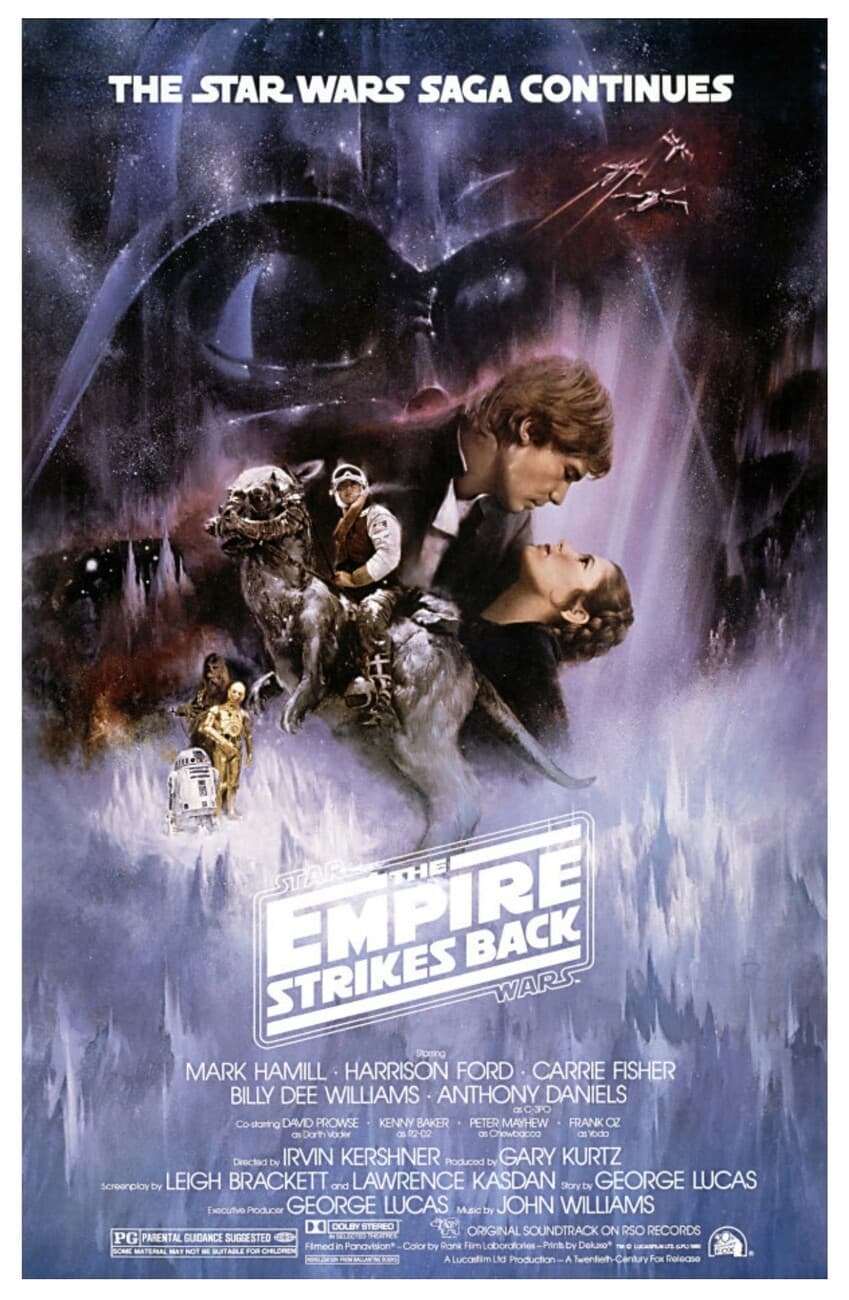
The setup
The Empire Strikes Back takes the original’s playground rowdiness and turns it into a proper lesson. Irvin Kershner’s middle chapter splits the cast, raises the stakes and hands Luke Skywalker the kind of apprenticeship that leaves him changed — not just cocky. It’s still worth revisiting for how it makes growing up feel like something dangerous and inevitable.
THE MOVIE
Luke Skywalker is still the reason this movie works
This isn’t the same boy from the 1977 picture. From the moment the Rebels’ Hoth base is found and the evacuation begins, the film signals that the comfortable rules have changed. The early battle does more than provide spectacle: it kicks the story into a tougher register.
After Hoth the company fractures. Some characters run and hide; others are pursued. That split — Luke heading off to train with a reclusive Jedi master while his friends run from Imperial forces — gives the picture the tug-of-war between interior growth and external danger that defines the whole film.
It helps that Luke is played by Mark Hamill and that Irvin Kershner was in the director’s chair. The movie trusts the idea of a younger hero stepping into a harsher phase of training and self-discovery, and it builds its drama around that shift rather than another round of easy victories.
THE SETUP
The idea that sets Star Wars: Episode V – The Empire Strikes Back in motion
At its simplest the film does two things at once: it scatters the heroes and it puts a single, focused hunt on their trail. The Rebel base’s discovery on Hoth forces an evacuation that sends people in different directions, which keeps the narrative taut and restless.
That fragmentation is clever storytelling: it lets the movie run parallel lines — a solitary apprenticeship for Luke and a galaxy-wide cat-and-mouse for Han, Leia and the others — without turning either into filler.
Looming over both strands is Darth Vader’s pursuit of Luke. His hunt supplies the Imperial pressure that turns routine chases into set-piece confrontations, and it gives the drama a personal edge.
Behind those choices are familiar collaborators: the screenplay credits Leigh Brackett and Lawrence Kasdan for the script, Irvin Kershner directs, and John Williams returns to score the film — all elements that hold the larger ambitions together.
THE CHARACTER
Why Luke Skywalker matters
Luke matters here because he’s been forced into a deeper kind of test. The film deliberately moves him away from squad-based heroics and drops him into a solitary apprenticeship where the real opposition is temptation, doubt and what he does with his fear.
That journey begins when he travels to the swamp planet to train with a famously reclusive Jedi master. The point is less about flashy lessons and more about a younger hero encountering tougher moral and psychological demands.
There’s also personal danger: Darth Vader puts a special focus on learning about Luke, pressing his subordinates to bring the boy within reach. That turn makes Luke’s arc feel urgent — he’s not merely training for ideals; he’s preparing for confrontation.
All of this continues the story begun in 1977 while shifting tone. Luke’s choices in this film are the ones that move him from hopeful apprentice toward the sort of adult decisions the saga keeps testing him with.
THE PERFORMANCE
Why Harrison Ford's performance matters
One concrete critical observation about the film is that Harrison Ford’s interactions with Carrie Fisher feel deeper than before.
Commentators pointed to improved depth and chemistry between Ford and Fisher compared with the earlier film, and that shift matters because it raises the emotional stakes of the scenes in which Han and Leia are separated by danger.
Put simply: when the film asks you to care about their fate, the dialogue and exchanges make that request harder to shrug off.
So even if this chapter spends a lot of time with Luke alone, the Han–Leia strand is carrying weight precisely because writers and performers give it texture.
UNDER THE SURFACE
Star Wars: Episode V – The Empire Strikes Back has more on its mind than the plot suggests
On paper it’s a space-fantasy adventure, but thematically the film keeps returning to apprenticeship. Luke’s formal training reads as a moral as well as a practical education: he’s being taught what heroism will demand of him, and that training is not gentle.
Alongside mentorship sits coming of age. The film treats maturity as a process that bruises as much as it refines — an idea emphasised by Luke’s trials and the choices they force on him.
There’s a quiet but insistent thread about identity and parentage too. The confrontation that pivots the story makes those questions unavoidable: who you are, and where you come from, become core plot business rather than mere backstory.
Finally, pursuit and refuge run through the picture like a motif. From the Rebel evacuation to repeated chases by Imperial forces, the movie stages flight and sanctuary as opposite states that define the characters’ lives in this chapter.
PRACTICAL EFFECTS
The effects work that gives Star Wars: Episode V – The Empire Strikes Back its physical personality
A lot of the film’s physical personality comes from tangible, hands-on techniques. ILM relied on miniatures, matte paintings and articulated models to build the world in ways that feel tactile rather than purely generated.
Animator Phil Tippett and the effects team pushed those tools further by developing an early motion-blur stop-motion approach (commonly associated with the walkers), which helped animated elements move with a weight and believability that previously belonged only to live-action photography.
The picture also mixes full-scale set pieces and puppetry with model photography so actors could react to creatures and environments that read as real in the moment of performance.
Those combined methods give the film a physical texture: creatures and machines occupy space in a way the production clearly thought through, and the results are integral to the movie’s mood.
PURE 80S
Star Wars: Episode V – The Empire Strikes Back could not belong to any other decade
Although it premiered in 1980, Empire sits at the tail end of the blockbuster transition born in the late 1970s. It continues the industrial model — big production, franchise planning and wide merchandising — that the original film helped establish.
The production’s post-production demands and the scale of its effects work also helped cement ILM’s place as a leading visual-effects house as the industry slid into the 1980s, setting a professional standard that the decade would frequently return to.
So while the film is clearly a continuation of the 1977 story it also helped shape how the following decade would treat large-scale effects-driven adventure.
Put another way: Empire is a pivot point. It’s still part of the old blockbuster moment, but it pushes enough forward to shape the business and craft as the 80s proper dawned.
WATCHING IT NOW
What has aged — and what hasn't
The film’s continuity with the 1977 picture remains one of its strengths: it’s a direct narrative continuation, and that connective tissue keeps the stakes immediate for returning viewers.
Luke’s swamp training on Dagobah — a concentrated, almost monastic section of the film — still reads as a clever narrative choice: it’s where the story slows down enough to make the lessons land and where the coming-of-age beats feel earned.
The picture also did a neat job of planting characters who would have a long life beyond this chapter. Lando Calrissian’s expansion here and Boba Fett’s brief on-screen debut are examples of additions that continued to matter in later storytelling.
Those elements — narrative continuation, concentrated apprenticeship scenes and new franchise fixtures — are the aspects that tend to hold up best on a modern rewatch.
THE LEGACY
Why Star Wars: Episode V – The Empire Strikes Back still matters
This film is often treated as the formative middle chapter of the original trilogy — the sequel that showed a franchise could grow more serious without losing its adventurous impulse.
Part of that legacy comes from the technical recognition it received: personnel at Industrial Light & Magic associated with the movie were singled out for their effects work, and the film received special acknowledgement at the time for those achievements.
Beyond effects, the movie’s additions to the cast of characters mattered too. Lando’s larger role and Boba Fett’s first on-screen presence became durable pieces of the saga’s world, carried forward in later media.
Taken together, those things — narrative daring, visible technical craft and new franchise fixtures — explain why the film keeps getting talked about in retrospectives and why it still turns heads.
THE VERDICT
Does Star Wars: Episode V – The Empire Strikes Back still hold up?
Yes. The film’s decision to split its central players — evacuating the Rebels from Hoth, sending Luke off to train while the rest are hunted — gives it narrative range and emotional variety. It’s a middle chapter that actually feels like a middle chapter: harder, grimmer and more curious about cost than simple triumph.
The personal pressure of Darth Vader’s hunt keeps the action focused and dangerous, and the mid-film capture and carbon-freezing sequence give the story a real consequence that isn’t immediately reversible. These are risks the picture is willing to take.
The training beats — Luke learning from a strange mentor who serves as a counterpoint to Imperial force — and the improved depth in the Han–Leia interactions mean the movie balances inward, character-driven moments with outward spectacle. That balance still plays well.
So if you’re wondering whether to watch it now: go for the way it teaches its characters without softening the blows. It’s a film about becoming someone else — and about how the price of that transformation often arrives sooner than you expect.
Share this movie
Keep watching
More movies from the 80s
1986
Jumpin' Jack Flash
Jumpin' Jack Flash: our relationship with technology and freedom, and why this 1986 movie still matters.
Read our take →
1987
RoboCop
A murdered cop rebuilt as a product — RoboCop still asks who gets to sell justice.
Read our take →
1983
Christine
Obsession, adolescence and a car that won't let go.
Read our take →