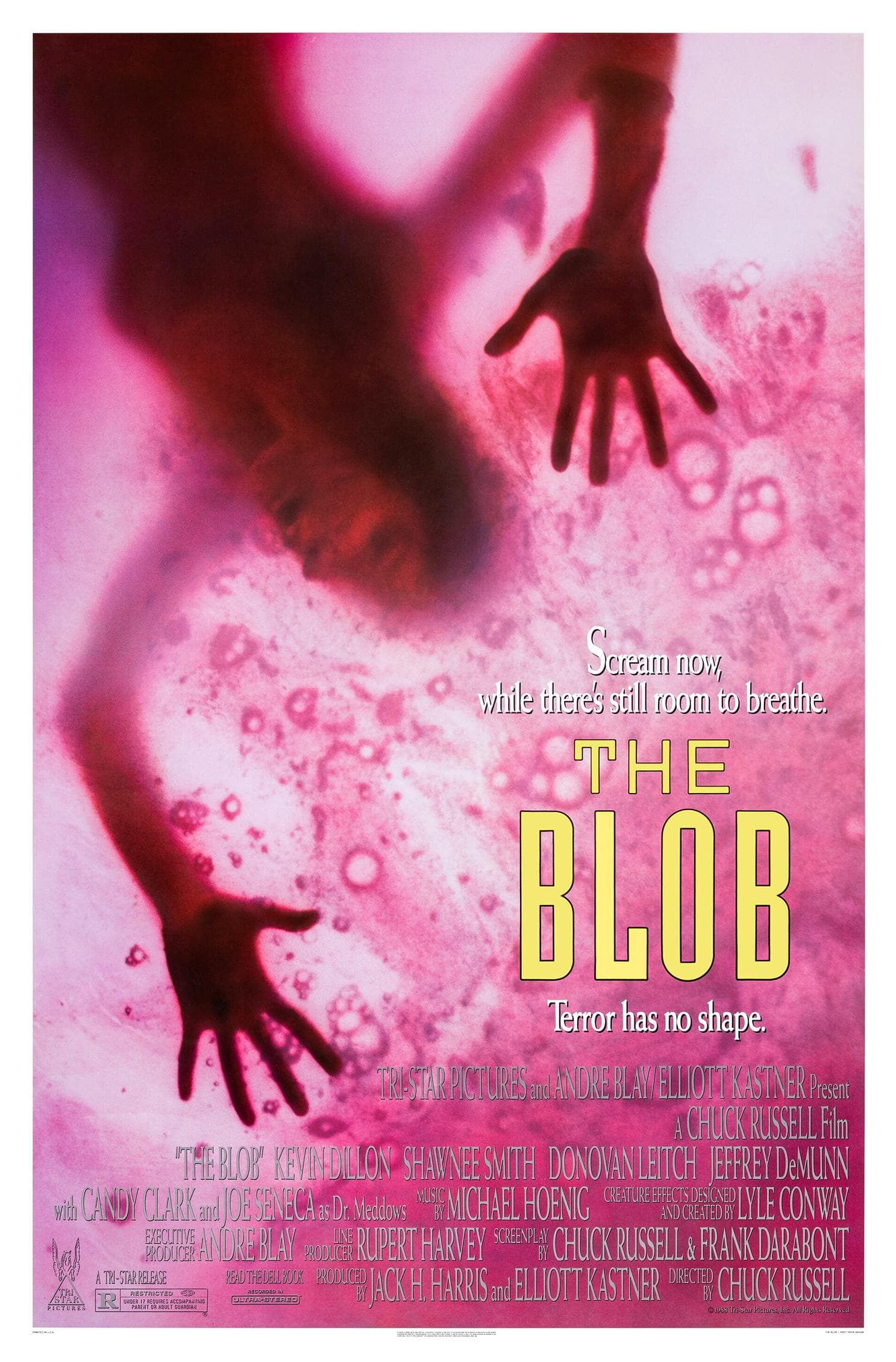
The Blob
Teenagers, a creeping alien goo and a whole town that won't listen — welcome back to The Blob.
The setup
The Blob (1988) is the sort of film that sells itself in two images: a stranger touching a glowing lump from the sky, and that lump deciding to eat the entire town. Chuck Russell’s remake leans into the panic, the practical gore and one particularly restless young hero, and that combination keeps you watching even now.
THE MOVIE
Brian Flagg is still the reason this movie works
You don’t come to The Blob for subtlety. You come for a glowing object from space that turns into an acidic, amoeba-like organism and proceeds to dissolve everything in its path. That single conceit — a thing that simply keeps growing and eating — gives the film its lovely, gruesome logic.
The picture wastes no time: a local eccentric, the 'Can Man', touches the gel and the town’s emergency problem begins. From there it’s teenagers against disbelief, and a spreading contagion that the military would rather control than explain. It’s a tidy set of stakes and it pushes the story forward with merciless simplicity.
Crucially, the movie is carried by a lead who can move: Brian Flagg, the rebellious, motorcycle-riding outsider at the heart of the action. Chuck Russell directs a 94-minute, effects-forward horror ride where mobility, daring and the refusal to wait around are the traits the plot rewards.
THE SETUP
The idea that sets The Blob in motion
At its best The Blob is economical: an alien gel that eats people, a group of teens who see what’s happening, and a town that doesn’t want to believe them. The creature’s behaviour — the way it oozes through vents and drains, eats through flesh and metal, and is slowed by cold — creates a reliable pattern of containment, escape and panic.
That pattern is useful because it gives the filmmakers a series of escalating set-pieces to play with: the blob forces characters into tight spaces, it turns everyday infrastructure into danger, and the temporary reprieve that cold provides becomes a recurring tactical beat.
Russell’s rewrite anchors the organism to a military biological experiment. Making the blob a failed weapon rather than a cosmic mystery shifts the movie’s mood: it becomes less about alien menace and more about human-made catastrophe and the messy consequences of that secrecy.
Framing the story around teenagers trying to warn their town keeps the film brisk. The setup gives you people who can run, shout and act without waiting for grown-ups to figure everything out — which, in a movie about a spreading goo, is exactly what you want.
THE CHARACTER
Why Brian Flagg matters
Brian Flagg is the film’s engine. He’s defined in the material as a rebellious outsider on a motorcycle, which matters because the plot rewards someone who can get around fast and doesn’t wait for permission.
That mobility is more than a costume choice; it’s plot currency. Brian’s ability to move — to chase leads, cut through town, and push the action — keeps the film from stalling in exposition. When the adults hesitate, Brian does something, and the story follows.
The movie’s choice to centre a daring teen rather than a cautious adult shifts its tone toward urgency and teenage resourcefulness. It’s the kind of storytelling shorthand that makes the chaotic parts of The Blob feel immediate rather than merely noisy.
So when people remember the film, it’s often because it gives you a protagonist who behaves like the situation demands: not with patience, but with motion.
UNDER THE SURFACE
The Blob has more on its mind than the plot suggests
Beneath the goo and the screams the film hangs on a handful of ideas that pull it away from pure creature-show territory. First: contagion. The blob behaves like a biological threat, spreading through the town and forcing people into quarantine-style scenarios.
Second: mistrust of authority. The organism is tied to a military experiment, and the film places the arrival of soldiers and suited scientists in tension with civilian life. There’s a clear seam of secrecy and control — the people meant to manage the crisis are sometimes the ones who make it worse.
Third: small-town panic and the teen-versus-adult dynamic. The story repeatedly sets up young characters who are dismissed by older officials until events force those officials to take notice. That angle keeps the film feeling immediate and, at moments, exasperatingly believable.
And finally, it’s worth mentioning that this is a movie that loves making things with its hands. The spectacle — the practical-effects horror — isn’t just window-dressing. It’s how the film makes the threat feel real and unignorable.
PRACTICAL EFFECTS
The effects work that gives The Blob its physical personality
If the blob feels tactile — slime you could imagine scooping off the pavement — that’s because the production built it that way. Creature design and full-scale effects were supervised by Lyle Conway, with Tony Gardner handling special makeup and animatronics work.
The movie didn’t rely solely on one trick. There was a dedicated workshop for prosthetics and physical blob materials — the sort of in-house effects shop that turns conceptual horror into touchable, often grotesque reality.
Miniatures and optical composites also play a part. Specialist vendors were brought in for miniature shots and post-production composites, with Greg Jein credited for model work, which helps sell the wider set-pieces when a practical creature needs to interact with a larger environment.
Put simply: a lot of the film’s personality comes from folks making odd, gooey things and finding ways to film them so the audience believes they’re alive. That commitment matters more than a single gag; it’s the difference between a joke and a threat.
PURE 80S
The Blob could not belong to any other decade
The Blob arrives squarely in a late-1980s pattern: revisiting 1950s sci-fi subjects with bigger budgets and more explicit effects. Russell’s remake sits alongside other decade projects that took old paranoia and gave it a modern, bloodier spin.
That approach wasn’t accidental. The production was backed and marketed as a mid-budget genre picture with a respectable effects budget — the kind of studio willingness that made summer releases like this possible in the late '80s.
So the film’s combination of remake instincts and practical-showmanship is very much a child of its time: a studio-era effort to turn a cult concept into something that could play to mainstream horror audiences.
WATCHING IT NOW
What has aged — and what hasn't
The thing that keeps The Blob watchable today is the physicality of the threat. Retrospectives and home-video coverage repeatedly point to the creature and makeup work as the film’s most durable element — the part that still thrills or disgusts on first viewing.
The movie’s choice to make the blob a military-linked experiment also helps it age better than a purely cosmic menace. The idea of a human-invented contagion taps into anxieties that haven’t gone away, which keeps the film from feeling like a period oddity.
The teen-versus-adult dynamic likewise survives time. Stories about young people being ignored until catastrophe lands are evergreen; here, that tension keeps scenes sharp because the stakes are personal and local, not abstract.
What hasn’t aged as cleanly is the film’s original box-office reception: it underperformed in theatres, which is a reminder that taste and timing matter. But the movie’s afterlife — reissues and retrospective interest — shows that the material found a better fit on home video and in cult circles.
THE LEGACY
Why The Blob still matters
The 1988 Blob matters because it is the obvious, high-profile remake of its 1958 predecessor. Film literature and criticism regularly treat it as the principal studio reworking of that earlier film, which keeps it in the conversation whenever the original is discussed.
It also survives through the home-video ecosystem. Multiple reissues, including a 4K UHD collector's treatment, have given the movie fresh attention and kept it circulating among new viewers and collectors.
Finally, while it did not set the box office alight, a persistent fan and cult audience has grown around it via festival screenings and home releases. The movie’s afterlife is not the same as mainstream success, but it’s a stable kind of remembrance: specific, devoted and focused on the film’s pleasures.
THE VERDICT
Does The Blob still hold up?
Yes — but with a clear rider. If you want slick modern scares or subtle psychological horror, this isn’t your film. If you want a physical, hands-on creature, a compact 94-minute pace and a story about kids who refuse to be ignored, The Blob still delivers.
The picture’s core mechanics — an acidic, amoeba-like organism tied to a military experiment that moves through drains and is briefly slowed by cold — remain straightforward and effective for what the movie aims to do. Those recurring containment-and-escape sequences make for reliable, escalating set-pieces.
Contemporary notices singled out the teenage leads as the story’s emotional anchors, and that matters here: Meg Penny and Brian Flagg are the viewer’s route into the panic. The film stages the town’s distrust, the military’s arrival and the escalating quarantine in a way that foregrounds those young perspectives.
So watch it for the blob itself and for the energy of a movie that doesn’t let its adults solve everything for it. It’s a remake that remembers why the original scared people — and then decides to get messier about it.
Share this movie
Keep watching
More movies from the 80s
1986
Jumpin' Jack Flash
Jumpin' Jack Flash: our relationship with technology and freedom, and why this 1986 movie still matters.
Read our take →
1987
RoboCop
A murdered cop rebuilt as a product — RoboCop still asks who gets to sell justice.
Read our take →
1983
Christine
Obsession, adolescence and a car that won't let go.
Read our take →