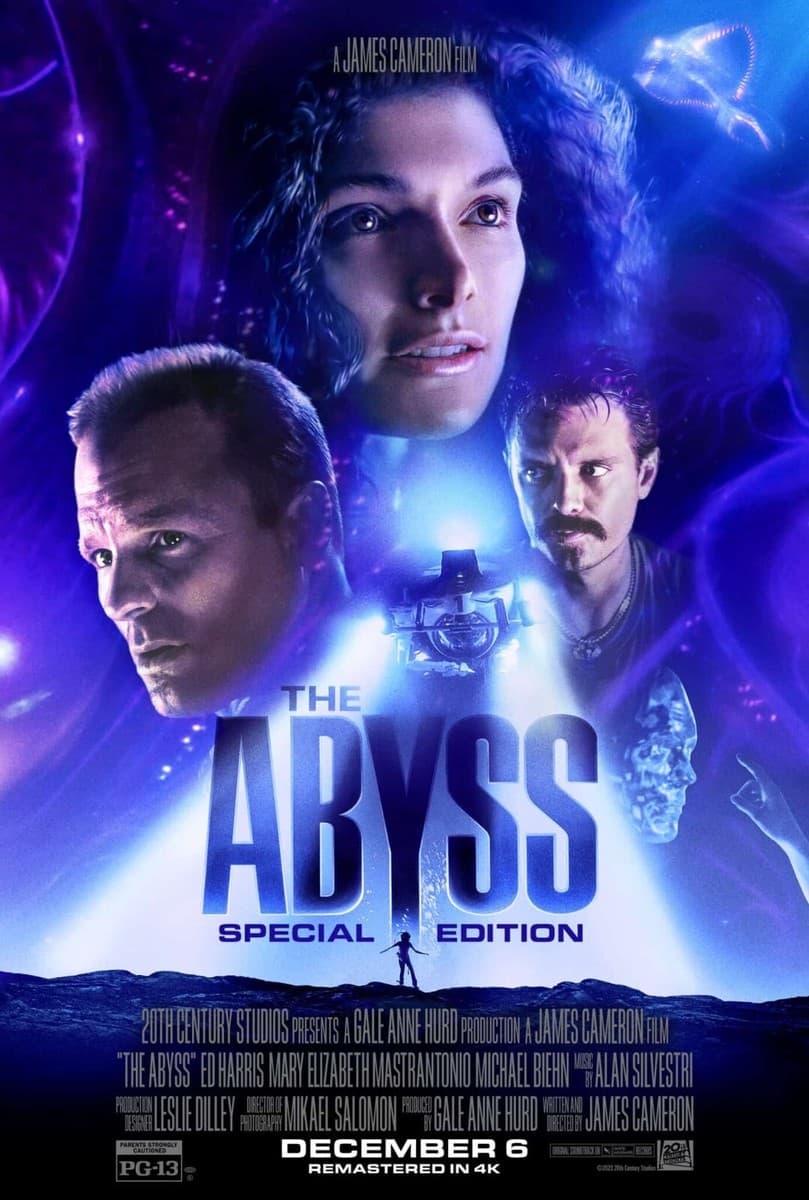
The setup
The Abyss feels, even now, like a movie built around a single dependable human decision: keep the rig together long enough to find out what’s down there. James Cameron stages the technical spectacle, but it’s Virgil 'Bud' Brigman and the people he’s responsible for who make the film worth revisiting.
THE MOVIE
Virgil 'Bud' Brigman is still the reason this movie works
Say The Abyss to someone who remembers it and they’ll usually picture one of two things: a machine-made water trick or a claustrophobic rig under the sea. Both are accurate. But the film’s heartbeat is simpler — a pragmatic foreman who knows how to steady frightened people when everything around them is failing.
The plot sets that practical test in motion: the USS Montana, a nuclear-armed submarine, collides with something unknown and sinks near the Cayman Trough, and the Deepcore crew are pulled into the recovery operation. That setup gives the movie a neat spine — rescue work, strangers shoved together, and pressure that is both physical and psychological.
James Cameron directs a 140-minute ride that places Bud Brigman — played by Ed Harris — at the centre. His calm leadership is the kind that lets the film swing between jaw-dropping effects and very human choices without collapsing under the weight of either.
THE SETUP
The idea that sets The Abyss in motion
At its most straightforward, The Abyss is a rescue-and-recovery story forced into strange territory. Bud and the Deepcore crew must cooperate with a Navy SEAL team led by Lt. Coffey — which produces cooperation and, crucially, conflict.
Cameron peppers the premise with believable technical detail to keep the danger feeling immediate. One recurring element is a fluid-breathing system — an oxygenated fluorocarbon that is demonstrated on small animals and discussed as deep-diving technology. It’s a neat way to make the underwater stakes feel tangible rather than purely cinematic.
That technical plausibility matters because the human stakes escalate: Lt. Coffey’s deteriorating mental state — shown as symptoms of High Pressure Nervous Syndrome — pushes him toward a catastrophic decision. When Coffey chooses to arm a recovered nuclear warhead aboard the rig, the movie shifts into a countdown-style crisis.
So the setup does two things at once: it makes you trust the film’s deep-sea mechanics, and it raises a clear human threat that forces the crew into hard choices.
THE PERFORMANCE
Why Ed Harris's performance matters
Contemporary reviewers singled out Ed Harris and Mary Elizabeth Mastrantonio as steadying presences — performances that helped the film keep its emotional centre while production threw almost everything at them.
That’s useful information. The Abyss asks you to care about a group of technicians and soldiers while also accepting some fairly miraculous on-screen events. If the human relationships felt flimsy, none of the spectacle would land. The reviews’ note that Harris and Mastrantonio sustained the film’s emotional core explains why audiences could go along for the ride.
Put simply: the movie needs actors who can make ordinary human decisions seem important, and the contemporary response suggests those two did exactly that.
UNDER THE SURFACE
The Abyss has more on its mind than the plot suggests
Beneath the rescue-plot machinery there are a handful of ideas the film keeps returning to. First is first-contact and ethical judgement: the encounters with a superior, non-human intelligence are framed not as an invasion but as a test, a question of whether humanity deserves salvation.
Second is the blunt Cold War logic of nuclear threat and escalation. A sunk submarine full of missiles, a recovered warhead and panicked human choices make the possibility of all-out catastrophe feel uncomfortably close.
Third, the film is very interested in how the body and the mind fail under pressure. The underwater environment is more than a backdrop — it’s a stressor that reveals human fallibility, as characters suffer physiological and psychological breakdowns.
Finally, the story is braided with reconciliation and sacrifice. Personal history between characters and the choices they make under extreme conditions turn the spectacle into something quietly moral: the film asks what people will give up to stop a bad decision from becoming disaster.
THE FILMMAKING
How The Abyss was put together
A striking practical choice from the production was the custom diving helmets. They weren’t props — they included aircraft-quality microphones and an audio system that let James Cameron talk to actors during underwater takes.
That detail explains a lot of the film’s tone. Recording the actors and keeping a director’s voice in their ears while they performed in a tank turns what could have been dislocated, mechanical scenes into connected moments. The technology helped the underwater performances feel continuous and directed rather than stitched together.
It’s an example of the film’s approach: technical solutions aimed at preserving the human element in extreme conditions.
PRACTICAL EFFECTS
The effects work that gives The Abyss its physical personality
The Abyss mixes hands-on model work with early computer graphics. Dream Quest Images produced around eighty effects shots and built a filmed, seventy-foot miniature of the USS Montana using an overhead motion-control system.
Industrial Light & Magic supplied the film’s most talked-about digital work — the computer-graphics 'pseudopod' sequence — while the production also relied on practical underwater photography, blue-screen compositing and remotely operated vehicles to make its world feel physical.
Even small practical touches appear in the story: the film puts a fluid-breathing sequence on-screen, using an oxygenated fluorocarbon emulsion with tested procedures and trained divers. That blend of practical technique and cutting-edge CGI gives the movie a distinct material presence.
PURE 80S
The Abyss could not belong to any other decade
The Abyss arrived at the tail end of the 1980s, when studios were willing to bankroll effects-heavy projects that demanded long post-production schedules and lots of miniature and optical work.
Its extended visual-effects pipeline and the production pressures that came with making large-scale practical and digital effects are very much of that moment. The film’s mix of ambitious miniatures and nascent CGI reflects late‑80s workflows rather than any later VFX shortcut.
In short: The Abyss is a creature of its time because it uses the era’s available technologies to chase a single cinematic ambition — make the ocean feel like an alien environment while keeping human choices front and centre.
THE LEGACY
Why The Abyss still matters
The Abyss won the Academy Award for Best Visual Effects, a concrete recognition of how its practical and digital work were combined to produce something technically notable.
The film’s computer-graphics water sequence — the ‘pseudopod’ work — is recorded in VFX histories and vendor records as an early example of CGI integrated with practical effects, and ILM’s role is central to that story.
There’s also an extended afterlife in a Special Edition released a few years later; that longer cut restores about half an hour of footage which clarifies more of the aliens’ mission and gives viewers a different, more explanatory experience of the film.
THE VERDICT
Does The Abyss still hold up?
Yes — with a health warning. The Abyss works because it ties big-picture spectacle to recognisable human decisions. The sinking of the USS Montana and the presence of a nuclear warhead create stakes you can actually understand, and the story keeps returning to the question of whether people under pressure will choose prudence or panic.
Ed Harris’s Bud is central to that bargain. As the rig foreman whose practical experience keeps the operation functioning, he gives the film someone to trust when the environment is trying to make everyone irrational. Mary Elizabeth Mastrantonio’s Lindsey, as the platform’s designer and Bud’s estranged wife, complicates things — technical authority meets messy personal history — which makes the choices they must take together feel earned.
The film’s mix of believable technical detail (the fluid‑breathing sequences, the Deepcore rig work and the filmed underwater photography) with a clear human countdown — Lt. Coffey’s decline and his decision to arm a warhead — keeps the film tense. Add the period’s ambitious practical and early‑CGI effects, and you have a movie that still surprises visually and still asks a provable moral question: how should humanity act when faced with judgement?
So should you watch it now? If you want a character-led science-fiction film that blends technical imagination with very human pressure-cooker drama, The Abyss still delivers. It isn’t just a curiosity for VFX historians; it’s a film that uses spectacle to test people, and that test still matters.
Share this movie
Keep watching
More movies from the 80s

1986
Jumpin' Jack Flash
Jumpin' Jack Flash: our relationship with technology and freedom, and why this 1986 movie still matters.
Read our take →

1987
RoboCop
A murdered cop rebuilt as a product — RoboCop still asks who gets to sell justice.
Read our take →

1983
Christine
Obsession, adolescence and a car that won't let go.
Read our take →