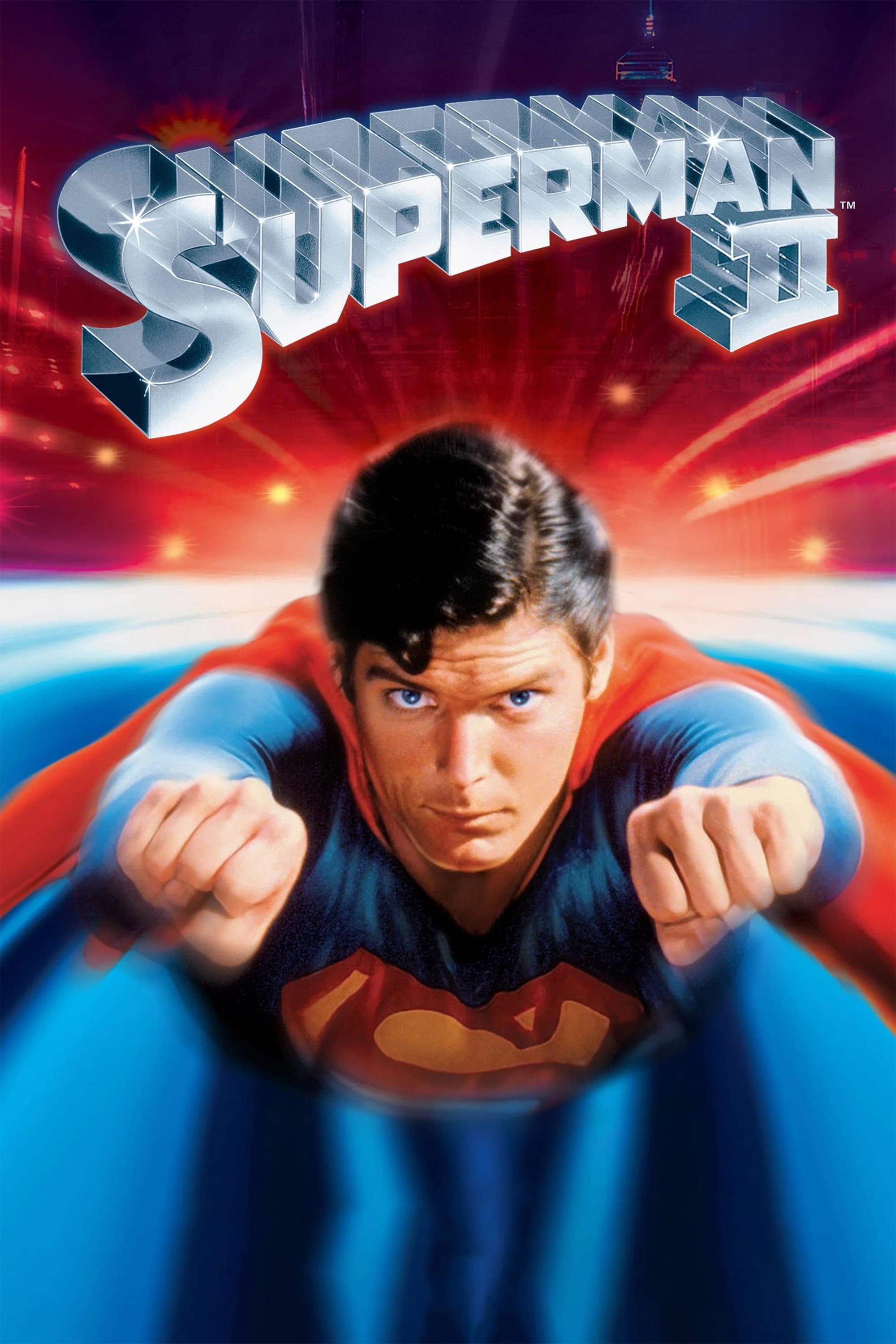
Superman II
Love, duty and a handful of Kryptonians — Superman II asks what a hero gives up to be human.
The setup
Superman II is the rare superhero sequel that treats its big battles as the backdrop for a smaller, stubbornly human question: what happens when a man with everything chooses to live without it? Between world-shaking showdowns and a very intimate trip to the Fortress of Solitude, the film pins its emotional stakes on Clark Kent’s choice — and that’s still worth revisiting.
THE MOVIE
Clark Kent / Superman is still the reason this movie works
If you remember one thing from Superman II, it’s probably the minute the film turns a textbook superhero rescue into the story’s fuse: Superman diverts a nuclear missile into space, and the blast that follows shreds an otherworldly prison to free three Kryptonians. Suddenly the stakes are both global and personal.
On one level the movie is a grand, old-fashioned tussle — three Kryptonians arrive, take on the sun’s power and decide to lord it over Earth. That external threat gives the film its action spine, but it’s the quieter decision at its centre that keeps pulling you back: Clark chooses love over power and voluntarily relinquishes his abilities to try a normal life with Lois Lane.
That split — public saviour versus private man — is the film’s magnetic centre. It’s why the director credit line matters (Richard Lester is the theatrical director, though Richard Donner shot substantial earlier material) and why the film still feels like more than set-pieces; it’s a big, noisy movie that never stops being about one person’s choice.
THE SETUP
The idea that sets Superman II in motion
Superman II picks up where the first film left its characters — same world, same people, and a reasonably straightforward escalation: a trio of Kryptonians freed from the Phantom Zone gain powers beneath Earth’s yellow sun and decide to try ruling the planet.
That gives the piece the obvious popcorn appeal: invincible bad guys against an invincible hero. It also does the sensible thing for a sequel and turns the threat into a test. The Kryptonians’ appetite for control becomes a counterpoint to Superman’s sense of responsibility.
Instead of spinning a completely new premise, the film pivots on a single dramatic gamble: Clark Kent chooses love. He deliberately gives up his powers to pursue a life with Lois Lane, and that voluntary loss reshuffles every card — emotional stakes suddenly matter because the hero can be hurt.
All of this sits inside a production that had its own complications: some sequences keep footage shot during the original production, while others were reshot later. That patchwork doesn’t erase the setup — it just means the movie stitches together material photographed at different times to tell one continuing story.
THE CHARACTER
Why Clark Kent / Superman matters
The movie makes Clark Kent’s interior life the full narrative engine. The plot’s big moments — the alien invasion, the city battles — are energetic distractions until you remember the film is really watching a man decide who he wants to be.
That decision to walk away from power is not a cheap costume swap. It forces Clark to face identity without the cape and to carry responsibility when it can no longer be solved by flight and strength. The dramatic tension becomes 'who is he when the suit is gone?' rather than 'how will he punch the bad guy?'
Because Superman II continues directly from the 1978 film, the audience already knows the shape of his life. The sequel’s cleverness is that it doesn’t simply reset who he is; it pushes that established life into one of the oldest but most potent conflicts: love versus duty.
So the character matters because the movie trusts him with contradictions. He is the bridge between the film’s spectacle and its quieter, human cost.
UNDER THE SURFACE
Superman II has more on its mind than the plot suggests
At first glance the movie is a tussle over brute force — Kryptonians who want to rule versus a Kryptonian who refuses. But under the punches you can see three repeated ideas: sacrifice, identity and power versus authority.
The sacrifice thread is straightforward and stubborn: Superman gives up everything for the possibility of ordinary happiness. That trade-off is what makes later conflicts carry weight; the danger isn’t only to the city streets, it’s to the life he’s chosen.
Identity and duality are threaded throughout. The film asks whether Kent can simply be a man, and whether Superman’s responsibilities shape who he is or whether he can set them aside and still be himself.
Finally, the showdown with General Zod reframes brute strength as a political project. Zod’s aim to impose order rather than coexistence makes the conflict ideological as much as physical — a showdown between different ideas about power.
THE FILMMAKING
How Superman II was put together
There’s a curious production fingerprint on Superman II: photography for the project was split across different crews and hands. Geoffrey Unsworth shot portions of the production but died before the film’s completion, and Robert Paynter was later brought in to shoot additional material.
That change in camerawork and the broader shift during production helps explain why the finished picture sometimes feels stitched from two different shoots. It’s not a defect so much as a visible seam — an honest result of a complicated shoot.
The director credit tells a similar story. Richard Lester delivered the theatrical cut, but substantial material was shot earlier under the original director. The film’s identity comes as much from how those pieces are assembled as from any single stylistic choice.
Put simply: Superman II is a patchwork in the best possible sense — different hands, same story — and the filmmaking is noticeable because the film makes its narrative choices do the heavy lifting more than any single technical flourish.
PRACTICAL EFFECTS
The effects work that gives Superman II its physical personality
Superman II depends on practical ingenuity to sell the impossible. For flight the production used the Zoptic front-projection system — a staged approach that helped the filmmakers place actors into aerial movement without modern digital trickery.
The film’s flying and city-battle moments were achieved through a mixture of techniques: front projection, staged flying rigs and mechanical cape solutions all combined to create the sensation of Superman in the air.
Credit for marrying those techniques goes to the special-effects teams; Colin Chilvers is named as special-effects supervisor and the production relied on multiple practical groups to carry the heavier sequences.
The result is a tactile, mechanical personality to the effects. They’re not invisible, but they’re purposeful and rooted in old-school problem solving — the visual equivalent of the film’s broader theme of physical choices over easy solutions.
PURE 80S
Superman II could not belong to any other decade
Arriving at the very start of the 1980s, Superman II sits inside a moment when studios were embracing large-scale, effects-driven franchise filmmaking. It’s very much a product of a blockbuster era that favoured spectacle and serial storytelling.
The film’s production and release pattern reflect that industrial logic: it continued the narrative from the 1978 film and formed part of a planned early-80s run — with Richard Lester returning to the franchise for the next instalment.
Its release strategy — first in parts of Europe and Australia in December 1980, followed by a wider U.S. opening the following summer — also points to the film’s positioning as a major-studio tentpole rather than a standalone curiosity.
In short, Superman II feels of its time because it was born from the decade’s appetite for big, sequenced storytelling and practical spectacle rather than any throwback affectation.
THE LEGACY
Why Superman II still matters
Part of the film’s afterlife comes from its complicated production: roughly thirty percent of the theatrical version uses footage shot by the original director, and that mismatch of material fuelled long-standing curiosity about what the film might have been.
That curiosity eventually produced a reconstructed version in 2006, which gathered the earlier director’s material into an alternate cut. The existence of that reassembly underlines how much fans and filmmakers have debated the film’s shape.
On release the theatrical cut also earned strong notices from major critics — it received notable contemporary praise, including a four-star review from Roger Ebert — and was recognised at the time as an early example of large-scale, comic-book-derived blockbuster filmmaking.
Beyond any single credit or controversy, Superman II remains a remembered chapter because it doubled down on character questions inside a blockbuster frame: it offered spectacle that insisted on moral complication.
THE VERDICT
Does Superman II still hold up?
Yes — if you’re watching for a big-hearted superhero film that dares to make its central hero choose smallness for a time. The movie balances the public spectacle of three Kryptonians trying to conquer Earth with a personal reckoning: Superman deliberately gives up his powers to be with Lois, and that gamble makes the film’s climax matter in a way pure action rarely can.
The film is also oddly interesting as an object: it stitches together material shot at different times and by different teams, which means the theatrical cut is a composite. That doesn’t ruin the story; it simply makes the finished film an assembly of choices, some visible in the seams.
There’s also a useful tonal counterpoint in the villains. General Zod is not just a physical threat but an ideological foil — his aim to rule rather than coexist gives the film an argument about power that sits beside the personal sacrifice at the centre.
So should you watch it today? If you like your blockbusters to come with a conscience and a question, then absolutely. And if you’re drawn to production curiosities or alternate takes, the existence of a later re-cut only deepens the conversation. In short: it still plays because it asks a small, stubborn question inside a very loud movie — what does a man give up to be human?
Share this movie
Keep watching
More movies from the 80s
1986
Jumpin' Jack Flash
Jumpin' Jack Flash: our relationship with technology and freedom, and why this 1986 movie still matters.
Read our take →
1987
RoboCop
A murdered cop rebuilt as a product — RoboCop still asks who gets to sell justice.
Read our take →
1983
Christine
Obsession, adolescence and a car that won't let go.
Read our take →