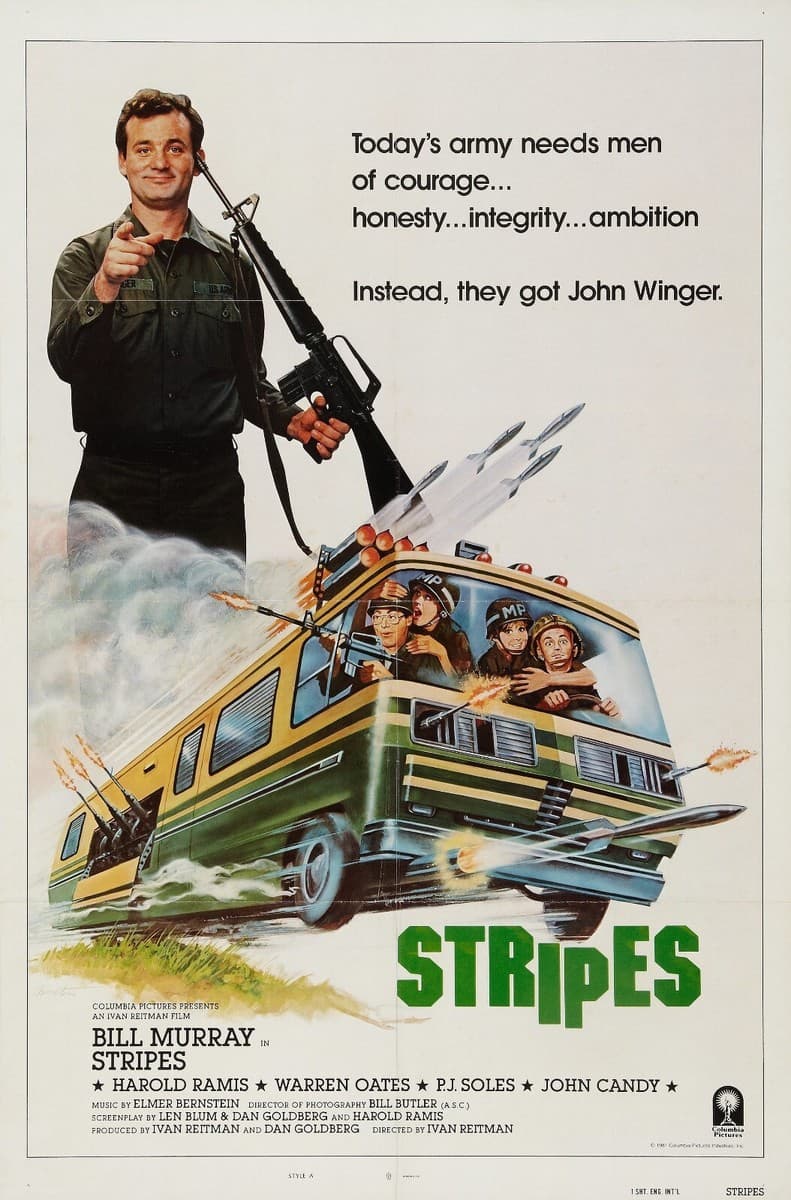
Stripes
A ragged platoon, one endlessly inventive idiot, and the sort of male friendship that still makes you grin.
The setup
Stripes is the sort of film you remember by a single figure: John Winger, a man who loses everything in a day and signs up for the army less because he wants to fight and more because he needs to be someone. Directed by Ivan Reitman and released in 1981, it turns that simple, daft choice into a buddy-fuelled comedy about misfits who end up depending on one another. If you're wondering why people still bring it up, it's less about spectacle and more about the particular shape of the friendships at its centre.
THE MOVIE
John Winger is still the reason this movie works
Stripes hooks you with a very plain, very human move: John Winger has a terrible day — the job, the car, the flat and the girlfriend all go in one go — and he reacts by joining the army. That single, stubborn choice is where the film’s personality begins.
He doesn’t go alone. John talkes Russell Ziskey into enlisting with him, and the pair tumble into basic training as two hopeless recruits among a ragged platoon. The movie’s plot is less a chain of set pieces than a string of occasions where Winger’s need for direction — and the misfits’ willingness to back him — produce chaos and, eventually, camaraderie.
Ivan Reitman directs with a light touch, and the film makes room for a large ensemble (including Sgt. Hulka, Stella and a memorable supporting cast) across roughly 106 minutes of action-comedy business. That blend — a central, restless lead and a tribe of eccentric teammates — is why Stripes still invites revisits.
THE SETUP
The idea that sets Stripes in motion
At its simplest, the film starts when John Winger, after one ruinous day, signs up for the United States Army. It’s a practical, ridiculous escape route that immediately makes the story about more than military life — it’s about people trying to find themselves.
From there the focus widens to the platoon: a motley crew of misfits who face the usual military hurdles — a by-the-book commanding officer and a hard-nosed drill sergeant in Sgt. Hulka — and the constant threat of being shown up by the system they’ve entered.
Once the recruits graduate the plot shifts to a new setup: they’re sent to test the EM-50, a prototype urban-assault vehicle. That assignment tumbles into an unauthorised off‑road trip that strands some men behind enemy lines and forces a small-unit rescue.
The film is clever about using training and parade sequences not merely as spectacle but as storytelling tools: the routines and rubrics of military life become the mechanics that let the platoon, by improvisation and initiative, transform from a random bunch into a functioning unit.
THE CHARACTER
Why John Winger matters
John Winger, played by Bill Murray, is the movie’s engine. He’s not heroic in any classical sense; he’s a man flung into action by embarrassment and a craving for validation after losing the things that were propping him up.
That makes him interesting because his choices are personal rather than patriotic: enlisting is less about national service and more about not having to be anonymous. His restlessness puts him constantly at odds with authority, and that tension is funny and narratively useful.
But Winger matters for another, quieter reason: he’s the social catalyst. Friendship and male camaraderie emerge around him — his schemes, his half-baked confidence and the way the others reluctantly rally — and the film’s warmth comes from watching that group cohere.
Contemporary critics also noticed the dynamic he forms with his screen partner, which helped cement the film’s comic identity: Winger only works because he’s not alone on the ride.
THE PERFORMANCE
Why Bill Murray's performance matters
Contemporary reviews singled out the pairing of Bill Murray and Harold Ramis as central to the film’s success. That’s important evidence: critics at the time didn’t treat Winger as a solo novelty but as part of a comic partnership that kept the film grounded.
Put simply, Murray was never just playing jokes; his role works because the material around him — especially the give-and-take with his co-star — supported and amplified those moments.
So when people point to Stripes as one of Murray’s key early comedies, they’re usually thinking of how his chemistry with the ensemble shaped the film’s tone rather than a single standout scene.
UNDER THE SURFACE
Stripes has more on its mind than the plot suggests
On the surface it’s a buddy comedy about a collection of losers and the trouble they get into. Scratch that surface and three clearer ideas emerge: friendship and camaraderie; authority versus irreverence; and the rite-of-passage shape of military life as a civilian coming-of-age.
Those themes are tidy and serviceable. The film isn’t heavy-handed about saying anything profound; instead it stages situations where the need to belong, the impulse to thumb one’s nose at rules, and the pressure to prove oneself all play out in jokes and half-serious gestures.
The military setting gives those themes a structure: the rules and rituals supply obstacles that force improvisation, and that pressure is where friendships are tested and, crucially, formed.
Ultimately the movie is a story of misfits becoming a team — not because they’re suddenly model soldiers, but because they learn to depend on one another in the specific chaos the film creates.
PRACTICAL EFFECTS
The effects work that gives Stripes its physical personality
Part of the film’s physical character comes from its tangible props: the production constructed the EM-50, an on-screen urban-assault vehicle that the plot revolves around in later action sequences.
That wasn’t a cheap bit of dressing; the EM-50 was central to scenes that demanded a believable, physical presence rather than a stand-in. The production also used real military vehicles where needed, which carried both logistical weight and a cost implication for the film.
In short, the movie leans on built things — hardware and authentic vehicles — to make its set pieces feel grounded rather than purely cartoonish.
Those choices shape how sequences read on-screen because the action plays off objects the actors can really interact with.
PURE 80S
Stripes could not belong to any other decade
Released in the summer of 1981, Stripes arrived at the tail end of a comedy wave that loved dropping anti‑establishment young protagonists into rigid institutions — think summer camps, colleges or, in this case, the military.
That placement matters because the film taps into an era’s appetite for anarchic ensembles who would rather subvert rules than revere them. Contemporary publicity and later commentary often set Stripes alongside those similar pictures.
There’s also an interesting, practical echo of the time: contemporary publicity linked the film to a measurable uptick in Army recruiting interest in 1981, suggesting the movie’s portrayal of enlistment struck a note beyond box-office receipts.
Speaking of which, studio reporting from the film’s run records strong commercial returns during that summer — evidence the film wasn’t just of-the-moment but commercially significant for its season.
WATCHING IT NOW
What has aged — and what hasn't
One of the things that survives repeat viewings is the movie’s core: the friendships and male camaraderie formed under pressure. Those beats are straightforward and human enough to still read well.
If you’re watching for more than the jokes, that sense of a ragged group learning to function as a unit is the piece that keeps its emotional currency decades on.
There’s also a technical footnote for completists: later home releases included an extended cut with roughly eighteen additional minutes, so viewers curious about a little more running time have an option that expands the film slightly.
But the simplest takeaway: the heart — the way the platoon stitches itself together — remains the element most likely to land for a modern audience.
THE LEGACY
Why Stripes still matters
For Columbia the film was a clear commercial success in the summer of 1981; studio and trade reporting of the time record it as an important box-office title for that season.
It also occupies a tidy place in comedy history as an early feature that brought Bill Murray and Harold Ramis together under Ivan Reitman’s direction — a pairing that retrospectives return to when discussing early‑1980s American comedy.
The movie’s afterlife includes a slightly longer cut prepared for a 2005 DVD release, which gives fans an expanded version to revisit.
So Stripes matters both for what it did at the box office in its moment and for how it helped establish a comic ensemble chemistry that people like to look back on.
THE VERDICT
Does Stripes still hold up?
Yes — with a couple of caveats. If you come for Bill Murray as John Winger and the way he drags a reluctant Russell Ziskey along with him, you’ll find the film does what it sets out to do: it turns a stupid, personal choice into a string of scenes that forge genuine group bonds.
The plot’s structure — misfits clashing with military discipline, graduating and then being trusted with the EM-50 prototype only to end up in an unauthorised scrape that demands a rescue — keeps the stakes low enough for comedy but high enough to let those friendships matter.
Critics at the time noted the Murray–Ramis pairing as central to the picture’s success, and that comic chemistry still does the heavy lifting. The training and parade beats aren’t just filler: they’re the engine that converts a loose assortment of characters into a functioning unit through improvisation and initiative.
If you like buddy-action comedy with a fondness for irreverence, Stripes remains a very watchable product of 1981 — not a flawless masterpiece, but a film where the charisma of its leads and the shape of its friendships still repay your time.
Share this movie
Keep watching
More movies from the 80s
1986
Jumpin' Jack Flash
Jumpin' Jack Flash: our relationship with technology and freedom, and why this 1986 movie still matters.
Read our take →
1987
RoboCop
A murdered cop rebuilt as a product — RoboCop still asks who gets to sell justice.
Read our take →
1983
Christine
Obsession, adolescence and a car that won't let go.
Read our take →