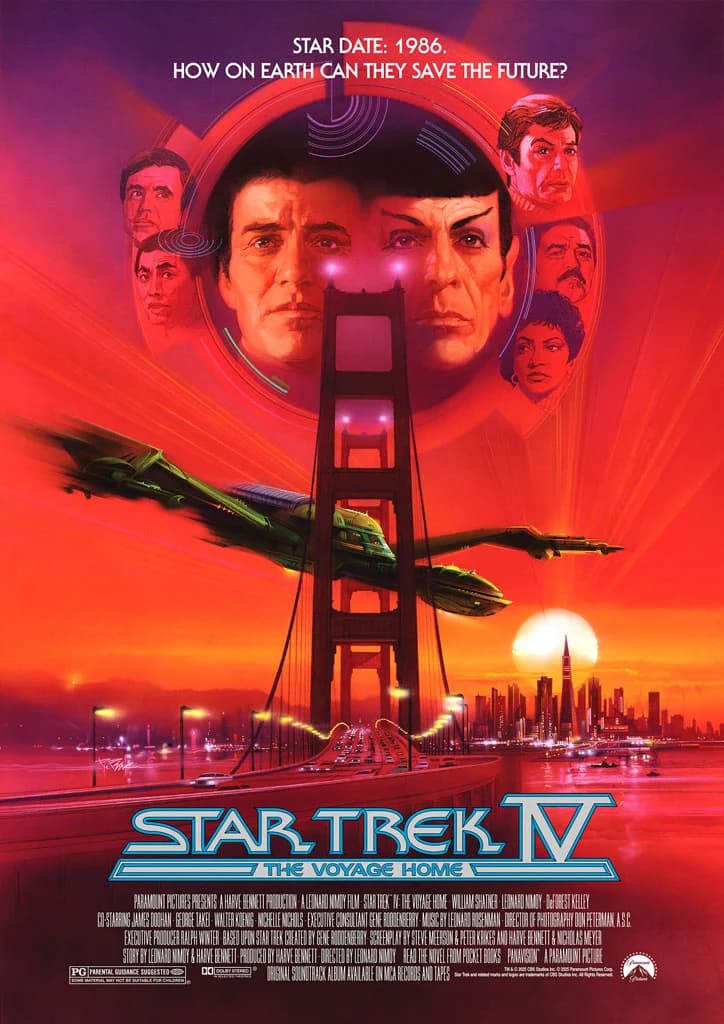
Star Trek IV: The Voyage Home
Humpback whales, a stranded starship crew and Admiral Kirk’s habit of ignoring the rulebook — in other words, proper Star Trek business.
The setup
Star Trek IV: The Voyage Home is the one in the original series of films where the fate of the 23rd century depends on two 20th-century whales and a crew who find themselves very uncomfortable in modern San Francisco. Directed by Leonard Nimoy and fronted by William Shatner as Admiral James T. Kirk, it mixes genuine urgency with a deliberate comic looseness — and it’s the tonal leap that still makes people bring it up.
THE MOVIE
James T. Kirk (Admiral/Captain) is still the reason this movie works
Say the film’s name to anyone who knows the original cast and you’ll likely get a laugh and then a shrug of admiration: a future Earth threatened by a mysterious probe that’s actually singing the language of humpback whales. That premise — an alien signal matched to whale song — is the original bit of cleverness that turns an abstract sci‑fi hazard into something oddly intimate and immediate.
Because live humpback whales no longer exist in the 23rd century, the whole story hinges on a very specific, slightly ridiculous solution: Kirk and his fugitive crew must travel back to 1986 San Francisco to find two real whales who can reply. The time‑travel conceit plants the film squarely in fish‑out‑of‑water territory, and Nimoy leans into that choice.
Put simply: the movie works because William Shatner’s Admiral Kirk leads a mission that treats Earth’s survival as worth breaking the rules for. That decision — loyalty to the crew and planet over bureaucracy — gives every absurd moment a moral spine, and Leonard Nimoy’s direction keeps the film brisk and surprisingly warm across its 119 minutes.
THE SETUP
The idea that sets Star Trek IV: The Voyage Home in motion
The film gives itself two related problems to solve: first, Earth is jeopardised by a probe broadcasting a signal that only humpback whale vocalisations match; second, the crew must face the legal and personal fallout from their recent decisions. Those two threads keep the stakes both planetary and peculiarly human.
Narratively it also sits where it needs to in the series: the movie begins shortly after Star Trek III and completes an arc that started in Star Trek II, so the rescue is sewn onto existing consequences rather than arriving out of nowhere.
On the screenplay front, the film is a group effort. The finished script credits several writers, and Nicholas Meyer’s return to the project during rewrites brought in elements of time‑travel treatment he’d used before, which helps explain why the modern‑day middle act feels both comedic and structured.
Leonard Nimoy’s story credit and direction pull those elements together, steering the film through tonal shifts from urgency to comfortable comedy without losing the sense that something very important is at risk.
THE PERFORMANCE
Why William Shatner's performance matters
We should be careful here: the evidence the film gives us about performances is limited, but telling. The movie’s cast — including Shatner as Admiral Kirk — received attention from genre award bodies the year after release.
Those nominations, which involved both William Shatner and Leonard Nimoy, are a concrete signal that the film’s leading turns were noticed within the community that follows this material closely.
That’s useful because it’s one thing to have a star name on the poster and another to have the screen work recognised. The nominations suggest Shatner’s portrayal did what the story needed: it made Kirk’s reckless loyalty believable enough that audiences would accept law‑bending to save the planet.
UNDER THE SURFACE
Star Trek IV: The Voyage Home has more on its mind than the plot suggests
On its face the film is a rescue story: an alien probe threatens Earth and the crew must find a way to answer it. Underneath, though, several clearer ideas hold it together. Environmentalism is the obvious one — the plot literally makes species preservation the key to survival.
That insistence transforms the probe/whale conceit into a motif about language and connection. The probe is communicating; it’s only human (or cetacean) stubbornness that makes those signals mysterious. So communication across species becomes a theme built into the mechanics of the story.
Another layer is the comedy that comes from temporal displacement. The crew’s 23rd‑century manners in 1986 create a fish‑out‑of‑water energy that lightens the film without erasing the stakes.
Finally, the movie is quietly about loyalty: an ensemble prepared to defy Starfleet authority because they judge the planet’s survival more important than regulations. That tension — loyalty versus institutional rule — gives the comedy some moral heft.
THE FILMMAKING
How Star Trek IV: The Voyage Home was put together
A few production facts tell us where the filmmakers were aiming. The movie picked up industry recognition in technical areas: it received four Academy Award nominations the following year, including nods for cinematography and original score, and it was noted in sound categories as well.
That cluster of nominations is revealing because it suggests the film was doing something technically ambitious beneath the comic surface — especially in sound and image — even while it staged a lighter, more contemporary middle section.
Leonard Nimoy’s dual role as story contributor and director is another stabiliser: having a director who helped shape the story tends to make tonal shifts feel intentional rather than accidental.
Put together, the production choices — from where to shoot to what emotional register to take — are plainly calibrated to make this one of the more approachable entries in the series while still courting serious craft recognition.
PRACTICAL EFFECTS
The effects work that gives Star Trek IV: The Voyage Home its physical personality
Sound plays a peculiar role in this film: the whale vocalisations were taken from real recordings, then edited and altered to construct not only the whales’ songs but the probe’s eerie audio signature.
That approach — using organic recordings as the basis for both natural and alien sound — keeps the film’s weirdness tethered to something recognisably real.
When the story needed close human‑whale interaction, the effects combined limited live footage with life‑size animatronics and smaller motorised puppets. The result is a mixture of real and made that reads, on screen, as practical and tactile.
And the credit goes to the sound team’s craft: Mark Mangini is specifically associated with creating the probe’s audio by treating and distorting organic sources and recorded elements.
PURE 80S
Star Trek IV: The Voyage Home could not belong to any other decade
This film is of its moment because it deliberately drops future starfleet officers into the contemporary 1986 world for a large chunk of the running time. That choice — to stage a comic, on‑location middle act in San Francisco — is a very 1980s production decision: it’s an attempt to make a franchise property more broadly accessible by showing it among the life and city‑streets of the present day.
The movie’s ecological concerns also map neatly onto mid‑1980s discourse. Production notes record that the filmmakers engaged with contemporary environmental thinking — material such as Edward O. Wilson’s Biophilia influenced how the film framed species preservation as a central moral problem.
Those two things — a fish‑out‑of‑water contemporary act and explicit ecological interest — root the film in 1986 in a way that isn’t just fashion or music. The era matters because it shaped the choice to make the crew meet the present in order to save the future.
The industry also recognised the result: the film’s technical and musical nominations the following year underline that this 1986 experiment paid off in ways beyond nostalgia.
WATCHING IT NOW
What has aged — and what hasn't
If you press play now, you’re watching a 1986 film that runs just under two hours and was steered by Leonard Nimoy, who had also directed the preceding entry in the arc. That continuity in direction helps the movie feel like a deliberate tonal detour rather than a stray experiment.
The runtime gives Nimoy room to swing: an urgent opening, a long, light contemporary middle and a return to consequence. For modern viewers who like their escapism mixed with real stakes, that structure still has a logic.
Because Nimoy carried story credit into the director’s chair, the film’s shifts in mood read as choices; they’re not accidental jolts but planned moves that aim to make the narrative accessible without losing momentum.
And as a period piece of sorts, it benefits from clarity: the plot remains readable, the whale premise is straightforward, and the film’s economy keeps it from outstaying its welcome.
THE LEGACY
Why Star Trek IV: The Voyage Home still matters
The film closed the trilogy that began with The Wrath of Khan and, at the time, stood out as the most commercially successful original‑cast Star Trek film; that commercial performance matters because it proved a different tonal approach could pay off for a franchise.
It also crossed the boundary between genre and mainstream with awards attention: multiple Academy Award nominations (and Saturn nods) in 1987 brought the movie technical credibility beyond the fanbase.
But more than awards or sales, the single image most people recall is the whale/probe idea itself — an odd, striking premise that married environmental concern to science fiction in a way the series hadn’t quite tried before.
That memorable central conceit — and the movie’s daring to treat whale song as the key to saving the planet — is why it still turns up in conversations about the original cast’s films.
THE VERDICT
Does Star Trek IV: The Voyage Home still hold up?
Yes — provided you come for the mixture it promises. The film’s central engine is an alien probe whose signal matches humpback whale vocalisations, so the solution — travelling back to 1986 to find living whales — is oddly specific and consistently embraced by the story. If you like a premise that’s both high concept and slightly daft, this is it.
A large portion of the runtime is devoted to the crew navigating contemporary San Francisco as displaced visitors. That fish‑out‑of‑water middle act was an intentional tonal choice and gives the film its approachable heartbeat; it’s where comedy and character do the heavy lifting while the larger rescue plot continues to tick.
Crucially, the movie keeps the consequences in view. The rescue narrative sits beside the legal and personal fallout the crew must eventually face, and Kirk’s willingness to put mission needs above strict Starfleet legality makes the film feel like a Star Trek story rather than a stand‑alone romp.
If you’re deciding whether to watch today: the film’s 119‑minute shape, Nimoy’s direction and the cast’s commitment to the premise — acknowledged by acting nominations — mean it still offers a satisfying, peculiar and thoughtful slice of 1986 sci‑fi. Bring a tolerance for the absurd and you’ll get a movie that’s both affectionate to its franchise and willing to bend rules to save the planet.
Share this movie
Keep watching
More movies from the 80s
1986
Jumpin' Jack Flash
Jumpin' Jack Flash: our relationship with technology and freedom, and why this 1986 movie still matters.
Read our take →
1987
RoboCop
A murdered cop rebuilt as a product — RoboCop still asks who gets to sell justice.
Read our take →
1983
Christine
Obsession, adolescence and a car that won't let go.
Read our take →