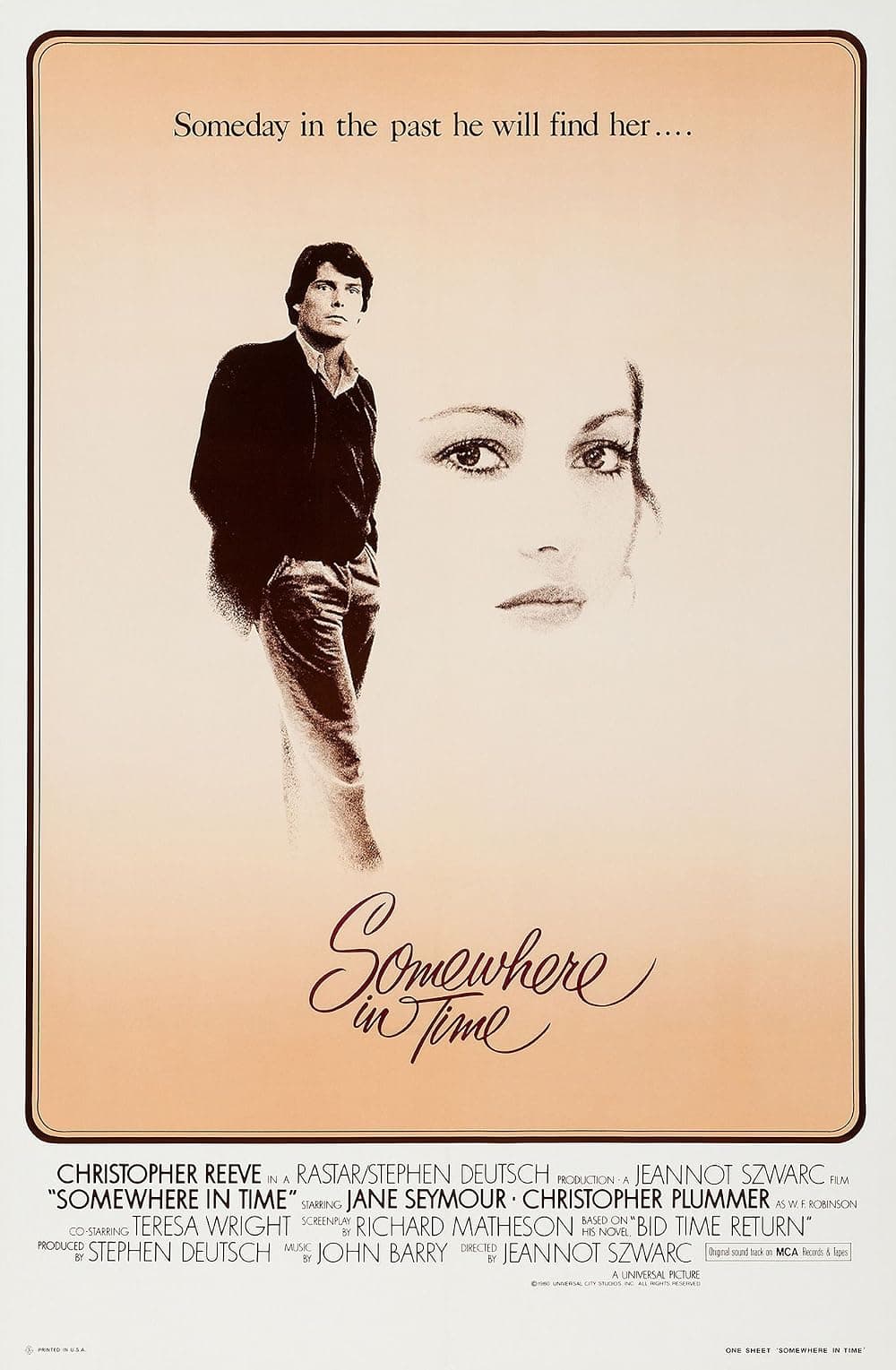
The setup
There’s a particular kind of obsession Somewhere in Time specialises in: the sort that starts with a photograph and becomes a life plan. Christopher Reeve’s Richard Collier sees a portrait of an actress at the Grand Hotel and decides that ordinary living won’t do — he will bend his own mind to reach her. It’s daft, romantic and utterly specific, and that specificity is why audiences keep returning to Jeannot Szwarc’s 1980 romance.
THE MOVIE
Richard Collier is still the reason this movie works
You can explain Somewhere in Time two ways: as a quaint period romance in which a modern playwright chases an Edwardian actress, or as a film about what a single person will do when obsession hardens into project. The story begins when Richard Collier becomes fixated on a vintage portrait of Elise McKenna at the Grand Hotel on Mackinac Island and never quite lets go.
That fixation isn’t merely sentimental. Years after the portrait first haunts him, Collier acts — he accepts an old pocket watch and, by ritualised self‑hypnosis, attempts to put himself into 1912 to meet the woman in the photograph. It’s the kind of plot choice that tells you this is a romance made of concentrated longing rather than a dry intellectual puzzle.
Jeannot Szwarc directs, John Barry supplies a score built around a wistful music‑box motif and Rachmaninoff’s recurring theme, and together those elements turn an odd premise into something you can feel physically. The film’s initial run barely registered, but persistent TV reruns and rentals found an audience who embraced the film with an almost cult‑like devotion.
THE SETUP
The idea that sets Somewhere in Time in motion
At its cleanest, the film’s engine is simple. A Chicago playwright becomes obsessed with a photograph of an actress — Elise McKenna — and fixes on the Grand Hotel portrait until obsession becomes action. That obsession is the plot’s fuel rather than a series of mechanical puzzles.
Time travel here isn’t scientific tinkering; it’s a practice. The screenplay treats temporal displacement as a discipline of the mind: self‑hypnosis, ritual and props (a watch, a music box, a photograph) that anchor belief. The mechanics aren’t explained in an essay; they’re enacted, which keeps the story focused on longing and consequence.
That focus also reshapes the source material. The filmmakers cut the protagonist’s fatal illness from Richard Matheson’s novel, which changes Collier’s reasons for urgency and turns the quest into a voluntary surrender rather than an act of desperation.
Opposition comes from the human world: Elise’s manager, W. F. Robinson, who guards her career, and a practical vulnerability built into the time‑travel method — a modern touchstone can snap Collier back. That double bind — interpersonal resistance and the fragility of his own method — is what keeps the drama moving.
THE CHARACTER
Why Richard Collier matters
Richard Collier isn’t a brooding, vaguely heroic type; he’s an ordinary man whose longing escalates into methodology. The plot doesn’t hitch him to heroics so much as to a single burning idea: reclaim the past embodied in a photograph.
That turn — from admirer to practitioner of self‑hypnosis — gives the character a clarity the film needs. We understand his choices because they’re consistent: obsession becomes programme, and programme demands sacrifice.
Because Collier’s motivation is so specific, the film can stage small tests that reveal character. It’s not about bravado; it’s about whether a man will organise his life around a photograph and then follow through.
And that’s why he lingers. The story is less interested in proving the mechanics of time travel than in watching a man who has decided that the past is worth the labour of becoming someone who can belong in it.
THE PERFORMANCE
Why Christopher Reeve's performance matters
Contemporary reviews paid attention to the leads. Critics singled out both Reeve and his co‑star when assessing the film on release, which matters because this is a movie that lives or dies on its central chemistry.
That attention isn’t accidental: the narrative hands Reeve a particular job — to make an obsessive project feel human and not merely theatrical — and critics’ response shows that viewers were tuning into how he carried that burden.
Talking about those critiques lets us see the film the way audiences did in 1980: less as a flawless romance and more as a risky attempt to make concentrated yearning believable on screen.
Whether the performance convinces you will depend on how comfortable you are with the premise. But the fact critics discussed it at length is itself revealing — Reeve’s role was plainly the film’s emotional test piece.
UNDER THE SURFACE
Somewhere in Time has more on its mind than the plot suggests
On the face of it, the film is a period romance with a time‑travel gimmick. Underneath, it keeps circling a handful of obsessions: the romantic idealisation of the past and how memory dresses absence in glamour.
There’s also a thread about celebrity and the business that shapes it. Elise McKenna is a public figure whose choices are managed, and the film sets her star persona against the private life the protagonist wants to rescue.
That creates an interesting friction: Collier’s will — his mental discipline to cross eras — bumps up against systems of control, chiefly a manager who protects a career more than a person. The tension isn’t merely romantic rivalry; it’s a collision between personal longing and institutional stewardship.
Finally, the movie flirts with the question of will versus determinism. Time travel here is less a technical problem to solve than a wager on what conscious intent can accomplish — and what it cannot.
THE FILMMAKING
How Somewhere in Time was put together
One of the film’s quiet, clever moves is how it signals time without diagrams. The cinematography separates past and present with two distinct film looks: the modern-day material reads crisper, while the 1912 sequences are warmer and softer.
That decision keeps the audience orientated without lecturing. It’s a visual shorthand that supports the story’s emotional logic: the past feels like a different texture of life, and the camera helps you feel that.
It’s a simple trick, but effective. When a film asks you to accept a ritualised form of time travel, anything that grounds mood and place without exposition is worth its weight in gold.
Jeannot Szwarc’s direction ties those choices together, trusting the audience to be carried by atmosphere as much as by plot mechanics.
PRACTICAL EFFECTS
The effects work that gives Somewhere in Time its physical personality
The film doesn’t lean on optical trickery to convince you of 1912. Instead, it uses old‑fashioned practical solutions: period dressing, costumes and the choice of locations to sell an earlier era.
Mackinac Island was a specific production choice because its ban on automobiles made the place feel authentically pre‑modern without digital surgery. It’s a logistical solution that becomes an aesthetic one.
Sound helps as much as sight. The movie uses a small music‑box arrangement — a tiny, diegetic device — to punctuate emotional beats and signal temporal transition, rather than treating time travel as a loud special effect.
Together, these elements keep the film tactile. It prefers the texture of locations and sounds to spectacle, which suits a story about longing more than it would a story about scientific invention.
PURE 80S
Somewhere in Time could not belong to any other decade
Though it opened in 1980, the picture sits on the cusp of the late‑70s/early‑80s tendency to adapt fantasy‑romance novels for the screen. Studios were willing to gamble on sentimental, atmospheric adaptations and this film fits that lane neatly.
Its afterlife is particularly an 80s story. The era’s expanding cable networks and booming home‑video market allowed films that underperformed at the box office to find second lives; repeated TV airings and rentals turned this one into a cult fixture.
That distribution pattern matters because it changed how audiences discovered the film. It wasn’t big on opening weekend but it lingered on airwaves and videotape, gradually building a devoted following rather than instant mainstream success.
So while the film’s craft looks back in its subject, its long tail of popularity is a product of 1980s media circulation more than anything the filmmakers could predict.
THE LEGACY
Why Somewhere in Time still matters
Its theatrical life was modest, but Somewhere in Time found a dedicated afterlife. An organised fan community, INSITE, now stages annual gatherings at the Grand Hotel — a vivid sign that the film’s emotional particularity connected with real people.
Music played a large part in that connection. John Barry’s score, and the film’s use of Rachmaninoff, have been revisited and reissued by specialist labels, which is telling: the soundtrack developed its own audience outside the film.
The story has also stretched into other forms: stage adaptations and periodic cultural references keep the basic idea — a love that crosses time — in circulation.
So its legacy isn’t blockbuster legend. It’s a quieter kind of persistence: a community, a soundtrack that refuses to be forgotten and a narrative that turns up when later conversations about time‑travel romance are being had.
THE VERDICT
Does Somewhere in Time still hold up?
Yes, with a caveat. If you go looking for rigorous time‑travel logic, you’ll leave disappointed — the film intentionally treats temporal crossing as a mental discipline anchored by a watch, a music box and ritual rather than a scientific mechanism. That’s a feature, not a bug, if you want a romance that trusts feeling over explanation.
The central conflict — a man determined to make a relationship happen and the manager who protects a star’s career — still reads as a neat dramatic engine. It keeps the romance tethered to real stakes: public persona, private loneliness and genuine obstacles to being together.
Technically, the film helps its case. The separate film looks for past and present and John Barry’s recurring musical motifs give the story an emotional architecture that supports the premise. Those choices make the period feel lived‑in without needing special‑effects pyrotechnics.
So should you watch it? If you can accept that this is a romance powered by obsession and atmosphere rather than hard science, it rewards patience. It’s not for everyone — but for those who respond to its peculiar insistence, Richard Collier’s single‑minded love still has the power to move you.
Share this movie
Keep watching
More movies from the 80s
1986
Jumpin' Jack Flash
Jumpin' Jack Flash: our relationship with technology and freedom, and why this 1986 movie still matters.
Read our take →
1987
RoboCop
A murdered cop rebuilt as a product — RoboCop still asks who gets to sell justice.
Read our take →
1983
Christine
Obsession, adolescence and a car that won't let go.
Read our take →