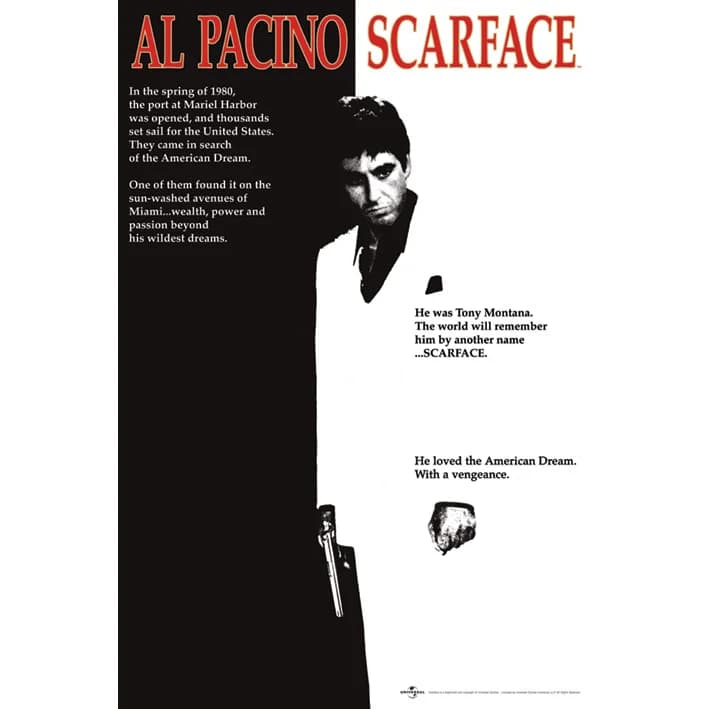
The setup
Tony Montana arrived in Miami with nothing and walked off with the movie. Brian De Palma’s Scarface is less a quiet morality play and more a loud, unapologetic portrait of appetite — for wealth, status and power — that runs at full throttle for almost three hours. Whether you love it, loathe it, or inherited it from a cousin’s VHS, it still insists on being watched.
THE MOVIE
Tony Montana is still the reason this movie works
Scarface follows Tony Montana, a Cuban refugee who arrives in Miami during the 1980 Mariel boatlift and, almost immediately, finds himself on a rapid trajectory through the city’s criminal underworld. That premise — displacement meets opportunism — gives the film a harsh, speeded-up fable quality.
What keeps the film alive is Tony’s hunger. He isn’t chasing ideals; he wants wealth, status and the respect he missed out on. The story’s engine is that craving and the hubris it breeds, and everything that happens is, at heart, a consequence of it.
Brian De Palma directs the whole thing with an unmistakable appetite of his own. At 170 minutes, Scarface doesn’t apologise for taking its time; it asks you to sit through the rise, the excess, and the inevitable collapse. And Al Pacino is the man at its centre — Tony Montana — whose presence anchors the whole noisy experiment.
THE SETUP
The idea that sets Scarface in motion
The story begins with a simple but telling premise: an outsider arrives in a city riddled with commerce and criminal opportunity and chooses the fastest route up. Tony Montana’s background as a refugee places him in a world where violence, ambition and opportunism are practical tools, not abstract choices.
That early displacement accelerates everything. The film moves Tony from small-time schemes into the drug trade quickly, which keeps the plot taut and the stakes feeling immediate rather than drawn-out.
At its core the conflict is straightforward and brutal: Tony’s ruthless ambition and hunger for power clash with law enforcement, rival criminals, and his own self-destructive instincts. It’s a rise-and-fall built on momentum and misjudgement.
Relationships supply the story’s levers: Manny is the friend and partner who helps Tony climb, Frank Lopez is the established boss who offers a route into power (and later becomes an obstacle), Elvira is the romantic figure caught up in the glamour and detachment of that world, and Alejandro Sosa is the international supplier whose business ties raise the moral and practical stakes.
THE CHARACTER
Why Tony Montana matters
Tony Montana matters because he’s not an accidental gangster; he’s a deliberate experiment in appetite. Al Pacino plays Tony, and the character’s motor is a craving for things he never had: money, status and, crucially, respect.
That hunger shapes every choice — from the risky partnership moves to the alliances that end up costing him. Frank Lopez, an established Miami boss, offers Tony a ladder. When that patronage curdles into betrayal, it becomes a pivotal push that accelerates Tony’s ascent and moral slide.
Then there’s Alejandro Sosa, the transnational supplier whose involvement raises the stakes from local ambition to international compromise. The business deals Tony makes with figures like Sosa are turning points: they promise expansion, but they also strip away manoeuvre and mercy.
Finally, Tony’s supporting circle matters because it reflects who he becomes. Manny, Elvira and his family show different mirrors of his success — loyalty, desire and isolation — and in watching Tony move among them you see how ambition reshapes a man and, eventually, isolates him.
THE PERFORMANCE
Why Al Pacino's performance matters
Contemporary critics made Al Pacino’s performance a frequent talking point, which tells you two things: the role is built to be noticed, and Pacino’s presence ensures it is.
That attention matters because Tony is not a background figure you can observe at arm’s length. He’s the engine. The way the film asks you to engage with its moral questions runs through how the central role is presented and received.
So whether you're watching for drama, bravado or discomfort, the film expects you to hold Tony's choices under a spotlight. Critics’ focus on the performance helped cement the character as the film’s unavoidable centre.
The result is a picture that depends on its lead being a presence people discuss — not merely a narrative device, but the reason the film keeps pulling your attention back.
UNDER THE SURFACE
Scarface has more on its mind than the plot suggests
On the surface Scarface is a gangster movie: deals, power plays, betrayals. But beneath that is a portrait of ambition and hubris — a man who believes the world owes him respect and tries to take it by force.
Another running idea is self-destruction. Addiction — in its various forms — threads through the story, turning success into a source of ruin when appetite stops being useful and becomes destructive.
Loyalty and betrayal are the story’s moral currency. The bonds Tony forms (and breaks) drive turning points; trust becomes both useful and dangerous in equal measure within the criminal networks he inhabits.
Finally, materialism and excess show how success in this world is displayed and how display corrodes. The trappings of power that attract Tony also isolate him, and the film uses that gulf to sharpen its tragic slope.
PRACTICAL EFFECTS
The effects work that gives Scarface its physical personality
Scarface doesn’t hide from physical brutality. Contemporary descriptions note graphically staged violent set pieces, including on-set practical work that presents gore and injury in a very immediate, tactile way.
The film’s large-scale final shootout was achieved with practical stunts and pyrotechnics rather than any digital trickery, which gives those sequences a grounded, lived-in force.
Because those moments are executed physically on set, they have a blunt, uncompromising presence that keeps the danger feeling real rather than stylised away.
That practical approach to violence matters because the story depends on consequences feeling painful and permanent — not like a glossed-up action showpiece.
PURE 80S
Scarface could not belong to any other decade
Scarface deliberately reworks the original 1932 template for early-1980s Miami. The film sets Tony’s arrival against the 1980 Mariel boatlift and the contemporaneous cocaine trade, which gives its story a very specific historical friction.
That setting placed the film inside contemporary 1980s conversations about narcotics, immigration and urban violence — the background wasn’t just scenery, it was part of what made the plot feel urgent at the time.
Scarface arrived in 1983 and then found a second life as home video became ubiquitous. Repeated VHS releases in the mid-to-late 1980s helped the film reach audiences beyond the theatre and contributed to the way people kept talking about it.
So while the film’s themes are older than the decade, its choices about who the characters are and what world they inhabit make it unmistakably an 80s movie in spirit and context.
WATCHING IT NOW
What has aged — and what hasn't
Watching Scarface today, the central cast of characters still carry the film. Manny, Elvira, Frank Lopez and Alejandro Sosa aren’t just props; they’re active influences on Tony’s choices, which keeps the emotional logic intact.
The film’s later life on home video and in re-releases has also shaped how modern viewers encounter it. That catalogue presence means new audiences don’t see it as a forgotten oddity but as a film with a persistent place in pop culture.
Because the story hinges on character-driven choices — ambition, betrayal, desperation — the dramatic engine plays across generations. The plot’s mechanics remain comprehensible and, for many viewers, compelling.
That said, much of the film’s force depends on how willing you are to sit with a long, occasionally excessive portrait of self-destruction. If you’re in for the ride, the main elements that matter are still there.
THE LEGACY
Why Scarface still matters
Scarface earned industry recognition at the time — the film received three Golden Globe nominations, including nods for its lead and supporting performances and its score, which helped keep it in the conversation.
Beyond awards, lines and visual moments from the film seeped into popular culture. That kind of repeated reference keeps the movie present in music, film and wider media discussions, even for people who haven’t seen it recently.
The film’s repeated home-video life and later remasters also matter: being constantly available — and repackaged — made Scarface less like a period relic and more like a persistent cultural artifact.
Put together, industry attention, cultural quoting and continual availability explain why Scarface still turns up in conversations about 80s cinema and gangster storytelling.
THE VERDICT
Does Scarface still hold up?
Yes — but with a caveat. Scarface still works as a bracing, sometimes brutal parable of ambition and hubris. The film’s structure deliberately stages Tony’s rise and fall as a classical tragic arc: success reveals and enlarges his flaws until they deliver the inevitable, violent denouement.
If you’re watching to see character choices played at scale, the film delivers. Tony’s refugee backstory and the fast path into crime make his hunger believable as motivation, and the dynamics with Manny, Frank Lopez and Elvira keep the consequences personal rather than purely transactional.
That said, the film asks for patience. At about 170 minutes it can feel indulgent; the length and excess are part of its personality, so your enjoyment depends on whether you accept excess as the film’s language rather than a flaw to be excused.
So should you watch it now? If you want a big, noisy, character-driven account of ambition and self-destruction — one that wears its 1983 setting on its sleeve while still telling a recognisable rise-and-fall story — Scarface is worth the time. It’s a persuasive cautionary tale dressed in flash and fury, and Tony Montana is the reason you’re still thinking about it by the credits.
Featured in
Explore more about Scarface
Share this movie
Keep watching
More movies from the 80s
1986
Jumpin' Jack Flash
Jumpin' Jack Flash: our relationship with technology and freedom, and why this 1986 movie still matters.
Read our take →
1987
RoboCop
A murdered cop rebuilt as a product — RoboCop still asks who gets to sell justice.
Read our take →
1983
Christine
Obsession, adolescence and a car that won't let go.
Read our take →