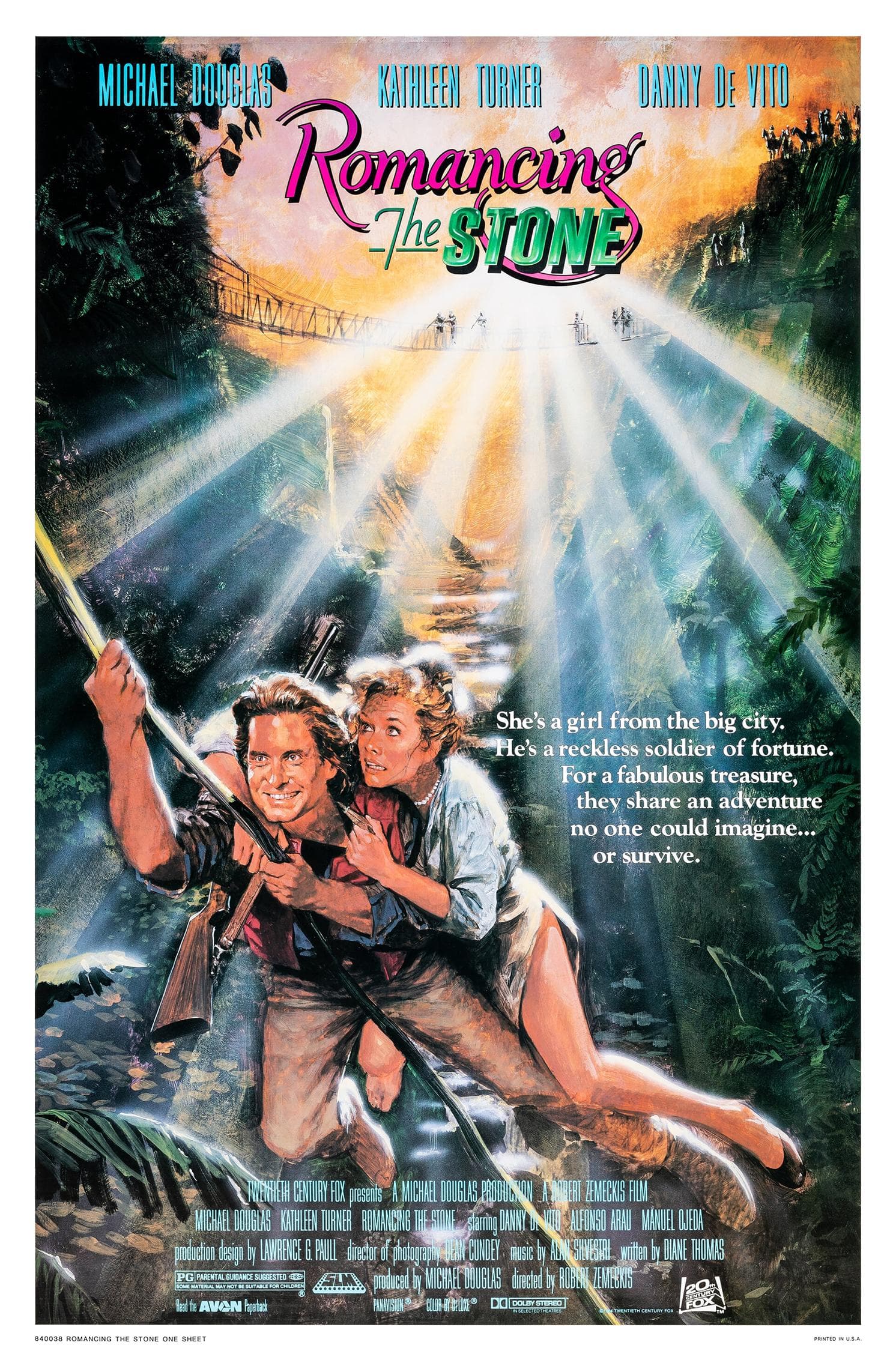
Romancing the Stone
A romance novelist, a smuggler, an emerald and a jungle: the adventure that taught Joan Wilder to stop waiting and start kicking.
The setup
Romancing the Stone is the sort of film that opens with a gentle shrug and ends in a grin. It pairs a sheltered romance writer with a grubby, practical adventurer and then spends 106 minutes enjoying the sparks. Robert Zemeckis stages the whole thing as a caper — equal parts treasure hunt and love story — that never forgets to have fun.
THE MOVIE
Jack T. Colton is still the reason this movie works
There’s a very particular pleasure in watching a romantic fantasy get shoved into a river and come out laughing. That’s the shorthand of Romancing the Stone: Joan Wilder, a New York romance novelist, is yanked from her desk and thrown into a real jungle quest when her sister is kidnapped, and the movie delights in the mismatch between her expectations and the messy world she’s landed in.
Robert Zemeckis directs the whole collision with a wink and a steady hand. The inciting kidnapping propels Joan out of safe habits and into danger — which is, crucially, the only thing that will make her change.
And at the heart of it sits Jack T. Colton. Michael Douglas’s Colton is the practical counterweight: a bird-smuggler/mercenary type whose priorities start with self-preservation and money and, by the end, land somewhere inconvenient and warm. The movie works because it trusts that collision — between Joan’s romantic instincts and Jack’s practical survivalism — to generate both laughs and a believable shift in each character.
THE SETUP
The idea that sets Romancing the Stone in motion
Keep it simple: Joan Wilder’s sister is kidnapped, and Joan goes after her. That single, urgent act pulls a woman whose day job is writing paperbacks into a far more dangerous story.
From there the plot arranges itself like a series of obstacle courses. Joan becomes embroiled in a hunt for a coveted emerald and is repeatedly forced to improvise, run and outsmart people who want the same thing she does.
The central friction is neat and economical: Joan and her reluctant ally Jack T. Colton versus criminal smugglers and a ruthless local antagonist. It’s less about a single showdown and more about a sequence of escapes and set-piece chases that test what Joan can do.
That structure plays to the movie’s strengths. The emerald and the pursuit mechanics give the story a forward shove, while Joan’s mission — rescuing her sister — keeps the stakes emotional rather than merely treasure-driven.
THE CHARACTER
Why Jack T. Colton matters
Jack Colton matters because he’s not a flawless hero. He arrives as a mercenary/bird-smuggler type: someone who values his freedom and his next paycheck. That makes him refreshingly selfish at first, which is fun to watch because the movie doesn’t pretend otherwise.
What Romancing the Stone does with Jack is slow conversion rather than instant redemption. He pairs up with Joan because circumstance demands it; protecting her becomes habitual before it becomes noble. That gradual shift keeps the relationship believable.
The character also performs an important narrative job: he’s the practical toolkit Joan needs. Where her instincts are for storybook romance, Jack supplies rope, grit and the knowledge of how to get out of a river alive. It’s a partnership built on reciprocal usefulness as much as attraction.
And on a final note, the casting and production facts matter here: Diane Thomas wrote the screenplay and Michael Douglas produced as well as starred, which frames Jack as a central, deliberately positioned figure in the film’s comic-adventure machinery.
UNDER THE SURFACE
Romancing the Stone has more on its mind than the plot suggests
On the surface it’s a treasure hunt; down below it’s mostly about learning to survive your own fantasies. Joan’s fish-out-of-water transformation — a sheltered woman learning to cope in a dangerous landscape — is the engine that keeps the film human.
There’s also a neat tension between adventure and romantic fantasy. Joan starts with a novelist’s appetite for tidy, cinematic passion; the adventure forces her into messy, physical choices. The romantic beats feel earned because the characters have been tested outside a drawing-room.
The movie is also about partnership. It stages a recurring back-and-forth where Joan rescues people with information, ideas or sudden courage, and Jack rescues people with muscle, know-how or sheer stubbornness. They keep saving each other, which makes their eventual bond feel mutual rather than lopsided.
Finally, Romancing the Stone wears its 1980s adventure-pastiche proudly. It borrows the genre’s momentum — chases, maps, the holy grail of a big jewel — but softens the macho edges with humour and romantic stakes, which gives it a distinctive voice among its contemporaries.
THE FILMMAKING
How Romancing the Stone was put together
One of the film’s strengths is how rooted it feels on location. Dean Cundey served as director of photography and shot across Mexico and the U.S. canyon sequences; that on-the-ground cinematography gives the chases and river sequences a lived-in texture.
You can feel the editors’ fingerprints too. Donn Cambern and Frank Morriss received an Academy Award nomination for Best Film Editing, which signals how much the film relies on tight cutting to sustain momentum between comedy and action.
Robert Zemeckis’s direction keeps the tone consistent: adventurous but self-aware. The staging favours clear cause-and-effect so the audience always knows what’s at stake, even when the characters are covered in mud and running for a boat.
And it helps that the score by Alan Silvestri sits under the action. Music and editing together shepherd the film from cosy opening scenes into full-on jungle caper without losing the emotional throughline.
PRACTICAL EFFECTS
The effects work that gives Romancing the Stone its physical personality
This is fundamentally a movie of live stunts and on-location action. Action sequences, stunts and many physical set pieces were executed live on location rather than relying on extensive optical or digital augmentation, which keeps the jeopardy immediate.
Production reports also note hazardous on-location practical work — river/whitewater and mudslide sequences in particular — that required real stunt coordination and safety measures. That sense of physical risk translates on-screen as urgency.
Because the film leans on real stunts, the comedy and the action feel unified. When characters slip, crash or scramble, the consequences look and feel real, which helps the lighter moments land without undercutting peril.
In short: the movie’s personality benefits from practical choices. Live-action work gives the sequences a tactile edge, and the filmmakers lean into that rather than papering over it.
PURE 80S
Romancing the Stone could not belong to any other decade
Romancing the Stone was greenlit and marketed in the wake of early-1980s Raiders-style adventure films, and it slots neatly into that post-Raiders adventure cycle. The film borrows the genre’s appetite for maps, chases and exotic peril but softens it with romantic comedy sensibilities.
Released in 1984, it arrived at a moment when studios were happy to blend genres and chase broad audiences. That willingness to mix treasure-hunt momentum with screwball romance is very much an 80s studio decision — big, breezy and engineered to entertain.
The film’s commercial success also mattered for careers. It helped propel its cast and director into higher-profile studio projects later in the decade, changing the kinds of opportunities they were offered.
And, tellingly, that success produced a direct narrative sequel the following year, which shows the market appetite for this particular cocktail of romance and adventure in 1984–85.
THE LEGACY
Why Romancing the Stone still matters
Two awards facts tell you how the film landed at the time: it won Golden Globes for Best Motion Picture – Musical or Comedy and for Best Actress – Musical or Comedy (Kathleen Turner), and its editing team received an Academy Award nomination. Those honours underline that the film was both popular with audiences and respected for craft.
Beyond trophies, the film’s success produced concrete career effects: it raised Robert Zemeckis’s profile and helped cement an ongoing collaboration between him and composer Alan Silvestri. That pairing would go on to define several later projects.
The box-office success that led to a sequel also shows the film found a sizeable audience eager for this mix of romance and adventure. That in itself explains why the movie remains part of conversations about 80s studio-era entertainment.
Finally, the characters — Joan, Jack, Ralph, Ira and their oddball allies — still form a recognisable squad. They’re the reason the film is recalled: a combination of colourful personalities and a plot that gives them room to play.
THE VERDICT
Does Romancing the Stone still hold up?
Yes — if you want an amiable, well-paced mash-up of treasure-hunt mechanics and romantic comedy, Romancing the Stone still delivers. The plot’s premise is straightforward: Joan Wilder travels to South America to rescue her kidnapped sister and becomes embroiled in a hunt for a coveted emerald, and that clarity keeps the film moving.
Where it earns its keep is in the balance. The movie alternates intimate moments — Joan’s gradual self-reliance and her growing bond with Jack — with broad physical-comedy and action set pieces, so you rarely feel the film overstays any beat.
Jack T. Colton’s pragmatic selfishness turned reluctant protectiveness gives the adventure emotional ballast. The treasure map and the emerald are useful MacGuffins that trigger a string of pursuit-and-escape sequences across jungle, town and river locations, but the real engine is the characters saving each other enough times that romance becomes plausible.
In short: Romancing the Stone is a breezy 106-minute reminder that a well-built genre mash-up can still feel fresh. It’s not trying to be deeper than it is — and that’s precisely the point.
Share this movie
Keep watching
More movies from the 80s
1986
Jumpin' Jack Flash
Jumpin' Jack Flash: our relationship with technology and freedom, and why this 1986 movie still matters.
Read our take →
1987
RoboCop
A murdered cop rebuilt as a product — RoboCop still asks who gets to sell justice.
Read our take →
1983
Christine
Obsession, adolescence and a car that won't let go.
Read our take →