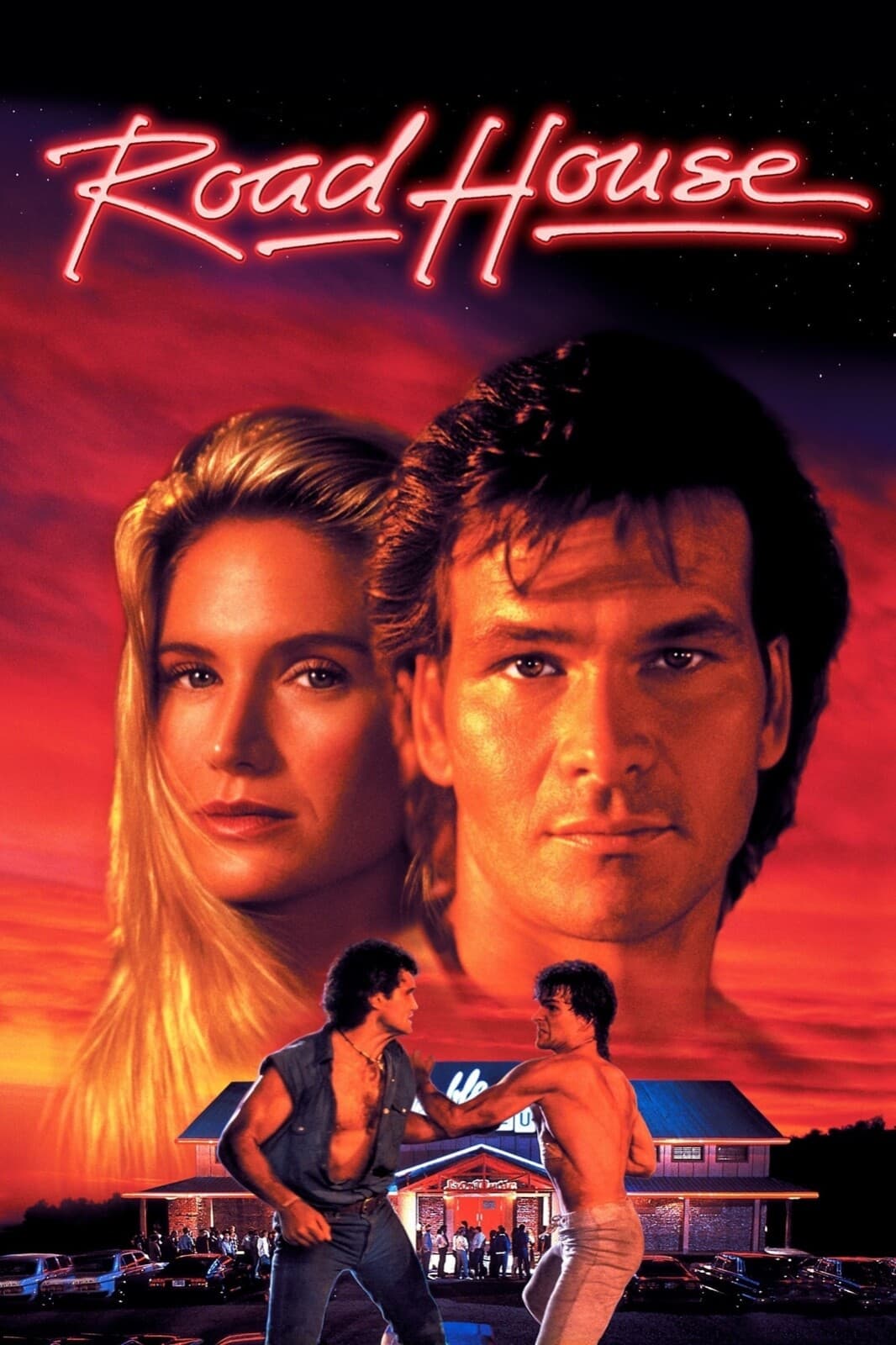
Road House
Stoic bouncer, small-town chaos and very particular rules about where to throw a punch.
The setup
Road House is the kind of movie you remember as a series of scenes: a calm man who handles trouble like a craft, a roadhouse in need of fixing, and an escalating row that never quite lets you look away. Directed by Rowdy Herrington and released in 1989, it pairs that central figure — Dalton — with a pile of problems that ask him to be more than a hired hand.
THE MOVIE
Dalton is still the reason this movie works
People keep coming back to Road House because it gives us a single figure who can calmly walk into a mess and make order look like a trade. Dalton is that figure: a professional cooler from New York hired to run the Double Deuce and keep the peace.
He arrives to find a club and a town that are fractured — violence on the floor, staff who can’t be trusted, and a local businessman named Brad Wesley whose reach makes the whole place feel constrained. The premise is satisfyingly simple: hire a specialist, watch him set rules, and then watch those rules get tested.
That simplicity is the movie’s personality. Rowdy Herrington directs this late-1980s action drama with Dalton — played by Patrick Swayze — at its centre, and the film runs a compact 114 minutes of rules, fights and the odd quiet beat where the character’s philosophy slips through.
THE SETUP
The idea that sets Road House in motion
At its core Road House is a how-to on restoring order. Frank Tilghman hires Dalton to be head of security at the Double Deuce; the immediate work is practical and local — keep the peace, protect staff, break up fights — but the stakes grow because the town itself is under pressure from an outside force.
Dalton’s operating method is explicit and repeatable: be civil on the floor, take the fight outside, and have each other's backs. That rule-book approach gives the movie a steady spine; when the rules are followed, the club functions, and when they’re broken, things escalate.
And escalate they do. The screenplay leans on staged confrontations — bar fights, ambushes and town-wide intimidation — each one designed to push Dalton’s methods and patience further, setting up the larger confrontation with Brad Wesley's control of the town.
So the setup works because the film is constantly testing its central idea. It isn’t trying to be clever; it keeps coming back to the single proposition that one skilled outsider can change how a place behaves — for better or worse.
THE CHARACTER
Why Dalton matters
Dalton matters because he's written and staged as a professional with principles. He’s the sort of man whose job is to neutralise violence, not celebrate it — a stoic, philosophically inclined 'cooler' whose calm is part of his skillset.
That quality turns every fight into a problem-solving exercise. Dalton isn’t there to start trouble; he’s there to end it in a way that protects the people who can’t protect themselves. It gives the action an organisational logic that most straight brawling movies don't bother with.
His relationships deepen that sense of purpose. Wade Garrett functions as a friend and mentor, reminding us Dalton is part of a lineage of high-end bouncers — he didn’t arrive from nowhere. And Dr. Elizabeth 'Doc' Clay offers him something different: a chance at a life outside the job, an emotional alternative that keeps the stakes human.
Small connections matter, too. The friendship Dalton builds with Cody, the blind singer at the Double Deuce, is a neat touch: it shows the softer side of the club and gives Dalton a reason to care about the place beyond professional pride.
THE PERFORMANCE
Why Sam Elliott's performance matters
Contemporary reviewers made a point of noting the solidity of Wade Garrett as a supporting presence. That matters because Garrett puts Dalton into context: he’s a rope into Dalton’s past and a voice that both steadies and challenges him.
The film depends on that kind of authority. Garrett’s role reads like the experienced hand who’s already seen the job’s cost, which helps the audience understand Dalton’s choices without an excess of backstory.
When critics singled out Elliott’s contribution they weren’t merely complimenting casting; they were pointing to how the character frames Dalton. Wade Garrett gives the movie a believable history and a humane counterpoint to the straight line of violence.
So even when the film’s tone wobble drew criticism, reviewers tended to agree that Elliott’s Wade Garrett was a reliable anchor — the one steady-looking thing in a film that likes to push and pull its own rules.
UNDER THE SURFACE
Road House has more on its mind than the plot suggests
On the surface Road House is about fists and order. Underneath it’s carrying ideas about redemption and the cost of sanctioned violence. Dalton’s past — and the way he continues to use force, even professionally — raises the question of whether someone can ever simply walk away from that life.
Mentorship and apprenticeship are written into the film’s bones. Dalton isn’t a lone wolf reinventing the wheel; he’s part of a trade. Training the bouncers and his exchanges with Wade Garrett make the movie interested in the passing on of skills and the ethics that should come with them.
There’s also a sustained conversation about masculinity and controlled violence. The film keeps circling the action-hero ideal and, rather than discard it, examines the discipline that should theoretically regulate that kind of power — a rule-set for violence, if you like.
All of this sits against a backdrop of small-town corruption: a community economically and physically dominated by one man. That contrast — a professional outsider trying to restore local autonomy — is why the movie’s pitched confrontations feel like more than spectacle.
PRACTICAL EFFECTS
The effects work that gives Road House its physical personality
Road House is a hands-on action picture. The production employed a large credited stunts team and multiple martial artists, which is the sensible way to build a film that depends on repeated in-room fights and set-piece brawls.
Those sequences feel tied to real bodies and trained performers because many of the beats were achieved through practical stunt work rather than any digital trickery. The choreography and second-unit coordination are central to how the club scenes read on-screen.
Given the film’s emphasis on hand-to-hand conflict, relying on experienced stunt performers keeps the fights coherent and purposeful. You can see the effect in the staging: the action is physical, directional and built to serve the plot’s escalating confrontations.
In short, Road House’s physical personality comes from craft: trained stunt teams, martial artists and a production that put the fighting where it belonged — in the hands of people who knew how to stage it.
PURE 80S
Road House could not belong to any other decade
Road House lands firmly in the late-1980s action mould. Produced by Joel Silver’s Silver Pictures and released in May 1989, it fits alongside films that favoured muscular lone heroes, staged hand-to-hand combat and commercially minded soundtracks.
That alignment helps explain its tone. The movie isn’t coy about what it is: it borrows the era’s appetite for a single tough protagonist who can impose order, and it pairs that appetite with frequent fights and clear moral lines.
Contemporary critics noticed the family resemblance, comparing the picture to Westerns and to the decade’s martial-arts and lone-hero pictures. Those comparisons aren’t lazy shorthand; they point to the film deliberately using familiar templates to tell a straightforward story.
So while Road House has its own local colour and characters, its DNA is unavoidably 1989: a commercial action film built around one man’s ability to stand between chaos and the people who don’t have the tools to stop it themselves.
THE LEGACY
Why Road House still matters
Road House didn’t vanish after its first theatrical run. It developed a late-1980s action title with a continuing cult profile and even spawned a direct-to-video sequel, Road House 2: Last Call (2006). That afterlife shows the film found an audience that kept returning to its particular pleasures.
The fact that a widely publicised 2024 remake was made is another part of its legacy. The new version brought renewed critical attention to the original, prompting people to revisit the 1989 film to see what the remake kept, changed or tossed out.
The soundtrack has had its own little afterlife, too: the original score and licensed selections have been the subject of reissues and expanded editions, which is a tidy sign that parts of the film — the music, the atmosphere — have maintained a following.
Taken together these things explain why Road House still matters: it’s a movie whose characters, rules and soundscape kept enough fans interested to sustain reissues, sequels and a remake decades later.
THE VERDICT
Does Road House still hold up?
Yes — but with a clear rider. Road House works when you come for what it promises: a compact, late-80s action drama where a specialist named Dalton is hired to fix the Double Deuce, find the town’s fault lines and teach people to stop tolerating violence. The central conflict — Dalton versus the town’s corruption and Brad Wesley’s shadow — remains readable and immediate.
Where the film risks dividing viewers is tone and appetite. It stages a steady series of escalating confrontations and lives by a simple rule-set — be civil on the floor, handle fights outside, watch each other’s backs — so if you accept that framework, the action and the ethical questions about sanctioned violence and redemption land more often than they don’t.
Dalton’s relationships — the mentor figure of Wade Garrett and the possibility of a different life with Dr. Elizabeth 'Doc' Clay — give the story a human anchor. They stop the movie from being only a string of fights and make the idea of redemption feel like a real option rather than a tag line.
So if you’re deciding whether to watch it now: pick it when you want a muscular, character-driven action film that isn’t shy about its rules. Road House remains watchable because Dalton gives the film purpose. It’s not subtle about what it is, and that’s part of its charm — a professional who sets limits, and a movie that spends its time testing them.
Share this movie
Keep watching
More movies from the 80s
1986
Jumpin' Jack Flash
Jumpin' Jack Flash: our relationship with technology and freedom, and why this 1986 movie still matters.
Read our take →
1987
RoboCop
A murdered cop rebuilt as a product — RoboCop still asks who gets to sell justice.
Read our take →
1983
Christine
Obsession, adolescence and a car that won't let go.
Read our take →