The setup
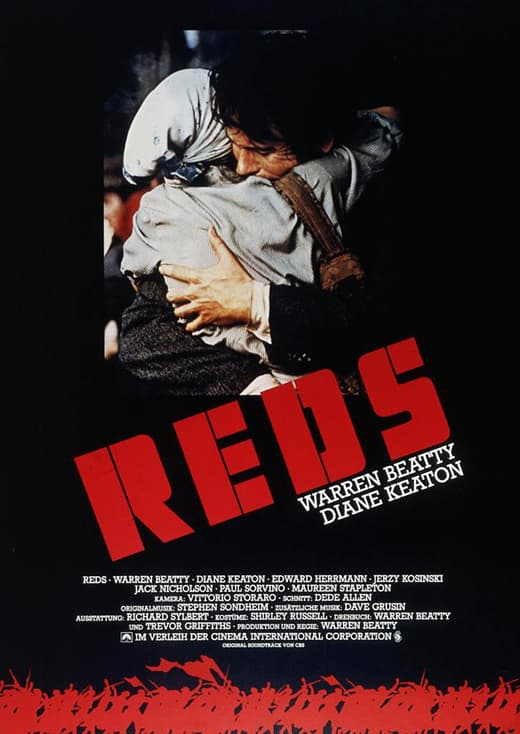
Reds is the sort of movie that announces itself by personality rather than a press release. Warren Beatty’s long labour of love follows a restless reporter who treats history like an assignment you can’t look away from — and then pays for watching. It’s grand, argumentative and stubbornly intimate all at once.
THE MOVIE
John Silas "Jack" Reed is still the reason this movie works
Reds tells the story of John Reed and his on-off relationship with Louise Bryant, but it’s Reed’s appetite — for reporting, for causes, for being where things are happening — that gives the film its forward pull. The movie begins with the two of them meeting at a lecture and then follows Reed as he moves from an American radical reporter to someone who insists on being both participant and witness to the 1917 Revolution.
Warren Beatty made this picture the way a devotee makes a shrine: he co-wrote, produced, directed and starred in it after years of development. That concentration of purpose matters because the film is unapologetically built around one man’s restlessness and the consequences it creates for the people around him.
Beatty layers dramatised sequences with on-camera interviews of real-life contemporaries, which keeps nudging the story back toward testimony and memory. It runs long — almost three and a quarter hours — and wears that length like a manifesto: dense, opinionated and keen to be heard. The craftsmanship around it was recognised too; the cinematography received the Academy’s top nod, a reminder that Reds was aiming to be more than a gossip about the Left.
THE SETUP
The idea that sets Reds in motion
At its simplest, Reds opens with a meeting: Reed and Louise Bryant encounter one another at a lecture, and that spark sends the rest of the film in motion. From there it maps Reed’s development as a radical reporter who will follow the story of his life straight into revolutionary Russia.
The movie isn’t content with a single kind of scene. It mixes biographical moments with episodes of political organising and the factional infighting of the American Left, giving a sense that history is made up of both high drama and small, bureaucratic quarrels.
War reporting in Europe, the practicalities of organising, and Reed’s journey into — and eventually back from — revolutionary Russia are all treated as mechanics that shape the characters’ choices. The historical events are not merely a backdrop; they push at private lives in ways that are sometimes personal and sometimes structural.
There was also another version of the story around at the same time: a Soviet-produced biopic treated Reed from a very different national perspective, which meant Beatty’s film arrived as one of several cinematic accounts of the same subject.
THE CHARACTER
Why John Silas "Jack" Reed matters
John Silas “Jack” Reed matters because he is written and staged as someone who cannot stay away. Politics for him is not abstract; it’s a beat-to-beat rhythm of reporting, presence and risk. That commitment — and the personal costs it brings — is what gives the film its dramatic engine.
Warren Beatty occupies that centre as the man who pushed the project into being. Saying he plays Reed is a fact; saying Reed is restless and driven is what makes him memorable on screen: the character’s appetite propels the plot and, often, complicates his private life.
Reed’s world is full of other people who anchor and oppose him: editors and left-wing organisers who embody factional divisions, and figures whose institutional realities shape what Reed can do. Those secondary characters stop the film from feeling like a one-man sermon and instead show politics as organisation — messy, compromised, human.
Finally, Reed’s private tensions with figures like Eugene O’Neill add an emotional ripple. They introduce recurring personal complications that stop the movie being only about ideas and remind us that the public life of politics is always tangled with private desires.
THE PERFORMANCE
Why Diane Keaton's performance matters
Diane Keaton plays Louise Bryant, and the film treats her as more than a foil for Reed. She’s an ambitious journalist and a public figure whose private life becomes tangled with Reed’s political mission and his wanderlust.
Contemporary notices singled out Keaton’s work as one of the picture’s central strengths, and that attention translated into an Academy Award nomination alongside Beatty’s and Jack Nicholson’s. The nominations are not the same as analysis, but they underline how reviewers at the time found her presence important to the movie’s balance.
What the film does with Bryant is to make her both a partner in the story of revolution and a character with her own stakes. The screenplay keeps bringing her back to questions about ambition, feminised public life and the cost of being visible.
So, when Reds asks whether history leaves room for love, Bryant’s role is the clearest place where that question plays out in full: a public woman whose private life bears the same bruises as the politics around her.
UNDER THE SURFACE
Reds has more on its mind than the plot suggests
On the surface, Reds chronicles events; underneath it argues. One persistent tension is revolutionary idealism versus disillusionment — a through-line that follows characters who are energetic converts at one moment and frustrated participants the next.
That political argument runs alongside private complications: the film keeps returning to the friction between private desire and public commitment. Reed and Bryant’s relationship is a vivid case study in how devotion to a cause can strain intimate bonds.
Journalism itself is treated as a moral and practical project. Reed isn’t merely a narrator; he’s a witness — and the movie wants us to weigh the value of witnessing against the lure of engagement. The filmed interviews of real contemporaries reinforce that the act of witnessing has its own ethics.
Lastly, memory and testimonial history matter to the film’s shape. By mixing dramatised scenes with testimony, Reds asks how stories are remembered, who gets to tell them and whether first-hand accounts change the way we read official history.
THE FILMMAKING
How Reds was put together
One of Reds’ clearest production signatures is its cinematography, which was handled by Vittorio Storaro and received the Academy Award for Best Cinematography. That recognition matters because the film was aiming to be both epic in scale and careful in its framing of historical moments.
Beatty’s multi-hatted role — co-writer, producer, director and star — shaped the film’s construction. The project’s long gestation and concentrated authorship give it a particular personality: ambitious, meticulous and intent on being a single, sustained argument.
The film’s ambition also shows in the way it balances large historical canvases with intimate scenes. That balance is part of the reason the technical choices attracted attention: they had to carry both crowd sequences and quieter personal beats.
So while the big production facts matter, the most distinctive choice is the picture’s commitment to marrying spectacle with testimony: a drama that keeps pulling itself back toward real voices and lived memory.
PURE 80S
Reds could not belong to any other decade
Reds arrived in December 1981, at the start of the Reagan era and a time when Cold War anxieties were back in public view. That timing gives the film a particular cultural resonance: a movie about revolution and American radicals feels insistently topical in that moment.
The film’s release date — December 4, 1981 — placed it squarely into an early-80s political moment in which questions about ideology and national belonging were unusually loud. Beatty’s choice to release such a long, argumentative film then was a deliberate one.
The industry response confirmed the film’s visibility: it received a large number of Academy Award nominations and went on to win several, which kept it on the awards-season agenda and in later retrospectives.
In short, Reds is of its time not because it looks 1980s but because it intervenes in the debates of 1981: a historical film that speaks straight into contemporary political nerves.
THE LEGACY
Why Reds still matters
Reds made a mark in awards-season terms: it picked up twelve Academy Award nominations and took home three Oscars, including Best Director for Warren Beatty, Best Supporting Actress for Maureen Stapleton, and Best Cinematography for Vittorio Storaro. Those honours cemented the film’s visibility within the industry.
Institutions have kept the film in circulation too: it appears on AFI lists that recognise its scale and romantic ambition, placing it where epic storytelling and passion meet. Those placements are a reminder that the movie was intended as a sweeping, formal statement as much as a biographical drama.
The production also generated debate: critics and commentators have argued about its political stance, questions of historical accuracy, and the formal choice to intercut dramatised scenes with witness interviews. That argument is part of the film’s afterlife — people still discuss what Beatty was trying to say and how well he said it.
There was even legal fallout: a lawsuit over research material used in the film was brought and later settled out of court, a story reported at the time that underlines how contentious the project was from development through release.
THE VERDICT
Does Reds still hold up?
If you want a brisk, tidy biography, Reds is not that film. It’s long — a 195-minute commitment — and it deliberately mixes dramatisation with interviews, insisting that you keep thinking about testimony as you watch a story unfold.
But if you want a film that argues with you, that stages the conflict between idealism and disillusionment through scenes of organising, wartime reporting and the literal crossing of borders into revolutionary Russia, then Reds remains a rare, uncompromising project. It’s a movie that foregrounds the labour of witnessing and the personal costs that labour exacts.
Its scale and the way it entwines public causes with private desire mean it still rewards viewers who like their history theatrical and their politics personal. The performances, the formal experiment of witness material and the clear through-lines about commitment give it shape and purpose.
So should you watch it today? Yes — if you have the patience for a long, argumentative film and an appetite for movies that insist history is lived by people who sometimes pay for watching. Reds isn’t quiet about its ambitions, and that bluntness is ultimately its most honest move.
Share this movie
Keep watching
More movies from the 80s
1986
Jumpin' Jack Flash
Jumpin' Jack Flash: our relationship with technology and freedom, and why this 1986 movie still matters.
Read our take →
1987
RoboCop
A murdered cop rebuilt as a product — RoboCop still asks who gets to sell justice.
Read our take →
1983
Christine
Obsession, adolescence and a car that won't let go.
Read our take →