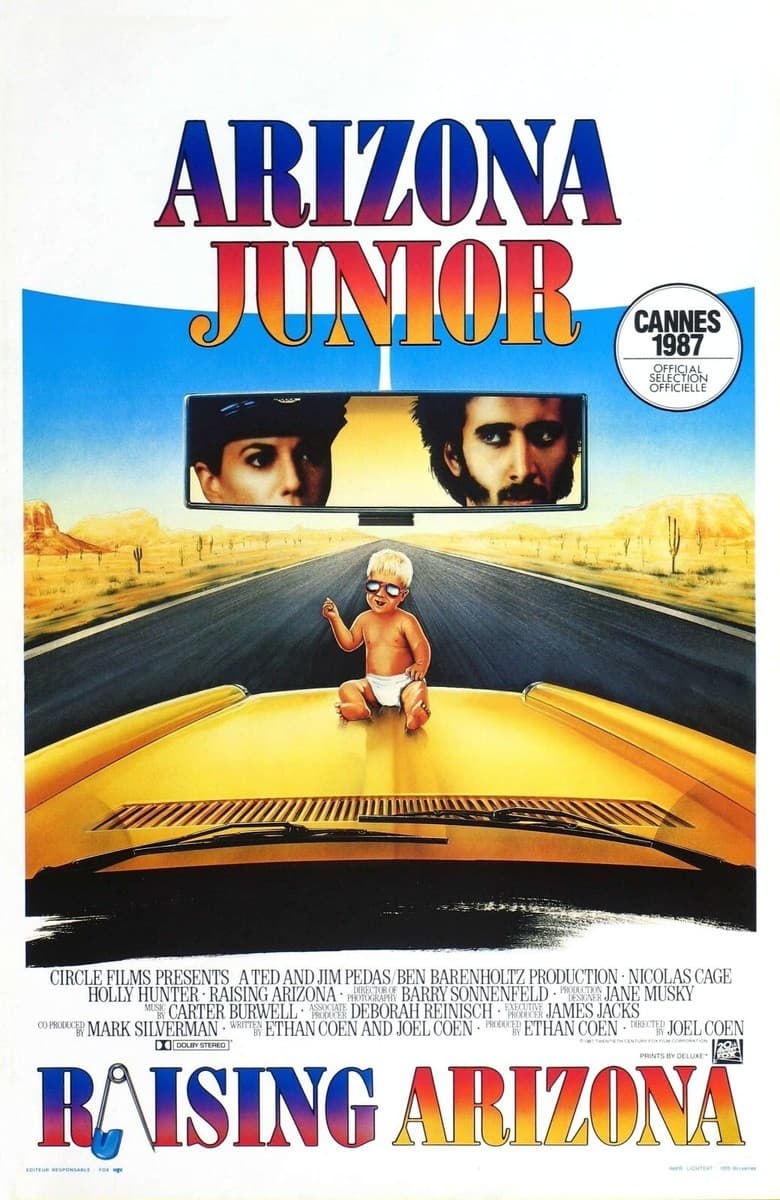
The setup
There are two very loud, very different promises at the heart of Raising Arizona: one is a madcap criminal caper about a stolen baby, the other is a stubbornly ordinary wish for a family. Joel Coen’s 1987 comedy pins both ideas together and refuses to let either one dominate, which is why the movie still feels like a comic tightrope walk worth rewatching.
THE MOVIE
H.I. McDunnough is still the reason this movie works
Talk to anyone who loves Raising Arizona and they’ll often begin, in one way or another, with H.I. McDunnough. He’s a small-time recidivist who narrates the film, and that voice does the heavy lifting: it frames the world, explains the plan and — crucially — tells you why a career criminal would suddenly decide parenthood is the hill worth dying on.
The inciting image is simple and strange: news of a local furniture magnate’s newborn quintuplets colliding with a couple’s long, unhappy run of infertility and the legal bars that keep them from adopting. It’s precisely that domestic longing — not greed or lust for chaos — that pushes Ed to lean on H.I., and that makes the film less a robbery movie and more a story about wanting to belong.
Joel Coen directs a 94-minute piece that never quite settles into one genre: it’s a crime caper, a screwball farce and a black comedy about family. Nicolas Cage plays H.I.; Holly Hunter plays Ed. Between the first ten minutes of H.I.’s extended voice-over and the madcap set-pieces that follow, the film stakes out a personality that still feels distinct.
THE SETUP
The idea that sets Raising Arizona in motion
At its core the film spins from a single, morally peculiar decision: a childless couple decide to kidnap one of the Arizona quintuplets. That act is not giddy villainy; it is presented as an absurd, desperate attempt to make a family happen when the usual routes have been blocked.
Once the baby is taken, the movie stops being a neat one-note gag. The plot’s energy comes from concealment and escalation: the couple must hide the child, H.I.’s criminal past invites trouble, and former cellmates turn up looking for the reward. What begins as domestic wish-fulfilment becomes a chain of consequences.
The Coens move the story through short, highly set-piece-driven scenes — including an extended, kinetic chase — and they punctuate the comic business with H.I.’s fever-dreams about a menacing bounty hunter. Those fantasy moments let the movie lurch from broad farce into briefly surreal, operatic territory without pretending it’s ever entirely realistic.
Behind the chaos there’s also planning: the brothers worked from a finished script and detailed storyboards and shot the film on a modest independent budget. That tight preparation keeps the film lean and gives space for the gags and the strange sequences to land.
THE CHARACTER
Why H.I. McDunnough matters
H.I. is not introduced as a paragon. He’s a recidivist petty criminal, and the movie gives you that information early and plainly. Importantly, it also gives you his wish: a steady domestic life. That private, ordinary desire sits oddly but satisfyingly inside a man whose past is anything but ordinary.
The film leans on H.I.’s narration. The extended voice-over at the start absorbs the viewer into his viewpoint — his improbable logic, his rueful tone, his domestic hopes — and because the story is told from his angle, you’re inclined to understand why kidnapping is a conceivable, if ridiculous, solution.
So H.I. matters because he is the pivot between two tones: his criminal history drags the plot toward chaos, while his longing for family drags it toward something softer. The tug-of-war between those two pulls is what gives the movie its emotional curiosities.
And structurally, the character is efficient: he motivates the central crime, he narrates the moral confusion, and he carries the film’s blend of farce and sentiment without the script needing to spell out which the audience should prefer.
THE PERFORMANCE
Why John Goodman's performance matters
John Goodman’s turn as Gale Snoats registered immediately with critics and audiences at the time. Reviews frequently singled it out as a breakout supporting performance.
That initial attention mattered practically as well as artistically: Goodman’s appearance created a rapport with the Coens that endured, and it marked him as a recurring collaborator in their early ensemble of trusted actors.
In the shape of the film, Gale is one of the forces that turn private chaos into public calamity. The role’s prominence in contemporary commentary helped the movie feel like the start of something — a growing Coen company rather than a one-off oddity.
So when people talk about Raising Arizona’s cast, Goodman’s name keeps coming up because his presence signalled both a memorable supporting part and the beginning of an ongoing working relationship with the filmmakers.
UNDER THE SURFACE
Raising Arizona has more on its mind than the plot suggests
On the surface it’s a crime comedy; underneath it’s a film wrestling with family and parenthood. The couple’s infertility and the legal limits on adoption are not throwaway background — they are the moral and emotional lever that sets everything else in motion.
That pressure — barred from conventional routes to parenthood — pushes the characters into an outlaw solution, and the movie repeatedly plays the contrast between criminal identity and domestic responsibility. The mismatch is where much of the comedy and the pathos come from.
Raising Arizona is also a screwball piece in temperament: it embraces absurdism and rapid reversals, and it lets improbable situations stand in for larger hopes and fears. That tone keeps the film light on its feet even when it’s staging life-or-death chases.
Finally, there’s an appetite for redemption and wish‑fulfilment here. The caper is less about getting rich or evading justice and more about trying, by any means, to build a home. It’s a strange, crooked version of a very human yearning.
THE FILMMAKING
How Raising Arizona was put together
A big part of the movie’s personality is the way it moves. Barry Sonnenfeld’s photography and the filmmakers’ appetite for rapid pacing and dynamic camera work give the comedy a kinetic edge; the action rarely sits still long enough to let jokes cool.
The Coens did not improvise the motion: they worked from a finished script and detailed storyboards, and that planning lets the madcap sequences feel rehearsed rather than scattershot. The resulting precision is one reason the film’s energy reads as deliberate mischief rather than chaos for chaos’s sake.
Jane Musky’s production design and the decision to shoot on location in Phoenix, Scottsdale and Tempe create a sunlit suburban-trailer/motel world the movie exploits for contrast — ordinary domestic spaces repeatedly invaded by criminal absurdity.
All of these choices — photography, storyboards, production design and location work — combine to give Raising Arizona its distinct look and rhythm: a film carefully staged to feel recklessly alive.
PURE 80S
Raising Arizona could not belong to any other decade
This is a film of the 1980s indie moment: it was the Coens’ second feature after Blood Simple and helped cement their reputation within American independent filmmaking of the period.
It was put together on a relatively modest budget — Circle Films raised roughly a mid‑single‑digit million dollar production fund — and that financial reality shaped the filmmakers’ choices: being inventive rather than lavish was the order of the day.
The movie also taps into the decade’s appetite for genre-mixing. It pairs screwball comedy with road-movie energy and kinetic, genre-blending set-pieces; contemporary critics drew lines to both classic screwball comedies and more modern pop-culture touchstones.
Released in 1987, Raising Arizona sits neatly inside that late‑80s moment where independent filmmakers were experimenting with tone and form in ways that didn’t yet belong to mainstream studio pictures.
WATCHING IT NOW
What has aged — and what hasn't
The film’s central preoccupation with family and parenthood still reads as human and immediate: the idea that people will go to absurd lengths to have children is not a period joke, it’s a motive that modern viewers can follow without explanation.
One formal choice that divides opinion is the long opening voice-over. That narrated ten-plus-minute lead-in sets up H.I.’s history and the couple’s hopes efficiently, but its old-fashioned radio-story tone can feel either charmingly theatrical or slightly showy, depending on your tolerance for that device.
What helps the movie hold up is the Coens’ preparation: the finished script and careful storyboards give the film a narrative economy that modern audiences appreciate. The comic set-pieces are sharp because they were planned, which keeps the pace brisk even today.
In short, the emotional premises remain clear and relatable, and the disciplined construction behind the lunacy helps the spectacle still feel purposeful rather than merely dated.
THE LEGACY
Why Raising Arizona still matters
One practical reason the film endures is that it helped cement working relationships that continued to define Coen projects: the movie established repeat collaborations with people like Barry Sonnenfeld and composer Carter Burwell.
John Goodman’s widely remarked supporting turn also mattered beyond this single picture; it became the foundation for a recurring actor-director rapport between him and the Coens.
Artistically, Raising Arizona occupies an important place in the brothers’ early career: it’s the tonal pivot between the darker, more contained debut and the larger-scale, stylistically daring comedies they would go on to make.
So the film’s afterlife is not a single kind of influence but a combination of practical relationships, a growing company of collaborators, and a clear step in the Coens’ evolving approach to tone and genre.
THE VERDICT
Does Raising Arizona still hold up?
Yes — with a small rider. If you respond to a film that wears wild comic ambition and genuine domestic longing in the same breath, Raising Arizona remains a bracing watch. The kidnapping premise is odd and uncomfortable in outline, but it’s always motivated by the couple’s blocked desire for a family, which keeps the picture from being mere anarchic noise.
The film’s early, extended voice-over does a lot of set-up work: it gives H.I.’s past and his courtship with Ed an economy that helps the rest of the film feel earned. After the theft, the story escalates plausibly into a series of consequences — escaped cellmates, a large chase, and those fever-dream bounty-hunter images — and the Coens let the tone slide from farce into a briefly surreal register rather than settling for realism.
There are pleasures that still read clearly: the tight scripting, the visual energy, and the way the movie balances outlaw identity against the yearning for ordinary domestic responsibility. Those elements make it more than an 80s curiosity; they make it a particular kind of comic fable.
So if you’re wondering whether to watch it now, do — especially if you like comedies that are compact, a little wicked and secretly about wanting a home. Raising Arizona is short, strange and stubbornly humane in almost the same sentence.
Share this movie
Keep watching
More movies from the 80s
1986
Jumpin' Jack Flash
Jumpin' Jack Flash: our relationship with technology and freedom, and why this 1986 movie still matters.
Read our take →
1987
RoboCop
A murdered cop rebuilt as a product — RoboCop still asks who gets to sell justice.
Read our take →
1983
Christine
Obsession, adolescence and a car that won't let go.
Read our take →