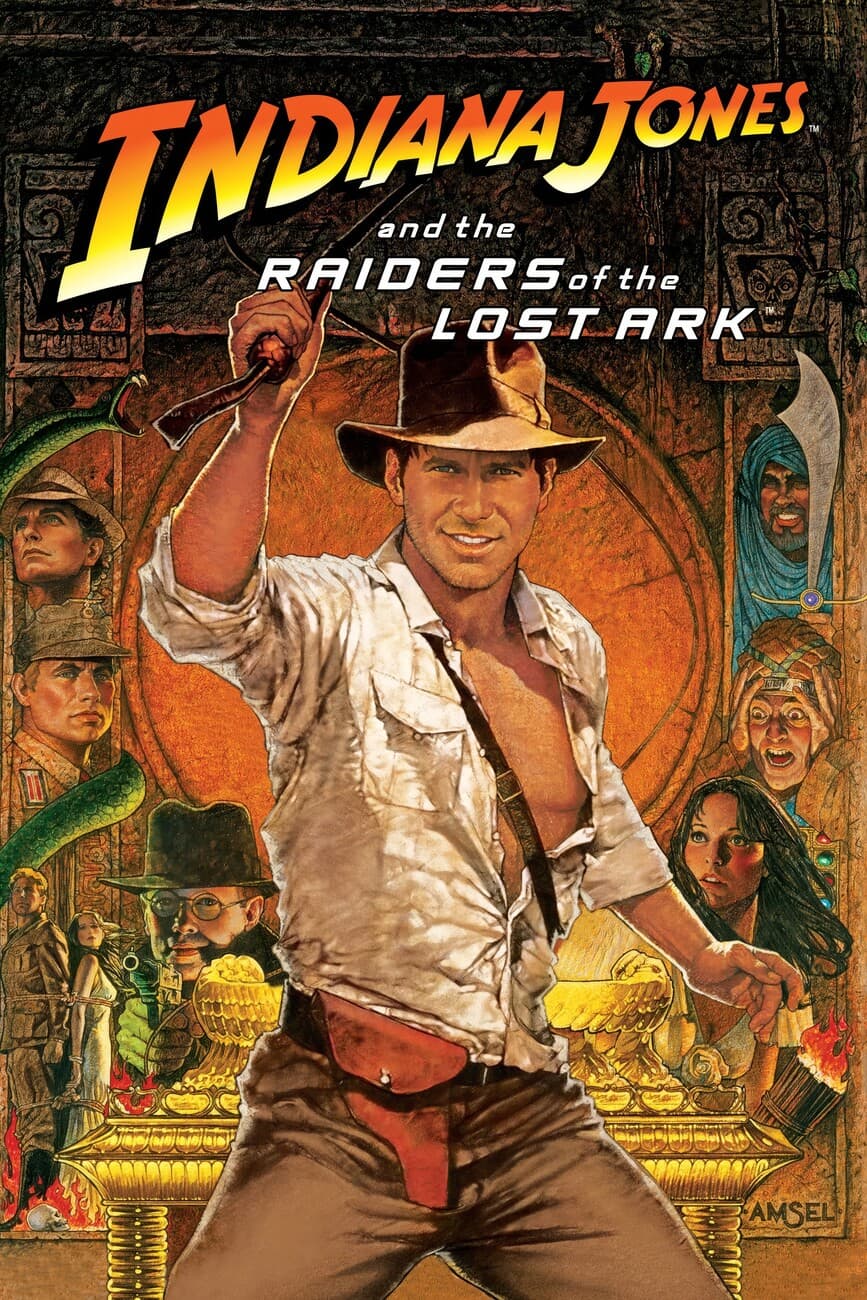
Raiders of the Lost Ark
A museum-minded professor, a globe-trotting chase and a very particular taste in religious artefacts.
The setup
Raiders of the Lost Ark still feels like watching someone get the adventure you used to only read about — fast, clever and a touch ruthless. Steven Spielberg built it around a single force: Indiana Jones, the kind of lead who can make archaeological ethics feel exciting. This is a look back at how that one idea — a sensible academic who will punch a man to protect a relic — carried a whole movie and a franchise.
THE MOVIE
Indiana Jones is still the reason this movie works
People still talk about Raiders of the Lost Ark because it gives us a particular, stubborn hero at the centre of a very greedy chase. Set in 1936, the film pitches Indiana Jones into a race to recover the Ark of the Covenant before it can be seized by the Nazis — and that race is what makes the film tick.
The plot nudge is almost gloriously straightforward: U.S. intelligence brief Jones because Nazi digs in Egypt might have turned up the Ark, and a clue connected to Abner Ravenwood’s research is the only way to make sense of it. That compact setup lets Spielberg keep the camera moving and the story honest to its own serial-adventure roots.
Crucially, Jones is written as a museum-minded archaeologist who would rather see objects available for study than pressed into ideological service. Spielberg’s direction wraps that ethical stance in pace and polish, and the result is a film that still reads like a passionate handshake to old-school adventure cinema.
THE SETUP
The idea that sets Raiders of the Lost Ark in motion
Raiders plants its flag with a tidy premise: 1936, the Ark may be within reach, and Indiana Jones is the man who can read the clues. From that first conversation the film invents a very serviceable engine — a globe-trotting race with clear stakes.
Rather than a single, endlessly unfolding set-piece, the movie prefers familiar beats: booby-trapped temples, map-room puzzles and excavations stitched together. Each episode functions like a chapter in a serial: set up a problem, deliver a perilous solution, then drop a hook that sends you to the next place.
René Belloq plays the story’s opposite number — a rival archaeologist who willingly collaborates with Nazi forces. That professional betrayal sharpens the conflict; this is not just treasure-hunting, it’s stewardship versus exploitation writ large.
Behind that structure is a screenplay credit for Lawrence Kasdan, which keeps the mechanics brisk and clear enough to let the set-pieces breathe without getting lost in explanation.
THE CHARACTER
Why Indiana Jones matters
At the centre of all the crashing doors and narrow escapes is a simple idea: this is an archaeologist who treats objects as things to be known, not trophies to be displayed under a flag. That single professional instinct colours everything he does.
Harrison Ford plays Indiana Jones, and the casting anchors the film’s approach: this isn’t a fantasy wizard or a spotless explorer — he’s a working professor with dirty hands and clear principles. The character’s priorities give every chase a reason beyond spectacle.
Because Jones is defined by what he protects, the plot’s moral tug-of-war becomes personal. When a relic is threatened by ideological use, Jones doesn’t simply want it recovered — he wants it kept available for study, which raises the stakes in a human, believable way.
That practical ethic means the audience isn’t just watching stunts; we’re watching a man defend a set of ideas about history and knowledge. It’s a tidy trick that makes the adventure feel, oddly, respectable.
UNDER THE SURFACE
Raiders of the Lost Ark has more on its mind than the plot suggests
On the surface Raiders is a string of spectacular episodes. Beneath that surface it’s a conscious nod to the serialized adventure pictures of the 1930s and ’40s — those chapter-driven thrillers that kept audiences coming back for the next instalment.
But the film also sketches a sharper moral argument: who gets to possess the past? Indiana Jones represents scholarly stewardship; his opponents represent ideological exploitation. The Ark is less a MacGuffin and more a battleground over that question.
There’s another layer, too: man facing myth. The Ark isn’t merely treasure; it’s a source of faith and power, an object that could transform politics if misused. That elevates the chase from personal to existential.
So while the movie delights in dust and gunfire, its dramatic engine rides on questions about authority, belief and the right to interpret history.
THE FILMMAKING
How Raiders of the Lost Ark was put together
If the film’s pleasures feel effortless, that’s partly because the craft behind them was exemplary and recognised at the time. Raiders won multiple Academy Awards in technical categories — quick proof that the industry noticed the care in its construction.
Those awards covered areas that directly affect how a movie of this kind feels: art direction, editing, sound and the visual effects that let the stunts read convincingly on screen. Each department helped make sure the serial beats landed with clarity.
Steven Spielberg’s direction kept the momentum taut and readable. The technical departments served that aim; nothing in the film’s machinery calls attention to itself for its own sake.
Put simply: the mechanics of the movie were built to support a particular kind of storytelling — fast, clear, and designed so the audience always knows what’s at risk.
PRACTICAL EFFECTS
The effects work that gives Raiders of the Lost Ark its physical personality
A lot of the movie’s personality comes from things you can point at. The boulder that chases Indy, for instance, wasn’t a trick of the edit — it was a large physical prop mounted on an arm-like rig so it could move in a controlled way behind the actor.
Then there’s the famous Well of Souls sequence, which involved the production planning for and handling of thousands of live reptiles. The sequence relied on practical handling of live snakes on set rather than purely optical devices.
Those choices — physical props, creatures in-camera — made the danger feel concrete. You could sense the performance, the crew and the prop all occupying the same space, which suits a film that trades on tactile thrills.
The industry noticed: visual and physical effects work contributed to the film’s Academy recognition, alongside awards for sound and editing, underlining how central practical techniques were to the final result.
PURE 80S
Raiders of the Lost Ark could not belong to any other decade
Raiders was produced by Lucasfilm and released in 1981 at a moment when the modern blockbuster model was consolidating itself. It was positioned to recapture the serial-adventure spirit and present it with late-20th-century polish.
That timing mattered. The film’s commercial success made it one of the highest-grossing pictures of 1981 and helped define what a big adventure movie could look like for the rest of the decade — a mix of spectacle, clear stakes and character-driven momentum.
It wasn’t nostalgia for nostalgia’s sake; it was a conscious repackaging of older storytelling techniques into a new industrial framework, one that could sustain sequels and a wide audience.
In short: Raiders belongs to the early-1980s blockbuster era because it married old-school serial structure to a very modern production and marketing model.
THE LEGACY
Why Raiders of the Lost Ark still matters
Raiders is the first entry in the Indiana Jones franchise and it directly led to additional feature films, television spinoff material, and extensive merchandising. The movie became the seed for a much larger storytelling and commercial ecosystem.
Beyond the marketplace, the film received multiple Academy Awards in technical categories and was later selected for preservation in the U.S. Library of Congress National Film Registry. Those are institutional acknowledgements that the film carries cultural and historical weight.
Put together, the franchise expansion and the institutional recognition explain why the film keeps being revisited: it exists as both entertainment and an artefact of industry taste.
That double status — lively adventure and an approved piece of film history — is part of why people still argue about it, watch it and, sometimes, remake its pleasures in new forms.
THE VERDICT
Does Raiders of the Lost Ark still hold up?
Yes — and here’s why in plain terms. The film is built on a tight, clear premise: Indiana Jones racing to reclaim the Ark before the Nazis can seize it. That simplicity gives every scene a readable imperative.
The structure helps. Rather than one endless set-piece, the movie strings together serial-like cliffhangers — map-room puzzles, booby-trapped temples, excavations — and uses them to keep the momentum honest. Belloq, as Jones’s professional foil working with Nazi forces, sharpens the moral contrast at the heart of the plot.
The characters matter in practical ways. Marion Ravenwood’s loyalty and toughness are not window dressing; they genuinely assist Jones and help move the story. Sallah and Marcus Brody are the reliable allies who keep the logistics of the globe-trotting chase believable and efficient.
Finally, the film’s construction and reception back up its pleasures: its technical craft won Academy Awards and the film has been archived by the Library of Congress. If you want an adventure that still feels purposeful — fast, clever and with a moral spine about what a relic should be — Raiders of the Lost Ark is worth your time.
Share this movie
Keep watching
More movies from the 80s

1986
Jumpin' Jack Flash
Jumpin' Jack Flash: our relationship with technology and freedom, and why this 1986 movie still matters.
Read our take →
1987
RoboCop
A murdered cop rebuilt as a product — RoboCop still asks who gets to sell justice.
Read our take →

1983
Christine
Obsession, adolescence and a car that won't let go.
Read our take →