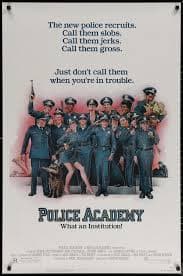
The setup
Police Academy still turns heads because it is unapologetically rowdy and very, very specific about who it is — a 96-minute punch-up between eccentric recruits and an institution that expects them to fail. It’s driven by Carey Mahoney, the likable troublemaker who joins the force to avoid prison and then proceeds to drag everyone else into his mess. Revisit it for the energy: the film is less about tidy plotting and more about a gag-a-minute approach to camaraderie and authority.
THE MOVIE
Carey Mahoney is still the reason this movie works
There’s a very simple engine under Police Academy: the city opens recruitment to anyone who applies, and chaos follows. That oddball policy fills the academy with a class of misfits — people who wouldn’t normally be paired together — and the movie spends 96 minutes enjoying the consequences.
Carey Mahoney arrives for a very unromantic reason: a parking-lot bust leaves him with the choice between jail or the police academy. He picks the academy, and for the rest of the film he’s the unofficial ringleader who nudges this eccentric group into being a team rather than a collection of punchlines.
Directed by Hugh Wilson in his feature debut, Police Academy doesn’t try to be anything other than a broad comedy about underdogs bickering with officious authority. It’s the sort of ragged ensemble picture that critics at the time linked to the Animal House template — fast, loud and intent on getting as many laughs as possible out of mismatched characters.
THE SETUP
The idea that sets Police Academy in motion
The movie’s premise is refreshingly mechanical: the academy must accept anyone who signs up because of a new hiring rule, so you get a class made up of people the institution never expected. That one decision hands the film a natural comic engine and an excuse for endless training-room setpieces.
Mahoney’s personal situation — a parking-lot incident that leaves him choosing the academy over prison — gives him a clear, slightly selfish motive. He’s not a noble crusader; he’s a bloke making the best of a dodgy bargain. That practical origin keeps the character grounded amid the silliness.
From there the structure is episodic. Rather than following a single criminal case, the film strings together training sequences and sight gags: each exercise is an occasion for humiliation, improvisation or unexpected competence from the recruits.
All of which funnels into a tidy dramatic friction: the misfits, led informally by Mahoney, are trying to survive and stick together while instructors and elite cadets do their best to expel them.
THE CHARACTER
Why Carey Mahoney matters
Call him a reluctant hero. Mahoney’s initial goal is to avoid jail, which already makes him more interesting than the typical straight-arrow lead: he’s motivated by self-preservation, not honour. That choice colours everything he does and keeps the comedy propulsive — he’s always got an angle.
Because Mahoney isn’t trying to be a role model, he’s free to be charming in a roguish way. The film relies on him to corral the ensemble; he’s the instigator who spots possibilities in people who are otherwise written off as losers.
He’s also the glue that turns isolated jokes into a group story. Without the cheap moral of the movie — misfits finding their feet together — those gag-based setpieces would remain pleasant noise. Mahoney gives them a reason to cohere.
And that mattered enough to the filmmakers to keep sending the character back: he’s one of the principals who continues across the sequels, which suggests the film saw him as more than a one-off joke.
UNDER THE SURFACE
Police Academy has more on its mind than the plot suggests
At surface level Police Academy is about pratfalls and quick-fire jokes, but the movie keeps returning to the pleasure of misfits finding a place. That camaraderie — a ragtag group figuring out how to work together — is what gives the film a beating heart beneath the broad gags.
There’s also a streak of institutional mockery running through it. The open-recruitment rule invites the comedy, and the academy’s rituals and officious instructors become targets for satire: the film enjoys poking holes in a bureaucracy that prides itself on order.
And then there’s the humour itself: deliberate, broad and often sexual in tone. The laughs are built from spectacle and embarrassment as much as wordplay, which makes it very much a product of its comic tastes.
Put together, the movie is a package of misfit-hero storytelling, a lampoon of authority, and an appetite for big, physical jokes — all serviced by the ensemble’s ability to play off one another.
THE FILMMAKING
How Police Academy was put together
Hugh Wilson came to this as a TV writer-director stepping into his first feature, which shows in the film’s brisk, scene-driven approach. The screenplay was shaped by Neal Israel and Pat Proft with Wilson revising, and the final product feels like a TV-trained director staging punchlines for a mass audience.
Visually, the movie isn’t trying to be arty. It prefers rapid-cut setpieces and clear physical-comedy blocking — everything designed so jokes land cleanly rather than to announce a personal visual signature. That economy keeps the pace choppy and, crucially, comic.
Because the direction prioritises staging over stylish camerawork, the film’s identity becomes the rhythm of the gags: quick setups, physical payoffs, and the odd character beat to move the ensemble along.
In short: it’s a director’s debut that knows what it is — a gag factory — and arranges production around that purpose.
PRACTICAL EFFECTS
The effects work that gives Police Academy its physical personality
There aren’t special-effects setpieces here; the movie’s physical personality comes from stunt work and the careful staging of slapstick routines. Falls, pratfalls and choreographed chaos are executed practically, so the comedy depends on timing and physical bravery rather than optical trickery.
That emphasis on real-world stunts ties into the film’s broader feel: it’s tangible, immediate and sometimes gloriously clumsy. The humour is a matter of bodies and timing rather than visual sleight of hand.
Because the gags live in the moment — a stumble, a collision, an awkward embrace — they read plainly to an audience: you don’t need post-production wizardry to get the laugh.
It’s an old-fashioned approach, but perfectly suited to a movie that chooses sight gags as its primary language.
PURE 80S
Police Academy could not belong to any other decade
Released in March 1984, Police Academy arrived at a moment when broad ensemble comedies — including raunchier fare — were finding big audiences. Its appetite for group-based, lowbrow laughs fitted neatly into the commercial tastes of the era.
The production also followed a familiar 1980s pattern: while an American picture, principal photography took place in Toronto, reflecting how many U.S. films leaned on Canadian locations and crews for budgetary reasons.
The studio model of the time loved properties that could turn into cheap, annual sequels; Police Academy’s quick follow-ups are a textbook example of that appetite for franchisable, low-cost comedy.
All of which makes the film feel like an 80s product in intention as well as style: designed to be immediately consumable, cheaply repeatable and easy to slot into a franchise schedule.
WATCHING IT NOW
What has aged — and what hasn't
A modern viewer will notice the film’s humour is very much rooted in 1980s lowbrow and sexualised comedy. That tone doesn’t land for everyone today; some viewers find elements dated, even awkward.
But the ensemble beats — the dynamic of outcasts discovering they’re better together than apart — still has a straightforward charm. Where the comedy depends on quick character recognition, those moments can still register.
The fact the movie kept bringing back the same principals for sequels shows how central those character relationships were to the property’s appeal; the personalities survived the immediate jokes enough to support more films.
So, parts of it feel of their time while other parts — the misfit camaraderie — continue to do useful work for a contemporary audience.
THE LEGACY
Why Police Academy still matters
Police Academy’s lasting footprint is largely practical: it became a multi-film franchise with six sequels and even spin-offs in television and animation, which kept its characters visible long after 1984.
Those recurring characters — Mahoney, Jones, Tackleberry, Hightower, Hooks, Lassard and Harris — formed the backbone of the franchise. The studio kept returning to them because their comic identities were easy to recognise and repeat.
And from a business perspective, the film’s commercial performance made it possible for the producers to greenlight consecutive annual sequels through the 1980s; it proved to studios that low-cost, character-driven comedies could be reliably franchised.
So Police Academy matters less as a singular masterpiece and more as a successful formula: an ensemble of memorable types you could keep putting into the same joke machine.
THE VERDICT
Does Police Academy still hold up?
Short answer: yes — if you approach it on its own terms. The film is built around a deliberately loose conceit (open recruitment) that creates an obvious comic structure: episodic training sequences, sight gags, and a central clash between the misfits and academy authority.
Carey Mahoney’s motivation — choosing the academy over jail — gives the picture a roguish centre and a plausible reason for his mischief. He isn’t doing noble work; he’s keeping himself out of trouble while helping the others find confidence.
The film’s satire of bureaucracy is broad rather than subtle: authority figures exist to be lampooned and Lieutenant Harris in particular is there to push the recruits out. That clear opposition keeps stakes simple and makes room for plenty of setpiece humour.
So if you want a tidy, witty deconstruction of institutions, look elsewhere. But if you want a handful of ingenious pratfalls, an ensemble that clicks when it needs to, and the novelty of Michael Winslow’s sound-effect tricks woven into the script, Police Academy remains worth a watch.
Share this movie
Keep watching
More movies from the 80s
1986
Jumpin' Jack Flash
Jumpin' Jack Flash: our relationship with technology and freedom, and why this 1986 movie still matters.
Read our take →
1987
RoboCop
A murdered cop rebuilt as a product — RoboCop still asks who gets to sell justice.
Read our take →
1983
Christine
Obsession, adolescence and a car that won't let go.
Read our take →