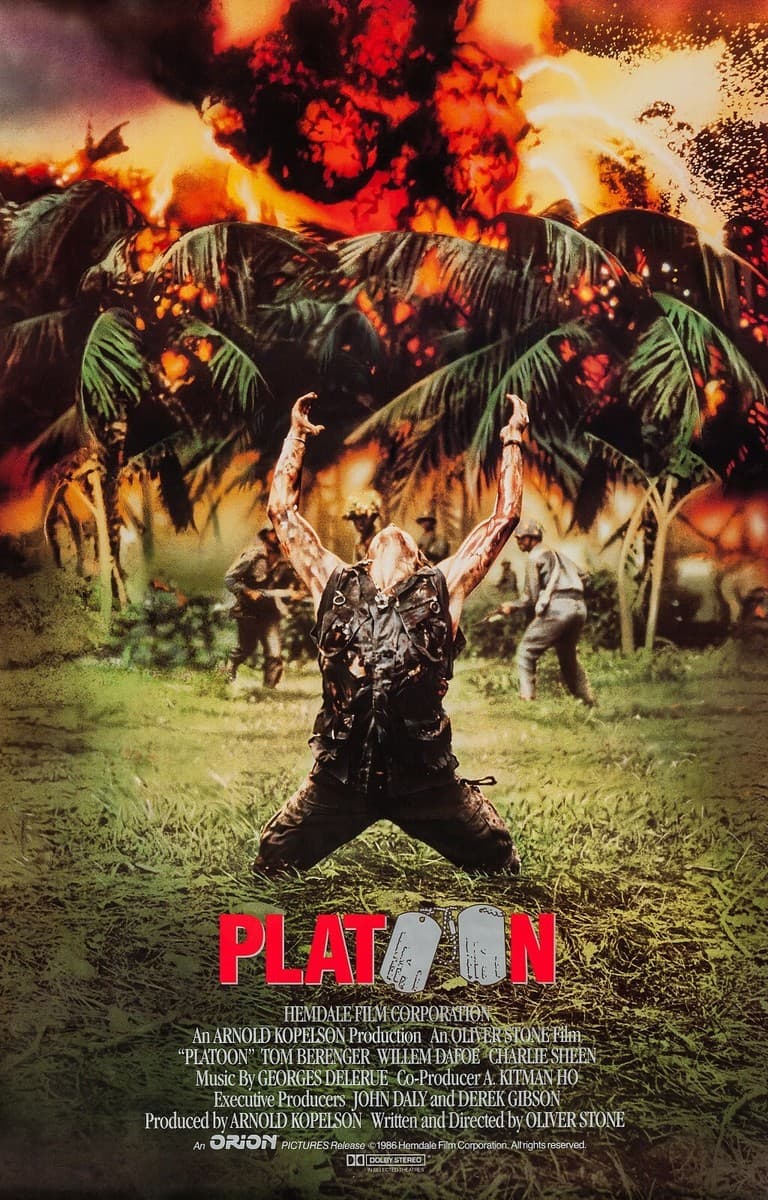
The setup
Platoon doesn’t open with a sermon about the futility of war. It opens with a kid from back home stepping into something that will test him in ways no training manual can foresee. Oliver Stone’s Vietnam film keeps pulling you back because it gives the viewer a proper place to stand: Chris Taylor’s point of view, and the argument inside his platoon.
THE MOVIE
Chris Taylor is still the reason this movie works
If you remember one thing about Platoon it’s not a single firefight; it’s the way the film asks you to sit next to Chris Taylor as he learns the job and loses his illusions. The film follows a volunteer recruit who arrives in South Vietnam and, crucially, stays inside the platoon’s point of view rather than treating the war as a distant spectacle.
That choice matters because the engine of the movie is not strategy or politics but a moral and command fight inside the unit — the fracture between a ruthless Staff Sergeant Barnes and a more compassionate Sergeant Elias. The argument between those men isn’t abstract; it dictates how everyone else behaves, and it’s what forces Taylor to choose — or fail to choose.
Oliver Stone directs the whole thing with the urgency of someone who knows the terrain. Released in 1986 and running roughly two hours, Platoon centres on that erosion of idealism: Charlie Sheen’s character starts a volunteer recruit and ends up a young man who has had his ethics tested to pieces.
THE SETUP
The idea that sets Platoon in motion
Platoon’s premise is simple and tight: a volunteer is shipped to Vietnam in 1967 and assigned to an infantry platoon operating near the Cambodian border. That geography matters only as a backdrop — the film is less interested in manoeuvres than in how the men inside the platoon learn to live with each other.
Stone frames the story through the perspective of Chris Taylor, and the film uses voice-over material drawn from his letters as a narrative device. That choice gives the audience a way in: we are not omniscient observers, we are reading the experience along with Taylor.
From that vantage the immediate dramatic motor becomes clear. The platoon is split by a command-and-moral conflict between two non-commissioned officers: the hard-line Barnes and the more humane Elias. Their differences don’t stay abstract — they shape orders, loyalties and who survives the next patrol.
So the setup works because the film stakes its drama on intimate, daily choices rather than grand strategy. Platoon is interested in what men do to one another when authority breaks down and character — not rank — decides fates.
THE CHARACTER
Why Chris Taylor matters
Charlie Sheen plays Chris Taylor, but the point here isn’t star wattage — it’s perspective. Taylor is the lens through which the movie measures moral corrosion. He shows us how a recruit’s neat ideas about right and wrong begin to fray under pressure.
There’s an economy to making Taylor the viewpoint character. Instead of preaching about war, the film lets us watch a young man’s ideals wear down, step by step. That slow erosion is what makes his journey memorable: you can see the choices arriving before he makes them.
Taylor also stands in for the film’s larger theme of brotherhood versus division. The platoon pretends to be a family, but factions form quickly. Taylor’s loyalties — who he trusts, who he doubts — carry more weight than any grand statement about the conflict.
In short, Taylor matters because Platoon asks us to learn the lesson at his pace. The film is less interested in telling you how to feel about the war than in letting you feel it the same way the recruit does: uncertain, stubborn and gradually more cautious.
UNDER THE SURFACE
Platoon has more on its mind than the plot suggests
On the surface Platoon is a war drama. Beneath that surface it’s a coming-of-age story in which loss of innocence happens under fire. That phrasing makes the point: the film treats combat as the environment where a young man’s moral education is performed, not merely where battles are won or lost.
Moral ambiguity is the film’s steady companion. Orders and survival tactics become tangled with personal judgments; right and wrong aren’t neat categories but arguments to be won or survived. That ambiguity is the engine that keeps scenes tense even when nothing cinematic is exploding.
Leadership and authority are explored through men who teach different lessons. One sergeant’s creed is about discipline and domination; the other believes in a humanity that can be preserved even in war. The platoon fractures because those models of authority produce different behaviours from the people who follow them.
Brotherhood versus division is the theme that ties those ideas together. Platoon asks whether comradeship can withstand competing moral codes. The question is urgent because it’s practical: when a unit splits, so does the ability to make ethical decisions as a group.
THE FILMMAKING
How Platoon was put together
A lot of Platoon’s power runs through the way it’s put together. Two verifiable production facts are worth flagging: Robert Richardson was the cinematographer, and Claire Simpson edited the film — Simpson later won the Academy Award for Best Film Editing.
Editing here is not decoration; the Oscar recognition points to an editorial approach that kept the film urgent and coherent across a dense two-hour runtime. The cuts help the narrative stay on Taylor’s nerve-ending perspective, moving from patrol to patrol without losing emotional continuity.
Naming Richardson and Simpson isn’t name-dropping. It’s noting that the movie’s look and its pace are creditable parts of how the story lands. The filmmaking choices are the scaffolding that lets the moral arguments inside the platoon come into focus.
And because Stone wrote and directed the screenplay from his own experiences, those filmmaking elements are allied to a very personal point of view rather than a detached, newsreel approach.
PRACTICAL EFFECTS
The effects work that gives Platoon its physical personality
Platoon relied on practical, on-location staging rather than studio trickery. The production staged large-scale jungle patrols, village sets and coordinated combat choreography on location in the Philippines to create the film’s physical feel.
That approach extended into training: reports document the use of military blank ammunition during training and staged exercises to simulate battlefield conditions for cast and crew. The crew chose real-world measures to make the actors and action respond like a functioning platoon.
Those choices are practical in the old-fashioned sense: build it, rehearse it, run it. The result is a physical texture to scenes that supports the film’s insistence on lived-in, consequential decision-making.
So when the film feels tactile — the dirt, the patrol rhythm, the way squads move together — much of that comes from hands-on staging rather than optical or miniature substitutes.
PURE 80S
Platoon could not belong to any other decade
Platoon arrived in 1986 at a moment when American cinema was revisiting Vietnam with a sharper, less nostalgic eye. It’s frequently identified as the first major mainstream feature about the war written and directed by a veteran of that conflict — and that vantage gave it a different authority than earlier films.
The film’s release and awards success in 1986–87 also helped establish Oliver Stone as a director working through recent historical conflicts, rather than a maker of period fantasies. That mattered for the 1980s because audiences and critics were ready for films that looked back with a mixture of personal memory and public reckoning.
So while Platoon contains the era’s appetite for cinematic scale, it’s its veteran-authored perspective that roots it in the decade: an 80s film that insists on directness rather than distance.
Put simply: it’s 1986 in the way it chooses a teller who was there, and then lets that teller take us through what being there actually did to a person.
THE LEGACY
Why Platoon still matters
A straightforward reason the film remains part of the conversation: it won four Academy Awards, including Best Picture and Best Director, and those wins are central to how people remember the picture.
Platoon also operates as a career-defining moment. It helped raise the profiles of several cast members and of Dale Dye, the military technical adviser, so the movie’s production and personnel are often cited when discussing authentic portrayals of infantry life.
Beyond trophies and careers, Platoon continues to be referenced in discussions of how cinema depicts Vietnam. The image that sticks isn’t a single heroic act but the way internal platoon conflict becomes the story’s beating heart — Chris Taylor between two conflicting sergeants remains the shorthand people return to.
Put together: the awards, the personnel and the clear moral argument all give Platoon a lasting place in conversations about the war on film.
THE VERDICT
Does Platoon still hold up?
Yes. Platoon still works because its commitments are clear and narrow: follow Chris Taylor into a platoon, watch the moral conflict between Barnes and Elias fracture loyalties, and see how that pressure reshapes a young man. The narrative stays close to that experiment for roughly two hours and doesn’t try to be a history lesson.
Part of the film’s staying power comes from its origins. Oliver Stone wrote the screenplay from his own experiences as an infantryman, and he modelled the protagonist and the opposing sergeants on men he knew. That personal stake gives the movie a focused seriousness rather than rhetorical flair.
Contemporary reviewers singled out the principal performances as central to the film’s impact, and key supporting players received Academy Award recognition. Those acknowledgements underline how the material landed on first release: people noticed the human argument the picture was staging.
If you’re choosing whether to watch it now, go for the moral tightrope. Platoon still feels like a film that prefers questions to tidy conclusions — and that’s exactly why it remains worth seeing.
Share this movie
Keep watching
More movies from the 80s
1986
Jumpin' Jack Flash
Jumpin' Jack Flash: our relationship with technology and freedom, and why this 1986 movie still matters.
Read our take →
1987
RoboCop
A murdered cop rebuilt as a product — RoboCop still asks who gets to sell justice.
Read our take →
1983
Christine
Obsession, adolescence and a car that won't let go.
Read our take →