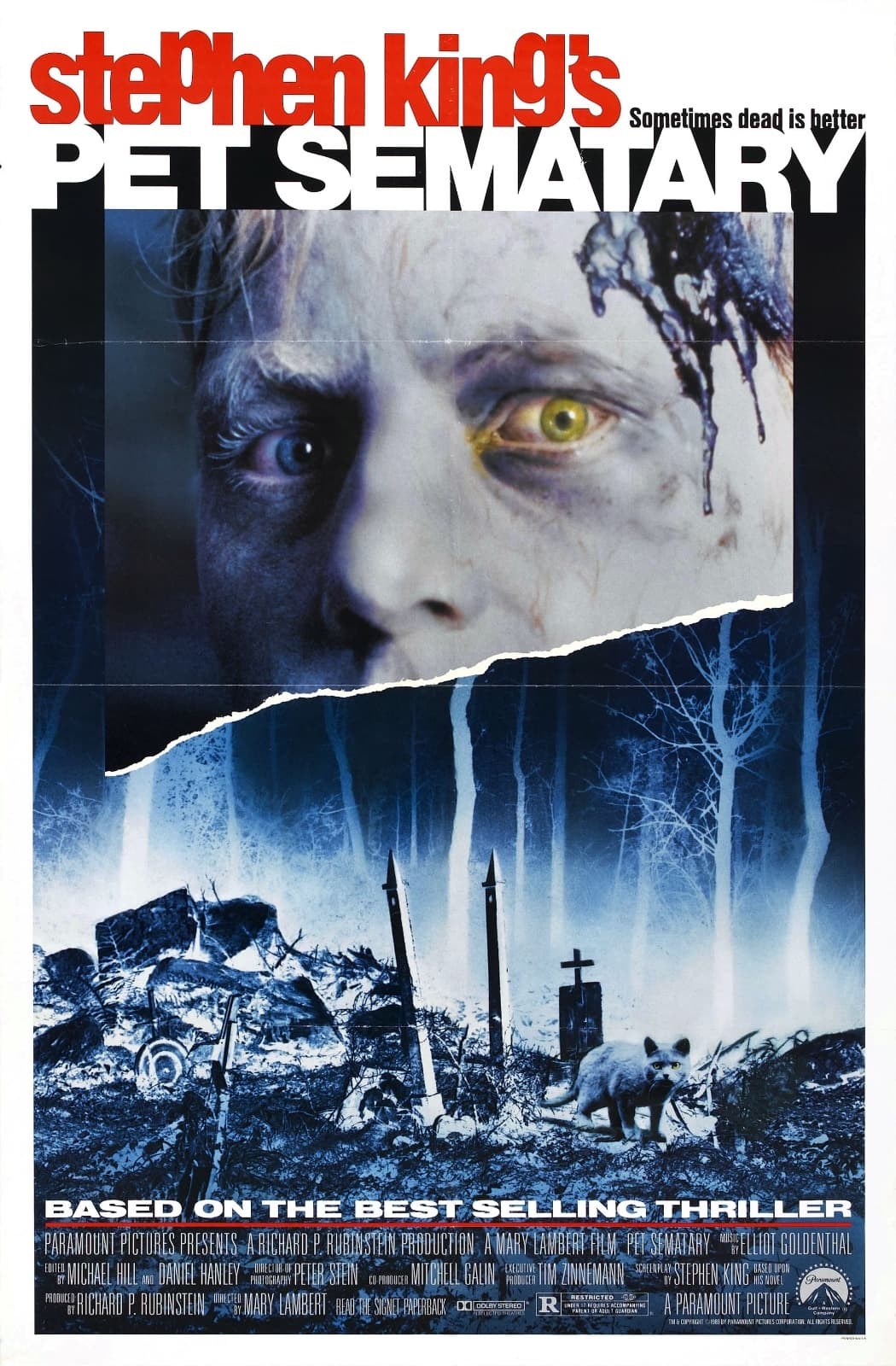
The setup
Pet Sematary is the sort of horror that crawls out from under the suburban doormat: a family move, a charming local, and a rule you absolutely should not break. Mary Lambert’s 1989 adaptation keeps its focus tight on Louis Creed — a practical, medically trained man whose terrible choice is the engine of everything that follows.
THE MOVIE
Louis Creed is still the reason this movie works
The movie slips in like an ordinary family drama until one small, devastating decision makes the entire house look unstable. Louis Creed moves his wife and two young children to a rural Maine home beside a pet cemetery — and beside another, older burial place the local Jud Crandall quietly explains to him.
When the family cat, Church, is killed on the road nearby, Jud suggests a burial in that older ground. The animal comes back. Different. Altered. That moment is the hinge: Pet Sematary is less interested in shock for its own sake than in what grief does to people who will not accept limits.
Dale Midkiff’s Louis is written as a practical, medically trained man, which is why his descent feels unsettling — a rational person pushed by desperation into choices that unravel the family. Mary Lambert directs the whole thing with an eye for family detail and escalating dread in this compact 102-minute story.
THE SETUP
The idea that sets Pet Sematary in motion
The premise is plain and, crucially, believable: a family moves into a quiet house beside a pet cemetery and, beyond that, an older Micmac burial ground that the neighbour, Jud, quietly knows about.
A roadside accident kills the Creed family’s cat, Church. Jud urges Louis to try the ancient burial place; the pet is returned, but not as it was. That single sequence turns a domestic drama into a story about curiosity and the price of refusing death.
THE CHARACTER
Why Louis Creed matters
Louis is the clearest thing the film has. He’s not a brooding, mysterious figure — he’s practical, trained in medicine, the sort of man who expects to solve problems. That ordinary competence makes his later choices feel none the less devastating; they read as desperate, not theatrical.
His relationship with Jud is important: Jud is the avuncular local who knows the burial ground’s history and, by nudging Louis, becomes both guide and reluctant instigator. That dynamic — a pragmatic outsider persuaded by a kindly neighbour — gives the moral tension real shape.
The family is written so the children are central to Louis’s decisions. Ellie and Gage sit at the emotional heart of the household; their vulnerability is what makes the stakes personal and believable rather than abstract.
THE PERFORMANCE
Why Fred Gwynne's performance matters
Fred Gwynne’s Jud is the film’s emotional anchor. Contemporary responses singled his presence out — not because he overplays the part, but because he grounds the story in a sort of weary, avuncular certainty.
In a movie where shock can easily tip into the absurd, having a steady, familiar figure who both knows the old stories and casually advises dangerous actions gives the horror a believable human face. Reviews noted that anchored quality at the time, and it’s easy to see why.
UNDER THE SURFACE
Pet Sematary has more on its mind than the plot suggests
At its simplest, the film is about grief and what happens when people refuse to accept death. That refusal is corrosive: it reshapes judgment and steals the small rational decisions that hold a family together.
There’s also a clear current of parental guilt. The story makes parental love the obvious motivation for terrible choices — not because the parents are villains, but because they are fallible people with an unbearable fear of loss.
And running underneath is the clash between local taboo and rationalism: an old burial ground full of warnings meets a medically trained outsider who thinks he can apply logic to tragedy. The collision of those worldviews is what turns a private sorrow into something monstrous.
THE FILMMAKING
How Pet Sematary was put together
Some of the movie’s texture comes from careful production choices. The team built a substantial 'deadfall' on set — piles of scrap wood mounted to form the concentric rings of the pet cemetery — so the place feels physically lived-in rather than painted on.
Credits name Richard P. Rubinstein as producer, Peter Stein as cinematographer and Michael Z. Hanan in charge of production design — the people responsible for turning Maine locations into a convincing domestic world that can be broken by a single, terrible decision.
Those grounded production elements matter because the story depends on the ordinary feeling of family life collapsing into the supernatural. The design work gives the movie its practical, tactile identity.
PRACTICAL EFFECTS
The effects work that gives Pet Sematary its physical personality
The film leans on physical work to sell its moments. For at least one attic scene, the production built a fully articulated puppet of the child actor, which lets the film stage a difficult sequence without risking an actual child.
The pet cemetery’s deadfall was realized on set by suspending truckloads of scrap wood on poles to create an organic-looking barrier. That kind of hands-on construction gives the scenes a tactile awkwardness that supports the film’s dread.
These are not headline-grabbing spectacles; they’re practical measures that let the story be staged convincingly and, at times, discomfitingly close.
PURE 80S
Pet Sematary could not belong to any other decade
Pet Sematary arrived in 1989 amid a run of high-profile Stephen King adaptations; it was, notably, the first time King adapted one of his own novels for the screen. That connection to a bestselling author gave studio horror a kind of literary legitimacy late in the decade.
Its mix of family drama and graphic supernatural horror is very much of its moment: studio horror in the late 1980s often married mainstream stars and domestic setups to genuinely shocking elements, and Pet Sematary fits that pattern neatly.
Mary Lambert’s film both benefits from and belongs to that context — it treats small-town family life as the staging ground for larger, more horrifying consequences, a choice Hollywood was comfortable investing in at the time.
THE LEGACY
Why Pet Sematary still matters
On its opening weekend the film hit No. 1 at the U.S. box office, which is one concrete sign it connected with audiences on release and gave Paramount a commercially successful run.
It spawned a studio sequel with Mary Lambert returning in 1992, and the novel was adapted again for the 2019 remake — both facts that show the story has continued life beyond the original film.
There’s also a musical footnote: the Ramones wrote and performed the movie’s title song specifically for the film, and that track became one of the band’s more prominent later-period singles. It’s a reminder the film reached beyond just the horror audience.
THE VERDICT
Does Pet Sematary still hold up?
Yes — but with a small, important rider. If you’re watching for a tight, unsettling horror about what grief can drive people to do, Pet Sematary remains powerful. The film places everyday family life — moving house, parental promises, routines — against an escalating supernatural consequence, and that contrast still cuts.
A central turning point is the accidental death of the Creed family’s toddler, which forces Louis into the terrible option of using the burial ground. The movie treats resurrection as a corrupting, dangerous force: returned animals and people behave unnaturally, and the consequences are personal and immediate.
Dale Midkiff’s Louis is written as a practical, medically trained man whose grief and desperation propel the moral collapse at the story’s core; that personal logic keeps the film from being mere shock-horror. Mary Lambert’s direction holds it together in a compact 102 minutes, and the production details — from the set deadfall to the practical puppet work — keep the world tangible.
If you want an effects-driven, modern reinterpretation, the remake exists. But if you want a late-80s studio horror that is still willing to ask uncomfortable questions about love, loss and where a parent’s duty ends, this original Pet Sematary is worth your watch.
Share this movie
Keep watching
More movies from the 80s
1986
Jumpin' Jack Flash
Jumpin' Jack Flash: our relationship with technology and freedom, and why this 1986 movie still matters.
Read our take →
1987
RoboCop
A murdered cop rebuilt as a product — RoboCop still asks who gets to sell justice.
Read our take →
1983
Christine
Obsession, adolescence and a car that won't let go.
Read our take →