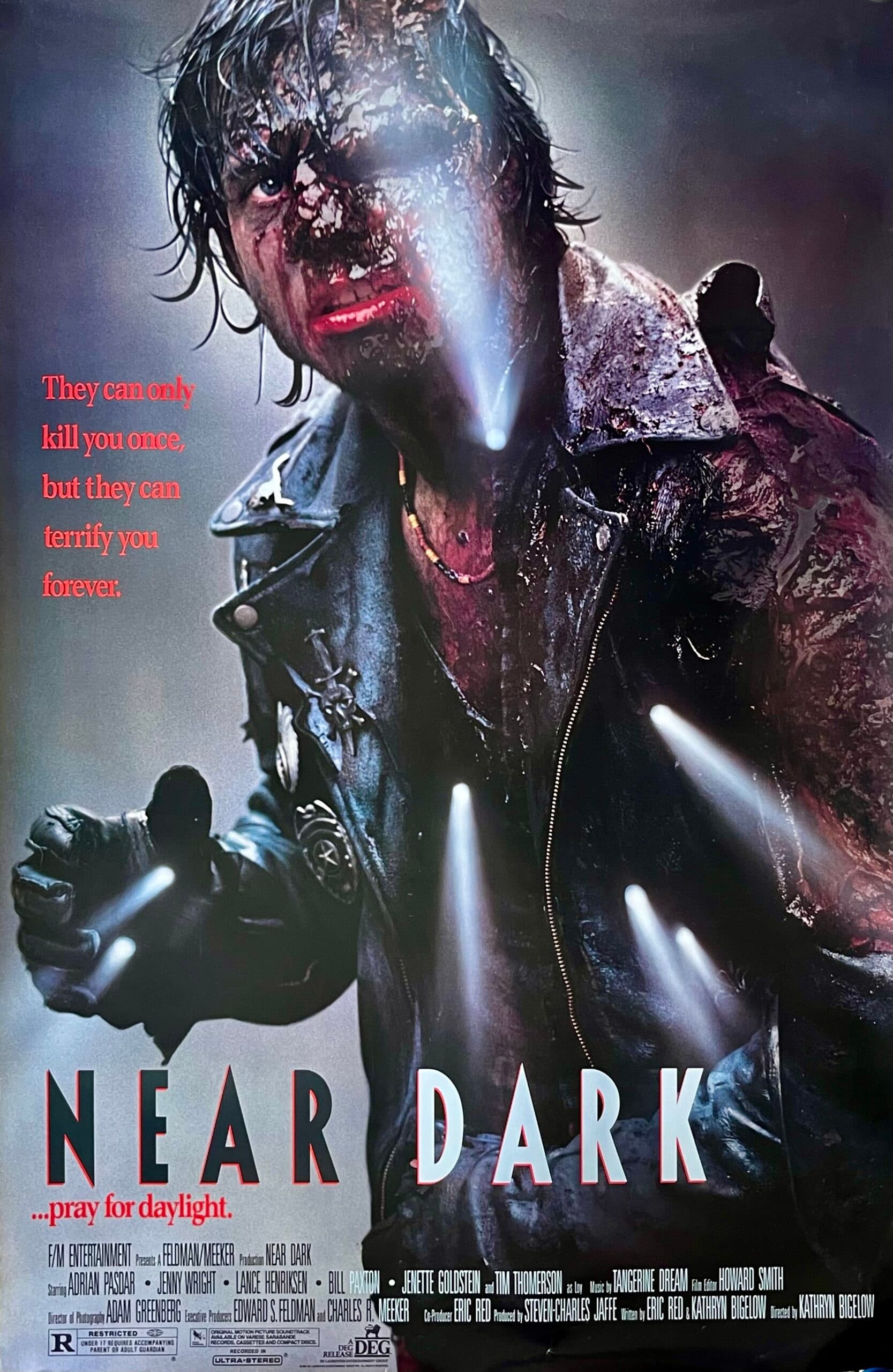
Near Dark
A road romance that turns into a hunt — and Caleb is the moral compass that keeps you watching.
The setup
Near Dark isn't a fogbound Gothic romp; it's a lean, mean American road-horror that starts when a young drifter named Caleb meets Mae and, quite quickly, nothing about his life is ordinary anymore. Kathryn Bigelow and Eric Red graft a vampire story onto a western-road template, and the movie's heartbeat is the choice Caleb must make between a settled life and a violent, nomadic tribe.
THE MOVIE
Caleb is still the reason this movie works
Near Dark wears its categories like a deliberately mismatched outfit: part western, part vampire picture, all lean thriller. What keeps it from feeling like a gimmick is Caleb — the ordinary kid who gets bitten, then pulled into a nomadic gang that preys on small towns.
That first meeting with Mae is the plot's icebreaker: it's romance as inciting incident. She isn't just a love interest; she's the recruiter who yanks Caleb out of a settled family life and into the group's orbit, and that tug — between home and exile — is the engine of the whole film.
Because Caleb stands in for us, his decisions matter. He isn't a bystander to the horror; he's the audience surrogate whose moral choices push the story forward. Kathryn Bigelow directs a tight 95-minute thriller that uses genre mixing to ask whether belonging is worth the compromise.
THE SETUP
The idea that sets Near Dark in motion
At its simplest, the film follows Caleb, a young drifter who is bitten and drawn into a nomadic group that preys on small towns. That's the premise, and it's tidy enough to let the movie get on with the discomforts of what that life demands.
What gives the premise weight is the moral question at its centre: Caleb must choose whether to remain with this violent, roaming group or to try to go back to his family and an ordinary life. It's a clear, human tug-of-war rather than an abstract theoretical debate.
There is also a practical plot device that matters: the story introduces the idea that a human blood transfusion can cure vampirism — a riff on older bloodletting ideas adapted from classic vampire lore. It's the kind of detail that keeps the horror game grounded in physical stakes.
Because the setup is compact, the film can spend its time staging temptations and consequences instead of filling in backstory — which suits a movie built around a sudden, life-altering choice.
THE CHARACTER
Why Caleb matters
Caleb is the film's hinge. Played by Adrian Pasdar, he's the ordinary figure whose induction into the gang lets the audience experience the group's rules, its seductions and its cruelties at close range.
Importantly, Caleb isn't a cipher. The story treats his choice as consequential: when he flinches, hesitates or fights back, it changes the group's direction. That gives the horror a moral dimension — this isn't only about surviving the night, it's about deciding who you want to be.
Mae complicates everything. As both love-interest and the person who recruits him, she embodies romantic initiation and temptation: she's the doorway to a shared outlaw life and the reason Caleb begins to see exile as an option.
So Caleb matters because the film asks us to follow his particular failure and courage rather than an abstract parade of monsters. His perspective is the drama's pulse.
UNDER THE SURFACE
Near Dark has more on its mind than the plot suggests
On the surface it's a vampire road movie; underneath, it's a compact study of belonging versus exile. The nomadic gang offers a perverse kind of community — fiercely loyal, violently mobile — and the film asks what price comes with that loyalty.
Romantic initiation is threaded through the plot. Mae's attraction to Caleb isn't just sexual; it's recruitment. The romance is also a rite of passage, and the film treats temptation as both intimate and social — a private choice with public consequences.
Monstrosity versus humanity is never posed as a metaphysical puzzle. Instead, the film stages small moments where the group's predatory life brushes up against ordinary compassion. Those moments make you wonder whether the actors labelled 'monsters' are more complicated than they first appear.
Finally, nomadism and predation act as two sides of the same coin: mobility brings freedom, but it also requires a constant taking. The film squeezes drama out of that contradiction.
THE FILMMAKING
How Near Dark was put together
One practical choice that shapes the film's look is its dependence on late-evening and early-morning 'magic hour' light. About a third of the schedule needed those short windows, which gives sequences a consistent, liminal feel — neither the bleach of full daylight nor the flatness of night.
That dusky light suits a story about creatures who live between states. It creates the sense that things are always on the verge of shifting, which is exactly what the narrative asks of Caleb.
Kathryn Bigelow's direction keeps the film compact — the runtime is economical, and the shooting choices favour momentum over exposition. The result is a small-scale genre film that feels tightly controlled rather than sprawling.
Those production constraints end up being assets: they sharpen the drama and keep the audience focused on the immediate choices on screen.
PRACTICAL EFFECTS
The effects work that gives Near Dark its physical personality
The film's depictions of sunlight damage rely on physical solutions. The production used a portable smoke device placed under costumes and prosthetics to create the illusion of smouldering skin when characters are exposed to sunlight.
Close-ups were handled with facial prosthetics constructed to show searing and decay, with smoke tubed under the prosthetics to sell the effect in tight shots.
When on-set conditions — usually wind — made the smoke gadget unreliable, some flame and smoke effects were added optically in post-production. That pragmatic mix of practical and optical fixes kept sequences convincing under tricky conditions.
Stunt ingenuity helped too: a special undercarriage and a platform attached to a truck were built for sequences where a performer needed to be dragged or to climb, letting the film stage dangerous moments with the necessary physical rigs.
PURE 80S
Near Dark could not belong to any other decade
Bigelow and Eric Red framed Near Dark as a western-horror hybrid, which plugs it squarely into the late-1980s hunger for genre mashups — action, horror and road-movie tendencies braided together so films could feel familiar and new at once.
The film also illustrates the era's casting habits: it reunited three performers from a successful 1986 genre picture, reflecting the informal networks that circulated actors through commercial projects of that period.
Its festival run and autumn release in 1987 placed it alongside other American vampire films of the year; being in that conversation helped define its contemporary context even if the tone was very different from some peers.
All of that — the hybrid ambition, the cast crossovers and the release moment — make Near Dark feel like a product of its time without relying on surface nostalgia.
WATCHING IT NOW
What has aged — and what hasn't
As a vampire film, Near Dark retains the punch of its premise: the hunted/ hunter flip and the moral choices Caleb faces still land. The genre mechanics hold up because they're used to force character decisions, not just to showcase effects.
The film's interest in belonging versus exile remains its most resonant thread. That question — do you stay with the safety of family or join a dangerous chosen community? — is no less urgent now than it was in 1987.
Some casting details that feel of-the-period are harmless curiosities today: smaller roles are filled by names who would go on to be recognisable in other genre work, and that continuity is amusing rather than distracting.
Finally, the western-horror hybrid approach still reads as a neat creative choice rather than a novelty. The fusion of road movie and vampire predation gives it a distinct rhythm that modern viewers can still appreciate.
THE LEGACY
Why Near Dark still matters
Near Dark earned festival recognition in Europe, including a grand prize at the Paris Sci‑Fi and Fantasy Film Festival, and it collected performance awards there as well. Those prizes are a useful reminder that the film found early advocates beyond the usual American horror circuit.
Beyond trophies, the movie has a consistent afterlife among genre audiences: later writing and conversations about the era frequently point to its distinctive late-80s take on vampirism and its road‑movie graft as reasons to revisit it.
Elements that get mentioned again and again are its electronic Tangerine Dream score and the way it blends Western and horror elements — features that helped define Kathryn Bigelow's early genre work and that critics and fans return to when mapping her development.
That mixture of festival respect and cult appreciation explains why Near Dark continues to be watched and written about: it's a compact piece of genre craftsmanship that wears its influences openly but stays stubbornly itself.
THE VERDICT
Does Near Dark still hold up?
Short answer: yes. If you care about tight storytelling where choices matter, Near Dark still delivers. The film's basic engine — a young drifter bitten and pulled into a nomadic group — remains an effective dramatic setup because it's first and foremost about the moral decision Caleb must make.
Mae's role as both recruiter and love-interest gives the romance teeth; it's not fluff, it's a plot lever that forces Caleb to pick a side between family and exile. That clarity of stakes keeps the film moving and gives the horrors narrative weight.
You won't watch Near Dark for unrestrained spectacle; you'll watch it for the way Bigelow and Eric Red use genre mechanics — even the idea of a transfusion as a possible cure — to put real pressure on character. The film is economical (95 minutes), purposeful and technically resourceful: its Tangerine Dream score and practical prosthetic work are part of its identity.
So yes: watch it. It's a compact, morally restless vampire-western that still makes the choice between belonging and being a predator feel urgent — and Caleb's conflicted path is precisely the reason it still matters.
Featured in
Explore more about Near Dark
Share this movie
Keep watching
More movies from the 80s
1986
Jumpin' Jack Flash
Jumpin' Jack Flash: our relationship with technology and freedom, and why this 1986 movie still matters.
Read our take →
1987
RoboCop
A murdered cop rebuilt as a product — RoboCop still asks who gets to sell justice.
Read our take →
1983
Christine
Obsession, adolescence and a car that won't let go.
Read our take →