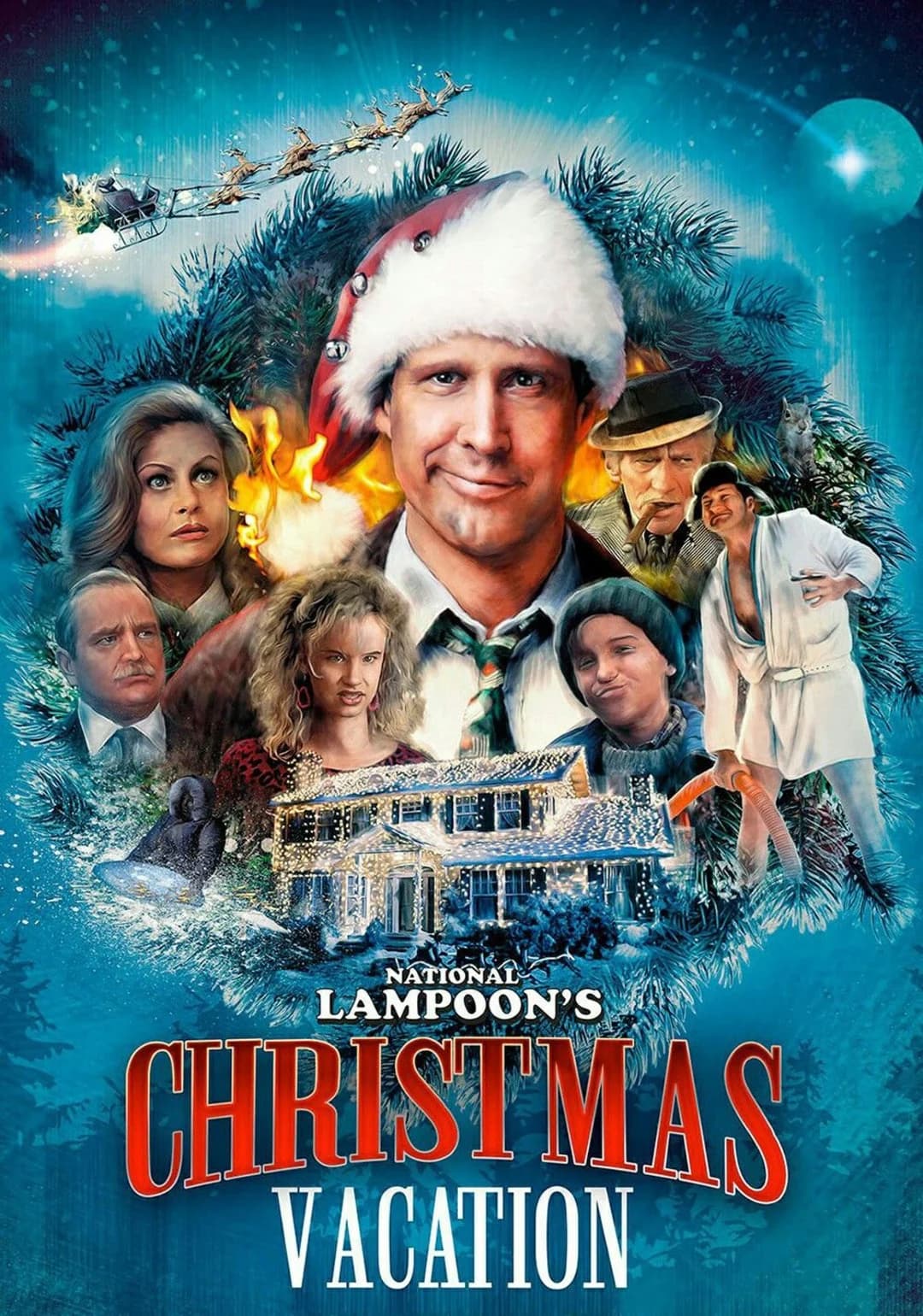
National Lampoon's Christmas Vacation
One man's quest for the perfect Christmas turns suburban order into glorious, very tangled chaos.
The setup
National Lampoon's Christmas Vacation is the sort of movie you can watch with half an eye on the mince pies and still find yourself laughing at the exact moment Clark Griswold's good intentions combust. Directed by Jeremiah S. Chechik and centred on Chevy Chase's determinedly optimistic dad, it funnels holiday aspiration into a series of escalating disasters that never quite lose their grip on the human stuff underneath.
THE MOVIE
Clark Griswold Jr. is still the reason this movie works
People still talk about National Lampoon's Christmas Vacation because it understands one reliable truth: give Clark Griswold an idea of the perfect holiday and watch the world resist. The whole movie is politely ordered mayhem — a man obsessed with an old-fashioned family Christmas, and life cheerfully refusing to comply.
That obsession is the engine. Clark's determination to manufacture a flawless festive spectacle keeps crashing into relatives, neighbours and the brick wall of suburban reality, and the film gets its momentum from those collisions rather than from any single gag.
It helps that the movie is built around a recognisable centre: Chevy Chase as Clark, directed by Jeremiah S. Chechik, in a neat 97-minute package that makes the fantasy of a perfect Christmas feel like both a romantic ideal and a dare.
THE SETUP
The idea that sets National Lampoon's Christmas Vacation in motion
At its simplest, the movie puts a man with a precise mental picture of Christmas into a world that prefers improvisation. Clark wants an old-fashioned family holiday; everything around him prefers the slapstick version.
That desire is more than nostalgia — it’s a plot mechanic. Clark needs a work bonus to realise part of his plan, and when that money doesn't appear the pressure moves from mild embarrassment to full-on domestic farce.
From there the screenplay prefers escalation. Small humiliations become bigger set-pieces: a failing tree, a house tangled in lights, an unwelcome squirrel and more, each gag deliberately turning Clark’s dignity into a resource the film gleefully burns through.
The story ends by widening the stakes into public spectacle — a hostage-style prank that brings in a SWAT-like response — which neatly resolves the problem without inventing melodrama or fantasy. It's a home comedy that keeps its chaos plausibly anchored.
THE CHARACTER
Why Clark Griswold Jr. matters
Clark matters because he is an apparatus for aspiration. His identity is bound up in an idealised, all‑American Christmas — which makes him an easy target for comic punishment but also gives the film a predictable and satisfying throughline: he tries, and keeps trying even when everything goes wrong.
That perseverance also drives the family dynamics. Ellen plays the long-suffering partner who often reins Clark in and steadies the ship when his plans collapse. Their relationship keeps the film from tipping into pure nastiness; there’s affection under the chaos.
The arrival of Cousin Eddie is written as a deliberate contrast: unannounced, crude and disruptive, Eddie exposes class and lifestyle tensions inside the extended family. He’s the splinter that forces Clark’s performance of domestic competence to wobble.
Finally, the film ties Clark’s personal crisis to his work life. His reliance on a promised bonus from his boss puts real stakes on his spectacle-making, so what begins as festive showmanship becomes a test of providerhood — and the film watches the consequences of that performance closely.
THE PERFORMANCE
Why Chevy Chase's performance matters
Contemporary reviewers pointed to a specific thing that keeps the film ticking: Chevy Chase's physical slapstick and timing. The movie uses his knack for pratfall and paced beats as a mechanical device — the comedy often depends on him misjudging a step or landing awkwardly.
That slapstick isn't decorative. It's the way the script turns Clark’s optimism into pratfalls, so Chase's physicality translates the character’s earnestness into comic currency.
Put simply: the film needs a performer who can sell the fall and keep the audience rooting for the man underneath the mishaps, and the film deploys physical comedy to do exactly that.
Because the comedy is frequently bodily — falls, collapses, and narrowly avoided disasters — the timing and clarity of those moments is central to whether the jokes land at all.
UNDER THE SURFACE
National Lampoon's Christmas Vacation has more on its mind than the plot suggests
Beneath the tinsel the movie is quietly interested in satire. Suburban consumerism — the lights, the presents, the competitive display — is mocked by how the film lets those rituals escalate into visual chaos. The jokes are as much about the ritual as they are about the mess.
Closely linked is the idea of masculinity as performance. Clark performs providerhood and spectacle-making; his self-worth arrives tied to visible success. When those displays fail, the film watches how identity frays.
Workplace disappointment is folded into that: the expectation of a bonus turns theatrical ambitions into a financial need, which makes Clark’s meltdown feel like a middle-class panic rather than melodrama.
All of this keeps the movie from being mere slapstick; it lets the farce feel like a comment on the pressures of family rituals, suburban showing-off, and what it costs a man to keep up the act.
THE FILMMAKING
How National Lampoon's Christmas Vacation was put together
Jeremiah S. Chechik came to the picture from commercials and music videos, and that background shows up in the film’s composed, big-frame approach. Contemporary critics noticed a glossy visual style that treats domestic comedy with studio polish.
That sheen helps the film sell its escalating set-pieces: when the camera and production value are tidy, the mess looks funnier because it’s operating against order.
The movie trades on that contrast — clean production values versus comic catastrophe — and often lets the filmmaking underline the absurdity rather than hide it.
So while the story is essentially about family and farce, the way it’s put on screen leans on a commercial director’s eye for spectacle and readable, high-concept staging.
PRACTICAL EFFECTS
The effects work that gives National Lampoon's Christmas Vacation its physical personality
A good deal of the film’s atmosphere is physical: a full Griswold street set was constructed on the Warner Ranch lot and the production used on-set snow made from cotton batting, sawdust and sparkles to sell winter where none existed.
Beyond the faux snow, credit is given to several practical and visual effects vendors for in-camera and optical techniques — process projection and opticals that sit alongside the hands-on production work.
Stunt and physical-comedy work underpin many of the best set pieces — roof falls, attic mishaps and the like — supported by credited stunt performers and second-unit direction.
All of this makes the movie feel tangible: the chaos is mostly built from real, on-set trouble rather than abstract digital trickery.
PURE 80S
National Lampoon's Christmas Vacation could not belong to any other decade
This is very much a late‑80s studio comedy: the third entry in the National Lampoon 'Vacation' series, released in 1989, it bears the hallmarks of commercial, star-led pictures of the period.
John Hughes—who adapted the screenplay from his earlier National Lampoon short story 'Christmas '59' and produced the film—brings a mainstream, audience-friendly sensibility associated with much of 1980s comedy.
The production sits comfortably within the studio system of the time: a recognisable name attached, a clear high-concept premise and a visual style that favoured readable spectacle.
Put simply: it shows how late‑decade Hollywood packaged family comedy for mass audiences, and that context is part of why the film plays the way it does.
WATCHING IT NOW
What has aged — and what hasn't
Some of the film's habits feel of their time. The broad slapstick, occasional crude bathroom jokes and certain caricatures are elements that many modern viewers and commentators point to when they say parts of the comedy can feel dated.
At the same time, the central tussle — a family’s attempt to hit an idealised holiday benchmark and the mess that results — is still clear and easy to relate to. That basic conflict continues to supply laughs and a recognizable emotional throughline.
The film also survives as an entry in a continuing series: Chevy Chase returns as Clark and the Griswolds are established characters whose repeated attempts at domestic normality remain a readable comic device.
So while bits of the humour may sit less comfortably today, the structural bones — the family stakes and the escalating set-piece logic — still function.
THE LEGACY
Why National Lampoon's Christmas Vacation still matters
The film has settled into a recurring place on holiday TV schedules and in seasonal retrospectives; it’s become one of those comedies people return to during December ritual viewing.
Part of that standing comes from its characters: Clark and Cousin Eddie in particular have lodged in popular recognition and even prompted a later television spin-off focused on Eddie.
That recognisability means the movie turns up in anniversary pieces and network programming events each year — not because it’s the only Christmas comedy, but because it offers a dependable mix of spectacle and family mess.
In short: it's a film that television programmers and audiences have consistently chosen to re-watch during the season, and that recurrent visibility keeps it in the conversation.
THE VERDICT
Does National Lampoon's Christmas Vacation still hold up?
Yes — with qualifications. If you want a tidy, sentimental holiday picture, this isn't it. If you want a sharply engineered comedy about aspiration gone off the rails, it still delivers. The premise is simple: Clark tries to stage an old-fashioned family Christmas and a series of escalating mishaps turns everything into farce.
The film is at its best when the stakes feel personal rather than fantastical — Clark’s obsession with the perfect holiday, his dependence on a promised bonus, the pressure of family expectations and the arrival of disruptive relatives all keep the chaos recognisably human.
Some of the humour shows its age — broad slapstick and crude gags crop up — but the movie compensates by keeping its emotional focus on family roles and on the idea of masculinity as performance. Ellen as the steadying partner is crucial here; she stops the film from tipping into pure cruelty.
If you’re deciding whether to watch it now: treat it as a well‑constructed, late‑80s studio comedy that still finds ways to be both mean and oddly affectionate. Clark’s dream of the perfect Christmas still feels like something worth chasing — even if the chase involves far more fairy lights than sense.
Share this movie
Keep watching
More movies from the 80s
1986
Jumpin' Jack Flash
Jumpin' Jack Flash: our relationship with technology and freedom, and why this 1986 movie still matters.
Read our take →
1987
RoboCop
A murdered cop rebuilt as a product — RoboCop still asks who gets to sell justice.
Read our take →
1983
Christine
Obsession, adolescence and a car that won't let go.
Read our take →