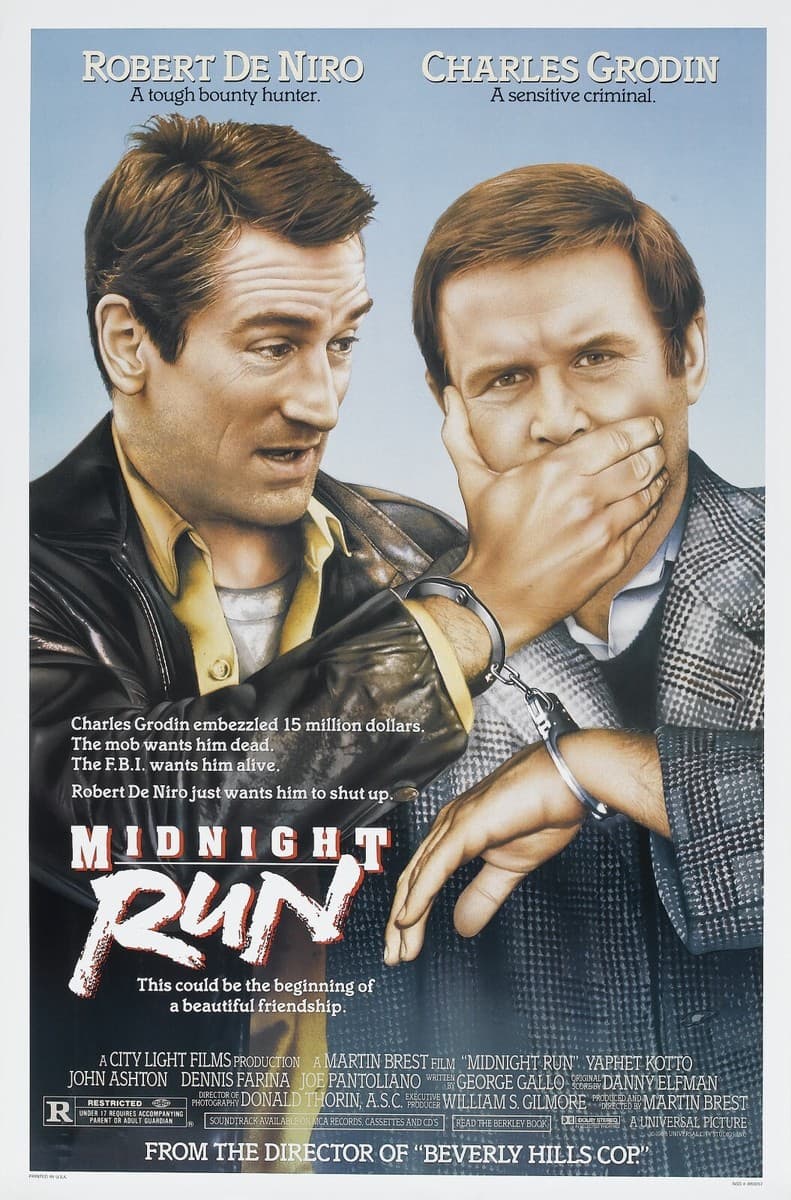
Midnight Run
A cross-country manhunt that’s really about two very different men learning how to care — and how to argue for money.
The setup
Midnight Run isn’t a neat caper or a quiet character piece. It’s a road movie that keeps colliding with mafia men, federal agents and two stubborn egos until something resembling friendship emerges. Directed by Martin Brest and fronted by Robert De Niro’s bounty hunter Jack Walsh, it’s the sort of 1988 studio picture that mixes set-piece action with proper odd-couple argument.
THE MOVIE
Jack Walsh is still the reason this movie works
If Midnight Run is the film people come back to, it’s because the whole thing spins around a very particular centre: Jack Walsh, a bounty hunter with an eye for profit and the patience of someone used to disappointing outcomes. Walsh is hired by bail bondsman Eddie Moscone to track down Jonathan Mardukas and bring him from New York to Los Angeles on a strict deadline — literally a 'midnight run.'
That setup gives the film its engine: a simple job that becomes complicated whenever mobsters, federal agents and other loose cannons get involved. It’s a late-1980s buddy-road picture, directed by Martin Brest, that trades the polished romance of a crime thriller for repeated collisions — of character, of loyalties and, frequently, of temper.
And yet, what keeps you watching isn’t the chase so much as the argument. Walsh starts as a professional motivated by money and the practicalities of his trade; the job is a business transaction. What the film quietly does — and does well — is turn that business into a test of what he’s willing to risk for another human being.
THE SETUP
The idea that sets Midnight Run in motion
On paper it’s a neat, economical premise: a bail bondsman posts bail for an accountant who’s skipped town after embezzling from a mob boss, then hires a bounty hunter to bring him back. The job is framed as a deadline — get him to Los Angeles — but the real constraints are everyone else who wants the same man for different reasons.
Moscone’s initial offer for the job is deliberately modest, which matters because Walsh treats his work like a ledger: risk equals pay. So there’s negotiation, and that bargaining chip becomes part of their relationship; Walsh isn’t just moving a person, he’s deciding how much danger his time is worth.
Those competing interests — organised crime on one side, federal authorities on the other — transform a straightforward pickup into a series of set pieces and detours. Each encounter tests Walsh and Mardukas in ways that aren’t just physical. The road trip becomes the place where priorities are argued into new shapes.
THE CHARACTER
Why Jack Walsh matters
Jack Walsh matters because he’s the movie’s practical centre. He’s presented as a hardened, professional bounty hunter: someone who treats a run like a job and sizes up danger the way other people check the weather.
That professional instinct defines most of his choices early on. Walsh negotiates fees. He plans. He expects the world to be transactional. Which is why the film’s slow pivot — from ‘this is a job’ to ‘this is someone’ — is so satisfying. The tension isn’t invented; it’s earned from the way Walsh approaches the work.
Supporting characters keep pulling at that neat, workerly surface. Mobsters, FBI agents, even fellow bounty hunters turn up not to reveal secrets, but to reveal limits: what Walsh will do for money, and what he won’t. Those confrontations show us the measure of the man in normal, believable increments.
Ultimately, the film rests on the fact that Walsh is capable of grudging respect. That evolution — from irritation to a begrudging kind of care — is what gives the story its emotional shape.
THE PERFORMANCE
Why Charles Grodin's performance matters
Charles Grodin’s Jonathan Mardukas gives the film its perfectly allergic counterpoint to Walsh’s bluntness. The whole dynamic depends on someone who recoils from danger and redefines discomfort as an art form.
Contemporary critics frequently pointed to the comic chemistry between De Niro and Grodin as a primary strength. Their interplay — the push-pull of a hardened pro and a fastidious fugitive — turns many of the film’s set pieces into character tests, not just opportunities for thrills.
That improvisational-sounding chatter and the small, sore exchanges are where the buddy part of the buddy movie feels lived-in. When two actors can trade annoyance and, in doing so, reveal character, you get a film that feels like a series of lived moments rather than a string of stunts.
UNDER THE SURFACE
Midnight Run has more on its mind than the plot suggests
Beneath the car chases and bail negotiations, Midnight Run is quietly about two men being made to re-evaluate what they owe other people. The road trip acts like a crucible: long hours together, repeated danger, and enforced dependence make small changes feel inevitable.
Redemption here isn’t melodramatic. It’s a practical thing: someone realising their priorities have shifted when the ledger of risk and reward is suddenly complicated by conscience. That’s the movie nudging Walsh’s professional code into something softer — not overnight, but enough to matter.
The odd-couple bond is the engine. The movie keeps returning to deadlines and outside threats as mechanisms that force choices; those external pressures are what let the characters’ private changes register in public. The result is a film that can be funny and brisk while still being quietly serious about responsibility.
PRACTICAL EFFECTS
The effects work that gives Midnight Run its physical personality
Midnight Run’s action has a tangible, get-your-hands-dirty quality because some sequences were solved on location. A notable cliff-to-rapids set piece, for example, was split between two countries: the cliff was filmed in Arizona, while the rapids section was completed in New Zealand because the Arizona waters were too cold for the actors.
That sort of logistical solution tells you how the production treated physical risk: if a scene needed authenticity, the crew moved the production rather than faking it entirely on a soundstage. The extended location work and frequent travel also imply a fair bit of coordinated second-unit and stunt activity, which is exactly what a road movie like this requires.
PURE 80S
Midnight Run could not belong to any other decade
Midnight Run sits firmly in the late-1980s studio mood for buddy-road action comedies. It followed Martin Brest’s earlier success with Beverly Hills Cop and belongs to a strand of films that wanted laughs and character alongside the big set-piece.
That combination — character-driven banter stitched to action set pieces — feels very of its moment in the best way. The production’s willingness to travel for location work, shooting across cities and even countries, also reflects an era when studios invested in broad, adventurous commercial films.
In short: it’s an 80s film by temperament, not just by date. It wants to be entertaining first, but it also wants the entertainment to come from characters who can take the violence and the jokes personally.
THE LEGACY
Why Midnight Run still matters
Part of Midnight Run’s afterlife is practical: Universal kept returning to the property on television, producing three TV sequels in 1994 that reused the premise and character name, with Christopher McDonald stepping into the Walsh role.
Another thread has been the occasional attempt to revive the movie on its own terms. Industry reporting in later years documented periodic development efforts for a feature sequel, and more recently there have been reports of a prospective follow-up attaching new talent and even naming Robert De Niro as a producing presence.
Those attempts tell you this: the original film left enough breathing room — a strong central relationship and a commercially flexible premise — that studios and producers still see possibilities in the characters and the format.
THE VERDICT
Does Midnight Run still hold up?
Yes. If you care for character-led entertainment where laughs and danger feel like part of the same conversation, Midnight Run still works. The film’s ticking deadline and competing threats — mob assassins on one side, federal attention on the other — keep the pace taut, but it’s the slow shift in relationship that gives the film a human weight.
Jack Walsh begins as a professional who treats the job like a balance sheet; the negotiations over fee and risk are part of his worldview. Putting him in a car with a terrified, fastidious fugitive forces choices that reveal new priorities. That evolution from distrust to begrudging respect underpins the payoff.
Contemporary reviewers singled out the chemistry between Robert De Niro and Charles Grodin, and that remains the movie’s heart: the arguments, the compromises and the small, reluctant acts of care. The result is an 80s studio picture that still feels specific, rather than generic — funny, sometimes sharp, and plainly interested in what people do for each other when there’s no neat headline attached.
So yes, watch it. Watch it for the arguments you wish you could have with someone you disagree with, and for the rare movie that sneaks a bit of humanity into a run that was supposed to be only about money.
Share this movie
Keep watching
More movies from the 80s
1986
Jumpin' Jack Flash
Jumpin' Jack Flash: our relationship with technology and freedom, and why this 1986 movie still matters.
Read our take →
1987
RoboCop
A murdered cop rebuilt as a product — RoboCop still asks who gets to sell justice.
Read our take →
1983
Christine
Obsession, adolescence and a car that won't let go.
Read our take →