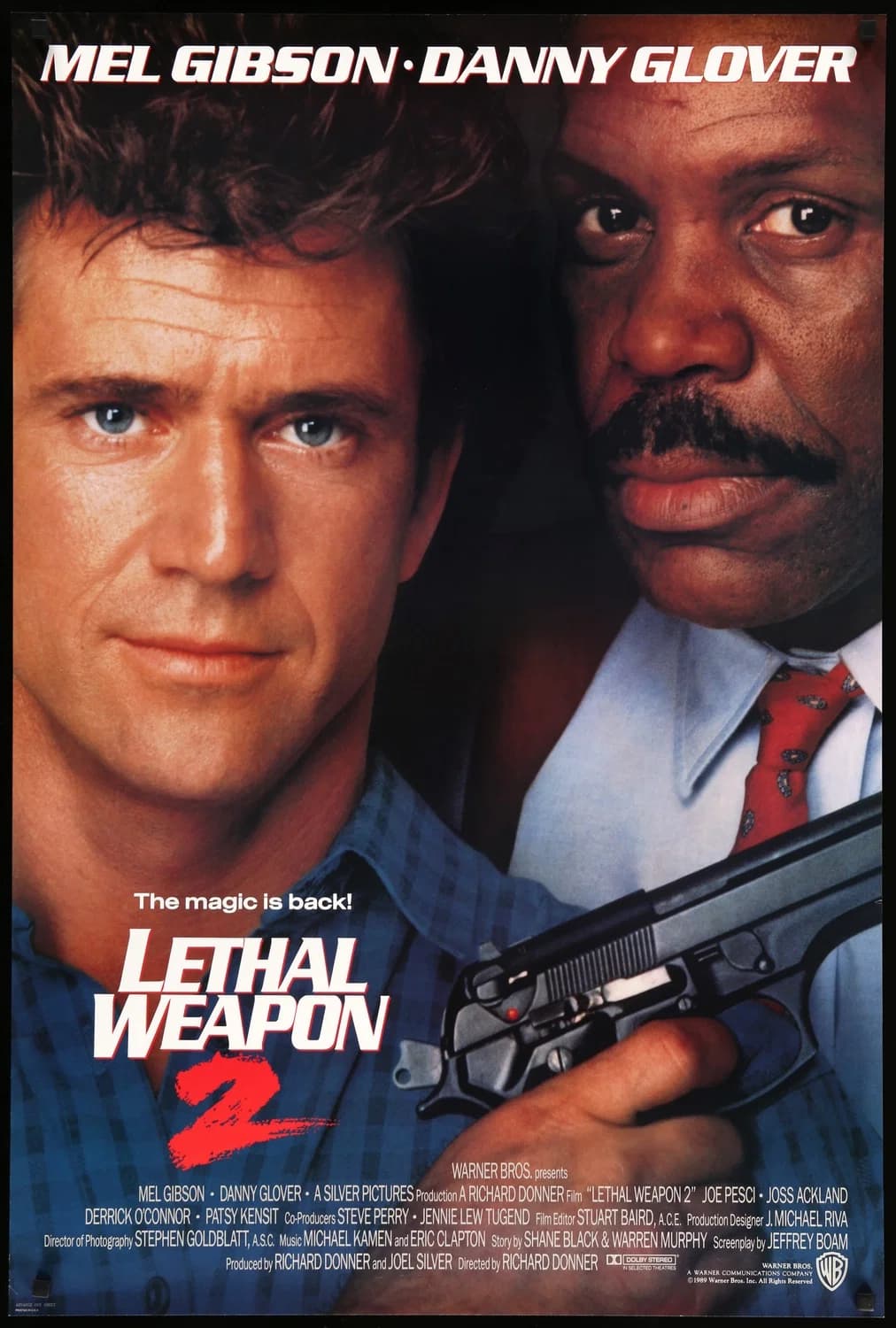
Lethal Weapon 2
Diplomatic immunity, dangerous loyalty and one very unstable partner — Lethal Weapon 2 thrives on its personalities.
The setup
Lethal Weapon 2 is the sort of sequel that doubles down on what worked: two mismatched cops, one obnoxious witness and a consulate using immunity as a get-out-of-jail card. Richard Donner keeps the throttle wide open, and at the centre of it all is Martin Riggs — volatile, keyed-up and unwilling to let the case go until it gives him answers.
THE MOVIE
Martin Riggs is still the reason this movie works
Think of Lethal Weapon 2 and you don’t first remember a container ship or a toilet bomb. You remember a man who will not sit still. Martin Riggs is combustible: reckless, grief-ridden and impossibly single-minded when the case brushes up against his past.
That personal heat is exactly what drags Roger Murtaugh and an eyebrow-raising federal witness, Leo Getz, into a mess that isn’t merely criminal — it’s diplomatic. The villains hide behind consular cover and diplomatic immunity, which turns ordinary police work into a frustrating, half-legal chess game.
Directed by Richard Donner and running at 114 minutes, the film keeps that strain — loyalty against legal limits — humming through its action-comedy beats. It’s why the movie still compels even when the explosions start.
THE SETUP
The idea that sets Lethal Weapon 2 in motion
At its simplest, the film gives Riggs and Murtaugh a witness to protect — Leo Getz — and through him the discovery that a South African consulate is running a criminal racket. The twist is administrative: immunity and diplomatic status blunt ordinary police tactics, so the detectives are forced to push at the edges of what they can do.
That tension gives the plot its steady forward motion. There’s witness protection work. There’s police investigation and staged distractions aimed at exposing the consulate. And there’s a final set of action beats centred on a container shipment used to move illicit cash.
The movie deliberately builds around a handful of memorable set pieces — a bomb threat hidden under a toilet, a house on stilts yanked from its foundations, and a climactic slot around containers and ships — rather than a dense chain of mysteries. They’re big, splashy, movie-moment scenes that keep the stakes visible.
And there’s a small but important inside route: Rika van den Haas, the consulate secretary, gives Riggs access to the operation and provides the film with a personal line into what otherwise might be a purely procedural conspiracy.
THE CHARACTER
Why Martin Riggs matters
Mel Gibson’s Martin Riggs is the film’s engine. Not because he’s the loudest, but because his grief and volatility make every choice personal. When the case brushes up against the people responsible for his loss, Riggs stops treating it as a job.
That personal tie changes the tone. This isn’t two detectives following procedure; it’s a man who will take risks because closure means more to him than the rules. That implacable stubbornness forces the plot into sharper emotional terrain than a routine action sequel would reach.
Crucially, Riggs isn’t alone. Roger Murtaugh’s steadiness — the family man who prefers the book to the gamble — reframes Riggs’s excess. Their partnership turns dangerous single-mindedness into something that can be checked and, at times, supported.
And those personal connections extend into the story through characters like Rika, who offers Riggs both a romantic thread and a practical way inside the consulate’s secrets.
THE PERFORMANCE
Why Mel Gibson's performance matters
Contemporary coverage noted something obvious but important: the movie benefits from the established chemistry between its leads. The continuation of Mel Gibson and Danny Glover as Riggs and Murtaugh carries a lot of weight.
What that means practically is the film can shortcut exposition. We already accept the mismatch; the movie spends time widening it rather than convincing us it exists. That continuity smooths the sequel’s bumps and lets the plot focus on the diplomatic mess at its heart.
So, whatever you think about any individual moment, part of the picture’s pull is two actors returning to a shorthand that the audience already understands.
UNDER THE SURFACE
Lethal Weapon 2 has more on its mind than the plot suggests
On the surface it’s bullets and stunts. Underneath, the film keeps returning to jurisdictional friction: what happens when people with official cover commit crimes and local cops hit a legal wall. Diplomatic immunity isn’t just a plot device; it’s the obstacle that shapes every clever escalation.
There’s also loyalty in play. Riggs and Murtaugh are a partnership that survives threat and error because it’s built on mutual commitment. That steadying friendship makes the film’s riskier moments feel tethered rather than gratuitous.
Revenge and personal closure give the movie emotional direction. Riggs’s choices are not purely procedural; they are driven by personal history, which raises the stakes beyond job description into the realm of personal reckoning.
And threaded through all of it is corruption wearing an official face: the idea that power and cover can be used to launder crime. That combination — personal motive meeting institutional protection — is what the film keeps returning to.
THE FILMMAKING
How Lethal Weapon 2 was put together
The credits behind the camera tell you what to expect: Stephen Goldblatt as cinematographer, Stuart Baird editing and J. Michael Riva on production design. Those names anchor the film’s look and pace, even when the script swings between broad comedy and violence.
That mix — slick production values serving high-energy set pieces — keeps the film moving. Careful cutting and deliberate design choices make the big stunts readable; you never lose the geography of a sequence, so the chaos feels controlled.
Richard Donner’s steady hand as director ties those elements together. He’s the sort of director who lets the actors’ chemistry breathe inside carefully composed action, so the movie rarely feels over-directed even when it’s noisy.
In short: competent, experienced craftspeople built a frame sturdy enough for loud stunts and slightly mad character beats to coexist without collapsing into incoherence.
PRACTICAL EFFECTS
The effects work that gives Lethal Weapon 2 its physical personality
This is very much a late-80s action film in its approach: real stunts, on-set pyrotechnics and practical destruction. The production stages physical spectacles — from vehicle stunts to a hillside house being torn free — rather than relying on invisible trickery.
Those decisions shape how moments feel. When something falls apart on screen, it reads as an actual event rather than a composited illusion. That physicality gives the film a hard edge, even beneath its comic beats.
Fight choreography and controlled explosions are used in a classical action-movie way: clear, dangerous and uncomplicated. The practical approach keeps the audience's attention on the immediate peril.
All of this places the movie firmly in the operational language of 1980s set-piece filmmaking — show, don’t explain; make it big; make it real.
PURE 80S
Lethal Weapon 2 could not belong to any other decade
This sequel doubles down on the late-1980s buddy-cop formula: a blend of broad comedy, ferocious stunts and macho energy. It’s a film that wears its genre loyalties on its sleeve and uses them to run bigger set pieces than the first picture.
Being a direct follow-up to the 1987 original, it keeps the same interpersonal shorthand and raises the spectacle. The combination of familiar characters and escalated action is textbook late-80s franchise thinking.
That era loved clearly defined heroes, punchy set pieces and plot devices that let action designers go wild. Lethal Weapon 2 is an archetypal product of that approach — entertaining and unapologetic in its aims.
Which is to say: it’s very much of its time, and it wears that era’s appetite for big, dumb fun like a badge.
WATCHING IT NOW
What has aged — and what hasn't
Many modern takes still find the movie entertaining because the central chemistry and action remain effective. The partnership at the heart of the film still gives it momentum, and the set pieces still land as crowd-pleasing sequences.
At the same time, some elements feel rooted in their period. Broad, comic takes on certain characters and the political framing around the South African consulate can read as dated to contemporary viewers.
Put simply: enough of the film’s pleasures are character- and stunt-driven that it survives the odd politically tone-deaf beat. But watching it now requires a small allowance for its moment in time.
If you go in for tight plotting and modern sensibilities about geopolitics, you’ll spot the seams. If you want a loud, character-led action film, it still has something to offer.
THE LEGACY
Why Lethal Weapon 2 still matters
Lethal Weapon 2’s box-office success helped secure the franchise’s future, paving the way for further sequels through the 1990s. Commercially, it made the series a dependable product for the studio.
Just as importantly, it reinforced the creative team — director, leads and producers — as the franchise’s core. That continuity meant later entries could rely on the established chemistry and formula.
It remains a reference point for fans of the series not because it changed the rules of cinema but because it carved out a reliable space: noisy, character-driven action that puts partnership at the front.
So its legacy is less about invention and more about consolidation: it doubled down on what the franchise did best and, in doing so, guaranteed more of the same.
THE VERDICT
Does Lethal Weapon 2 still hold up?
Yes — with a caveat. If you enjoy an action comedy that leans on a volatile lead, a dependable straight man and a handful of large practical set pieces, this will still deliver. The central setup — Riggs and Murtaugh protecting Leo Getz while uncovering a consular laundering operation that depends on diplomatic immunity — gives the film a clear engine and moral friction.
The movie’s best trick is how it makes jurisdictional limits into narrative pressure. Diplomatic immunity is not joked away; it’s the thing that forces the partners to improvise, to lean on each other and to take risks they might otherwise avoid.
There are moments that show their age — some broad comic treatments and a particular political frame that belong to the late 1980s — but the basics remain: partnership, loyalty and a protagonist who wants personal closure enough to bend the rules.
If you’re deciding whether to watch: go for the Riggs–Murtaugh pairing and the set pieces. Come for the action, stay for the way the film asks what a partner will do when the system protects the guilty.
Share this movie
Keep watching
More movies from the 80s
1986
Jumpin' Jack Flash
Jumpin' Jack Flash: our relationship with technology and freedom, and why this 1986 movie still matters.
Read our take →
1987
RoboCop
A murdered cop rebuilt as a product — RoboCop still asks who gets to sell justice.
Read our take →
1983
Christine
Obsession, adolescence and a car that won't let go.
Read our take →