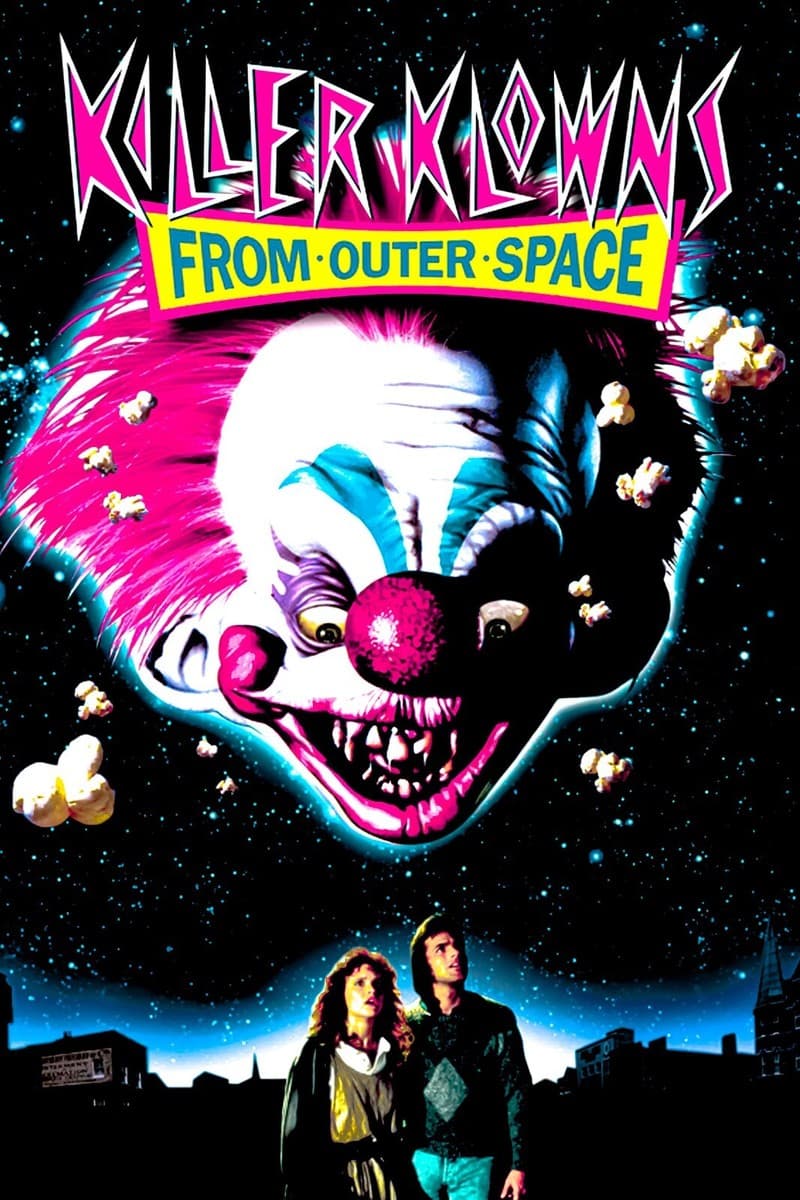
Killer Klowns from Outer Space
Teenagers spot a circus in the woods, everyone else shrugs — then the popcorn guns start firing.
The setup
Killer Klowns from Outer Space is the sort of film that sells itself with a single image: a carnival tent that is actually an alien ship. Stephen Chiodo’s 1988 oddball blends an affectionate wink at 1950s creature features with handcrafted creature work and a straight-faced refusal to apologise for its own silliness. At the centre of it all is Mike Tobacco — the slightly bewildered witness who sees the joke and, crucially, tells someone about it.
THE MOVIE
Mike Tobacco is still the reason this movie works
There’s no better entry point to Killer Klowns from Outer Space than the moment two young people find a streak of light in the woods and, curious as you like, stumble on a circus tent that isn’t a circus at all. That discovery — and the cotton-candy-like cocoons that follow — does the heavy lifting: it gives the film a single clear spine and someone to follow.
Grant Cramer’s Mike Tobacco is that someone. He’s the primary witness-protagonist whose discovery propels everything that comes after: the warning, the disbelief, the small-town escalation. Put simply, the movie is happiest when it is following him and his attempts to make adults pay attention to something they’d rather dismiss.
Stephen Chiodo directs a picture that is knowingly in the creature-feature business: the Chiodo brothers built the monsters and the props, and contemporary notices picked up on the film’s appetite for inventive, effects-led gags. It’s a brief, 88-minute show that makes a virtue of its single-mindedness — an alien invasion that dresses up as carnival chaos and never apologises for enjoying the spectacle.
THE SETUP
The idea that sets Killer Klowns from Outer Space in motion
The film opens with a simple, effective premise: two teenagers find what looks like a circus tent in the woods and then discover the town’s missing people cocooned in cotton-candy. That one sequence hands the film both its mystery and its comic-horror tone.
From there it settles into an episodic rhythm. Rather than build a psychological core, Killer Klowns strings together a series of clown-themed attacks — each one a set piece — that escalate the stakes for Mike and Debbie and keep the pace brisk.
Because the movie treats its conceit as a puzzle to be uncovered rather than a problem to be emotionally excavated, the pleasure comes from invention. You watch to see what the klowns will do next, and to see how the town reacts when the impossible shows up in familiar places.
That structure keeps the film unapologetically B-movie: a chain of escalating gags and dangers that rewards impatience and curiosity more than introspection.
THE CHARACTER
Why Mike Tobacco matters
Mike Tobacco matters because he is the film’s human compass. Grant Cramer plays him, and his role is straightforward: he sees the weirdness first, tries to explain it, and then is forced into action when nobody believes him.
That setup makes Mike the movie’s storytelling engine. His discovery sends everyone else running around the town and also gives the audience someone to latch on to amid the parade of practical gags and set pieces.
There’s a second reason Mike works: his presence turns the strange into an eyewitness problem. He transforms the film from a series of isolated skits into a civic calamity — somebody has to go knock on doors, call the police and try to explain cotton-candy cocoons to grown-ups.
Finally, Mike’s usefulness is tied to the Chiodo brothers’ approach. They made the creatures and the props, so the character who finds those creations is also the character who gets the best view of what the filmmakers want you to see.
UNDER THE SURFACE
Killer Klowns from Outer Space has more on its mind than the plot suggests
On the face of it the movie is a silly creature-feature riff. But it wears that homage to 1950s drive-in monsters proudly — it borrows the shape of those films: teens discover the threat, adults disbelieve, small-town panic unfurls.
That disbelief is more than a trope; it’s the film’s version of youth versus authority. The young witnesses have to cajole, alarm and then drag recalcitrant adults into the crisis. The tension of being ignored gives the comedy-horror a familiar emotional hook.
Then there’s the subversion of carnival and clown imagery. Clowns are usually meant to be safe—entertaining and absurd—but here the trappings of fun become instruments of danger. The film enjoys turning the familiar into something antagonistic.
Put together, the themes make Killer Klowns less like a lazy parody and more like a playful inversion: it borrows comforting midcentury forms and then uses them to surprise and unsettle.
THE FILMMAKING
How Killer Klowns from Outer Space was put together
This is very much a family project: the Chiodo brothers wrote, produced and realised the film creatively. Their fingerprints are all over the production design and the creature makeup, which gives the film a consistent, handcrafted personality.
Principal photography began in April 1987 and the shoot used Panavision cameras on location in Santa Cruz County. That choice of real locations — rather than a studio backlot — helps the film feel grounded even when the klowns are doing daft things.
John Massari led the score and music direction, and the title song was performed by The Dickies — a touch that leans into the film’s oddball sensibility and gives it a slightly punkish edge in moments.
Behind the scenes, editing and sound design were put to work to sharpen the comic-horror rhythm: cuts land the gags and sound punctuates the shocks, allowing a string of practical set pieces to read as a rapid series of escalating attacks.
PRACTICAL EFFECTS
The effects work that gives Killer Klowns from Outer Space its physical personality
The film’s creature work is deliberately hands-on. Production credits list multiple klown fabricators and visual-effects suppliers, and the movie relies on those craftspeople to realise its look.
Central gags — the cotton-candy cocoons, the popcorn guns and the inflatable 'big top' that turns out to be a spaceship — are physical props and set pieces. They’re not abstract ideas on a screen but mechanical devices that the story depends on.
Beyond costumes and rigs, the credits also acknowledge matte painting, miniatures and special-effects work used to bring klown transformations and set pieces to life. It’s a catalogue of practical skills rather than a digital trick bag.
Because so many of the movie’s moments come from tangible devices, the film reads as a sequence of crafted set pieces: each grotesque joke is an object in the scene, which explains why viewers often remember individual props as much as specific lines or beats.
PURE 80S
Killer Klowns from Outer Space could not belong to any other decade
The late 1980s were a sweet spot for independently minded, effects-driven genre films that found life outside long theatrical runs — on home video and the burgeoning cable scene. Killer Klowns fits that model: it’s a practical-effects labour of love from specialists who knew their craft.
The film’s overt homage to midcentury creature features sits neatly with that era’s tendency to revisit and remix drive‑in tropes. Filmmakers in the 80s liked to borrow the shape of older genre pictures and tilt them with contemporary humour and attitude.
Principal photography began in April 1987 and location shooting in Santa Cruz County gives the film a recognisably local, lived-in feel — another marker of independent production at the time, when filmmakers often leaned on real places rather than constructed studio worlds.
All of this places Killer Klowns as a product of its moment: a handcrafted genre experiment that speaks to the DIY side of late-80s horror-comedy cinema.
WATCHING IT NOW
What has aged — and what hasn't
The basic teens-warn-adults shape still lands. The youth-versus-authority tension — kids seeing something adults refuse to accept — is a simple engine that remains readable, and in a world full of scepticism it still has teeth.
Equally, the fact that the Chiodo brothers built the creatures and props means the film preserves a handmade sensibility. That craft gives the movie a physical personality that helps it stand apart from effects-driven fare that feels generically digital.
What doesn’t necessarily survive for all viewers is the film’s single-minded commitment to set-piece escalation. If you prefer character-driven stakes or subtlety, the episodic gag structure can feel thin; but if you come for invention, the film still delivers.
So its appeal is straightforward: it ages as a crafted oddity. The central joke — clowns as colonists of carnivorous comedy — still reads, provided you enjoy the ride rather than demand a deeper engine under the hood.
THE LEGACY
Why Killer Klowns from Outer Space still matters
Killer Klowns didn’t make the usual Hollywood waves, but it found a persistent second life: a cult following that kept the film in circulation through multiple home-video reissues and revival screenings. That steady afterlife is why people still bring it up at midnight shows.
The music also kept a toe in the public ear. The original score has been revisited and reissued, and the title song even had a music-video tie-in — small signs that the film’s oddness translated into other formats.
Beyond nostalgia, the property has been extended into other media: it inspired an official asymmetrical multiplayer video game adaptation that took the brand into interactive territory and kept the klown concept alive for new audiences.
Finally, the film earned recognition from the genre community with nominations in craft categories at the Saturn Awards, a reminder that while the film’s pleasures are peculiar, its work in music and costume did not go unnoticed.
THE VERDICT
Does Killer Klowns from Outer Space still hold up?
Short answer: yes, if you know what you’re signing up for. The film sets a clear bargain early on — two kids spot a streak of light, find a clown-filled tent, discover cotton-candy cocoons and then try to warn the authorities — and it honours that bargain without detours.
Because the story is built as a chain of clown-inspired attack sequences rather than a character study, the film reads as a parade of inventive set pieces: popcorn guns and cocoons repeated until the stakes feel recognisably higher. That structure keeps it entertaining in small, immediate doses.
Grant Cramer’s Mike Tobacco is central for a reason: he’s the witness who compels the town to pay attention. The dynamic of teens being ignored — and a cop like Dave Hanson initially doubting them — is classic creature-feature material, and it still supplies tension alongside the comedy.
If you like films that prioritise handcrafted invention and gleeful weirdness over subtlety, Killer Klowns remains a successful outing. It’s not for everyone, but for those who enjoy its specific blend of homage, practical spectacle and playful nastiness, it’s still worth a watch.
Share this movie
Keep watching
More movies from the 80s
1986
Jumpin' Jack Flash
Jumpin' Jack Flash: our relationship with technology and freedom, and why this 1986 movie still matters.
Read our take →
1987
RoboCop
A murdered cop rebuilt as a product — RoboCop still asks who gets to sell justice.
Read our take →
1983
Christine
Obsession, adolescence and a car that won't let go.
Read our take →