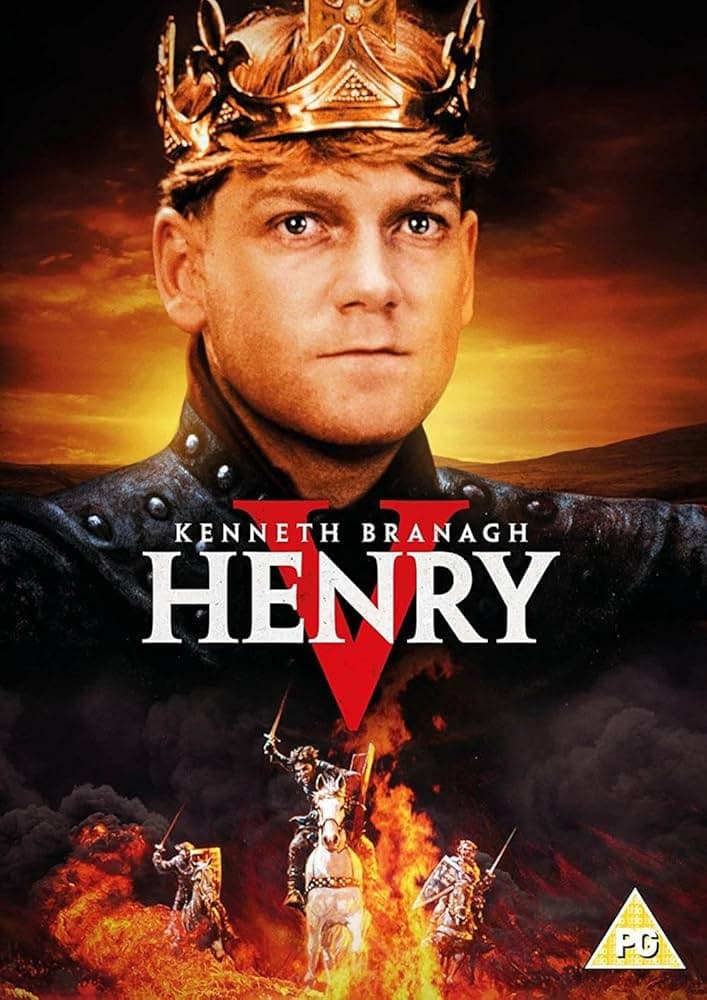
The setup
Kenneth Branagh's Henry V arrives like a dare: take Shakespeare seriously on film, but don't make it a museum piece. It opens with a modern-dressed Chorus in an empty soundstage and then moves, stubbornly and theatrically, into the mud and blood of Agincourt. What keeps you watching is not just the speeches, but the way the story insists that rhetoric has consequences.
THE MOVIE
King Henry V of England is still the reason this movie works
Put bluntly: this Henry V lives or dies on Henry himself. Branagh both directs and plays the role, and the film is built around the idea of a young courtier growing into a wartime king whose speeches actually shape events.
Branagh doesn't hide the theatrical bones. The picture opens with Derek Jacobi's Chorus, modern-dressed and standing in an empty studio, directly addressing the camera. That frame — a play staged for film — reminds you from the first shot that Shakespeare and cinema are going to argue, politely and loudly, all the way through.
And yet Branagh makes a point of dragging the story into real dirt. The movie edits the play heavily for the screen, folding in flashbacks and battlefield aftermaths so the stunts of rhetoric sit beside the human cost of battle. It still runs like a drama; it refuses to be just a lecture.
THE SETUP
The idea that sets Henry V in motion
The film takes Shakespeare's play and trims it for cinema, picking the moments that best dramatise a man becoming a king and a country committing to war. That central throughline — words turning into action — is the engine.
Branagh frames the whole thing with Jacobi's Chorus, speaking from a modern-dressed soundstage. It isn't just a coda or a classical flourish: the Chorus is the film's conscience and its announcer, nudging the audience between theatre and film.
When the fighting is done, the movie refuses easy heroics. An extended sequence set to 'Non Nobis, Domine' follows the casualty clearing across the field, turning the aftermath into a sustained, almost ritualised glimpse of what war leaves behind.
You get a theatrical spine — speeches, ceremonies, royal bargaining — and then you get the practical aftermath. The setup works because the film keeps those two registers in awkward conversation.
THE CHARACTER
Why King Henry V of England matters
What makes Henry memorable here is movement. The film watches him shift from the roguish younger man of the earlier plays into a ruler whose voice, decisions and public persona must be measured against their effects on other people's lives.
Those flashbacks to Falstaff — scenes the original Henry V only mentions — aren't nostalgia. They exist to show how Henry's friendship, appetite and mischief were left behind, and how that severing matters when he's commanding troops and signing treaties.
Branagh is both the actor and the architect of that journey: his screenplay and direction fold in material from the Henry IV plays to make the transition visible, not just reported. So Henry becomes a character you can follow through choices and consequences, rather than a shorthand for kingliness.
Put another way: the film gives you a Henry whose speeches are dramatic because the camera keeps asking what those speeches cost.
THE PERFORMANCE
Why Kenneth Branagh's performance matters
One clear yardstick people still point to is the St. Crispin's Day speech. Roger Ebert singled out Branagh's delivery of that scene as the moment the role must pass, because it converts rhetoric into feeling that moves the film forward.
That speech doesn't exist in isolation here — it's the payoff of a movie that has been assembling Henry's authority and doubts. So the performance matters less as an isolated star turn and more as the hinge that makes the film's larger argument believable.
If you want to test the movie, replay that speech and watch how it reframes what came before and what comes after.
UNDER THE SURFACE
Henry V has more on its mind than the plot suggests
On the surface there's campaign drama and bargaining with a fragile French court. Underneath the film is constantly circling four ideas: the human cost of war, how leadership depends on language, the theatricality of national ceremony, and the friction between stage and screen.
The movie stages battle and then returns us to rituals — oaths, treaties, songs — to show how public performance sustains or conceals violence. Ceremony isn't decoration here; it's part of the story's mechanics.
Leadership is treated as a rhetorical act. The film keeps asking: what happens when a leader's gift for persuasion meets real carnage? That tension is where the drama earns its weight.
Finally, the Chorus and the studio passages keep reminding us we're watching a play adapted for film. That difference colours everything: speeches are meant to be heard in a theatre, but Branagh forces them into the camera's intimacy and into the mud of the field.
THE FILMMAKING
How Henry V was put together
Branagh chose a visual approach that resists the polished, heroic picture many earlier adaptations favoured. The cinematography leans into rain‑soaked exteriors and close-up combat, so the fight feels tactile rather than glorified.
That grit acts as a counterpoint to the studio-bound theatrical moments. Where the Chorus speaks in a cleared space, the Agincourt footage gets dirty and immediate; the result is a film that alternates between declamation and physical consequence.
Those choices make the movie feel like a negotiation between two instincts: to honour Shakespeare's big speeches, and to make war look like something that happens to people, not just an occasion for heroism.
Seen this way, the directing choices are consistently in service of the film's central dilemma — rhetoric meets reality — rather than spectacle for its own sake.
PRACTICAL EFFECTS
The effects work that gives Henry V its physical personality
This is a film built on movement and bodies. Large crowd scenes and the Agincourt sequences were staged on fields next to Shepperton Studios to create those extensive battlefield tableaux you see.
The production leans on long tracking moves and carefully choreographed crowd movement to hold the camera through aftermaths. Notable here is an uninterrupted tracking shot across the battlefield during the casualty clearing — it keeps the lens moving and the viewer within a single, sustained composition.
Those practical staging choices help the film maintain tension between controlled studio passages and the sprawling, chaotic reality of war.
In short: it's less about trickery and more about organising people and the camera so the battlefield reads as a continuous, lived space.
PURE 80S
Henry V could not belong to any other decade
Branagh's film landed at the tail end of the 1980s, a moment when British cinema was paying renewed attention to literary adaptations and heritage projects. It feels like a film deliberately staking a claim in that conversation.
That period interest helps explain why a relatively young director would gamble on a full‑blooded Shakespeare movie: there was a cultural appetite for serious, prestige adaptations and a budgetary space to try them.
So while the film isn't a period-piece in the nostalgic sense, it is very much a child of its time — an earnest, theatrical attempt to put Britain's literary past on screen with cinematic ambition.
THE LEGACY
Why Henry V still matters
The film collected tangible recognition: it won the Academy Award for Best Costume Design and earned major nominations for Branagh, including Best Director and Best Actor. That kind of industry attention helped the picture travel beyond British theatre circles.
Branagh also won the BAFTA for Best Direction, and the production received further national and international acknowledgements. Those honours mattered because they turned a risky Shakespeare experiment into a recognised screen achievement.
Practical archival materials from the production — scripts and storyboards — are preserved in the Renaissance Theatre Company archive at the University of Birmingham, which underlines the film's place in Branagh's developing practice.
Finally, Henry V established Branagh as a filmmaker to watch on Shakespearean turf and began a fruitful collaboration with composer Patrick Doyle, ties that continued into his later adaptations.
THE VERDICT
Does Henry V still hold up?
Yes — but with a rider. If you come for a museum piece of Shakespeare staged in amber, you'll be surprised. Branagh's adaptation trims and reshapes the play, folding in flashbacks to the Henry IV plays so we can see what Henry leaves behind as he becomes king. That choice makes the film feel psychologically clearer and cinematically purposeful.
The movie is also unapologetically theatrical. Derek Jacobi's modern-dressed Chorus repeatedly reminds you of the play's origins, even as Branagh drags speeches into the visceral world of Agincourt. That friction is precisely the film's strength: it lets rhetoric and ritual collide with bodies and consequences.
There are moments that still sting — the extended post‑battle sequence set to 'Non Nobis, Domine' is a deliberate, haunting decision — and Roger Ebert's praise for the St. Crispin's Day speech captures why: the film wants its language to move you and then show you what that motion generates on the ground.
So watch it for the performance of a king, for the way leadership is argued into being, and for a version of Shakespeare that refuses to let ceremony cancel casualty. It's imperfect, often theatrical, and oddly modern in its insistence that speeches are not just words but acts with a price.
Share this movie
Keep watching
More movies from the 80s
1986
Jumpin' Jack Flash
Jumpin' Jack Flash: our relationship with technology and freedom, and why this 1986 movie still matters.
Read our take →
1987
RoboCop
A murdered cop rebuilt as a product — RoboCop still asks who gets to sell justice.
Read our take →
1983
Christine
Obsession, adolescence and a car that won't let go.
Read our take →