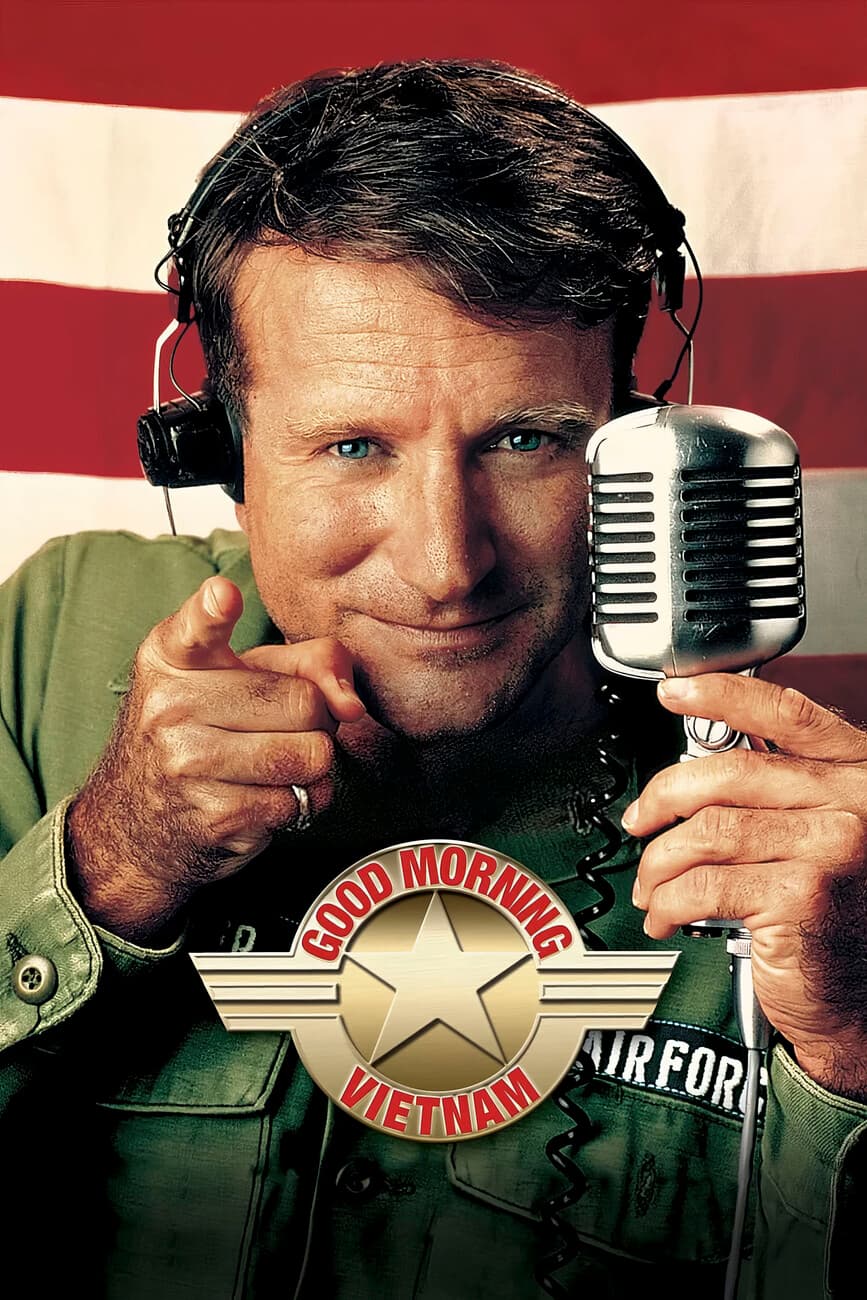
Good Morning, Vietnam
A loud, furious hello from a man who thinks radio can fight censorship and loneliness at once.
The setup
Good Morning, Vietnam is the kind of film that announces itself before the title card finishes: a radio voice barging in, civilisation briefly upended. Barry Levinson’s 1987 dramedy makes a simple swap — a small-town DJ in a war zone — and then refuses to treat that as a tidy joke. It’s still worth revisiting because the movie keeps returning to the same argument: humour isn’t fluff. It’s a way of keeping people human.
THE MOVIE
Adrian Cronauer is still the reason this movie works
Drop into Saigon, 1965, and the film hands you a radio and a man who treats it like a circus megaphone. Adrian Cronauer arrives at the Armed Forces Radio Service and promptly upends the station’s prescribed playlist, opening each broadcast with that now-famous, brash greeting and a stack of rock records.
What gives the movie its electricity is the friction. Cronauer wants to entertain troops and talk straight; the Army wants discipline and control. That clash — a comic broadcaster against military censorship — is the engine that keeps scenes moving from laughs to argument without ever feeling like padding.
Barry Levinson directed the film, and Robin Williams plays Cronauer. Released at the end of 1987, it’s a comedy-drama that mixes belly laughs with sharper, sometimes uncomfortable, moments — and it’s Cronauer’s personality that makes that mixture stick.
THE SETUP
The idea that sets Good Morning, Vietnam in motion
The basic move is neat and economical: an Airman — assigned to the Armed Forces Radio Service in Saigon — starts a high-energy radio show that the soldiers actually want to hear. His broadcasts become a running device; the film cuts to the microphone again and again, switching between gags and more serious on-air moments.
Those broadcasts don’t exist in a vacuum. They lift morale in the bars and barracks, but they also put him on a collision course with his superiors and with Army censors who prefer safer, approved copy. The institutional pushback is the movie’s principal conflict — not an action plot, but a battle over what language and comedy can do in wartime.
The radio monologues often feel improvised on-screen, which helps the film dodge stale wartime melodrama. That looseness also lets the story fold in quieter things: a relationship with a Vietnamese woman, Trinh, and a friendship with Private Edward Garlick. Those connections complicate Cronauer’s position; he’s no cartoon rebel, he becomes attached and accountable.
Crucially, the screenplay is loosely based on a real DJ’s experiences, even though several sequences are fictionalised for dramatic clarity. That mix of real-life colour and invented scenes keeps the setup alive without turning the movie into a documentary.
THE CHARACTER
Why Adrian Cronauer matters
Cronauer matters because he’s noisy where the world asks for silence. The film gives him a clear, almost childlike aim: to entertain troops and to speak plainly about what’s happening. That simple motive is enough to make him interesting, because it throws him against a world that prizes control over candour.
He’s more than a mouth behind a mic. His friendship with Private First Class Edward Garlick gives the film someone steadier to land on — a quiet counterpoint to the broadcast persona. That relationship keeps Cronauer from being a one-note showman; it makes him a human figure with attachments and consequences.
Then there’s Trinh, his local romantic interest, who links Cronauer to the Vietnamese civilian world the Americans often miss. The romance isn’t window-dressing. It’s a reminder that his station’s jokes and his on-air persona have real effects beyond the bubble of the base.
Finally, the fact the screenplay draws from a real DJ’s story helps: Cronauer isn’t pure invention, and the film balances invented scenes with enough real-life colour to make his choices feel believable rather than contrived.
THE PERFORMANCE
Why Robin Williams's performance matters
There’s a practical fact about this film that can’t be ignored: Robin Williams’s turn as Cronauer earned major awards attention. He won the Golden Globe for Best Actor (Musical or Comedy) and was nominated for the Academy Award for Best Actor.
Awards aren’t proof of everything, but they tell you how the movie’s makers and the industry read that performance at the time — as a central, show-carrying element.
Seen as a package, the film leans on that performance to sell the tonal tightrope: comedy that slides into more serious territory and back again. The recognition Williams received underlines how essential the role was to the film’s identity.
Put simply: the movie buys its bruises and its laughs by giving the centre of the frame to a performer the industry thought worth rewarding.
UNDER THE SURFACE
Good Morning, Vietnam has more on its mind than the plot suggests
On the surface the film is a radio-centred comedy. Underneath, it’s arguing about speech. The central tension — between Cronauer’s loose, honest broadcasts and the Army’s censorship — turns the radio booth into a tiny theatre of free expression.
Comedy isn’t decorative here; it’s a tool for coping. The jokes and records boost morale, yes, but they also work as tiny acts of resistance against the grind of war. Laughing at something often lets people survive it for another hour, another night.
Cronauer is an outsider in a strange land, and that outsider status is essential. He’s not there to be absorbed into the military machine; he’s there to unsettle it. That perspective lets the film make pointed, anti-authoritarian observations without turning into a sermon.
So the movie isn’t just trading laughs for tension. It’s asking whether the small rebellions of radio can change how people think about authority and about each other — sometimes gently, sometimes painfully.
PURE 80S
Good Morning, Vietnam could not belong to any other decade
Arriving at the end of 1987, the film sits in what you might call a second wave of Hollywood Vietnam stories that loosened the tonal rules. It wasn’t obliged to be a trench-muck epic; it could be a star-driven dramedy that mixed laughter and seriousness.
The way the film was positioned matters too. Distributed through Disney’s Touchstone label via Buena Vista, it’s an example of late‑80s studio strategy: adult-skewing dramas and dramedies fronted by bankable stars, not niche arthouse fare.
Commercially, it landed well — one of 1987’s higher-grossing films — which showed there was appetite for a Vietnam picture that balanced comedy and critique rather than just one or the other.
That combination — mainstream distribution, a star turn, and a willingness to play with tone — is very much an 80s Hollywood move. It let the movie reach audiences who might otherwise have ignored another war story.
THE LEGACY
Why Good Morning, Vietnam still matters
A straightforward reason it’s still talked about: the performance drew awards attention — a Golden Globe win and an Academy Award nomination — and that helped the movie remain visible beyond its initial run.
The soundtrack also left a mark. It sold strongly, reached platinum, and the film’s use of ‘What a Wonderful World’ nudged new interest in the song — a small cultural ripple you can trace directly to the movie.
Industry lists and institutional nods have kept it in the conversation about films that successfully blend comedy and drama around the Vietnam era, and those mentions reinforce the idea that the movie sits in a particular cinematic lane.
There was even talk of a sequel, Good Morning, Chicago, in the early 1990s, which never materialised — a reminder that the film’s life after release included a few abandoned directions as well as the sticking points that preserved its reputation.
THE VERDICT
Does Good Morning, Vietnam still hold up?
Short answer: yes. If you’re curious about a movie that makes a case for humour as a human response to chaos, this still delivers. The repeating radio device — the improvised-sounding on-air monologues and the way they alternate between pure comic blasts and sober reportage — gives the film a rhythm that remains engaging.
The institutional conflict matters. Watching Cronauer push back against military censorship never feels like a dated stunt because it’s rooted in a concrete argument: language can sustain people, and control over language can strip that away. That tension is the movie’s spine.
The supporting relationships — Garlick’s steadiness and Trinh’s link to the Vietnamese civilian world — stop the film from being a one-man show. They give weight to Cronauer’s choices and remind the audience that comedy has effects beyond the booth.
So watch it for the voice and the argument, not as a flawless history lesson. Good Morning, Vietnam still works because it trusts its own mixture of laughs and seriousness: it makes you laugh, and then it asks you to listen.
Share this movie
Keep watching
More movies from the 80s
1986
Jumpin' Jack Flash
Jumpin' Jack Flash: our relationship with technology and freedom, and why this 1986 movie still matters.
Read our take →
1987
RoboCop
A murdered cop rebuilt as a product — RoboCop still asks who gets to sell justice.
Read our take →
1983
Christine
Obsession, adolescence and a car that won't let go.
Read our take →