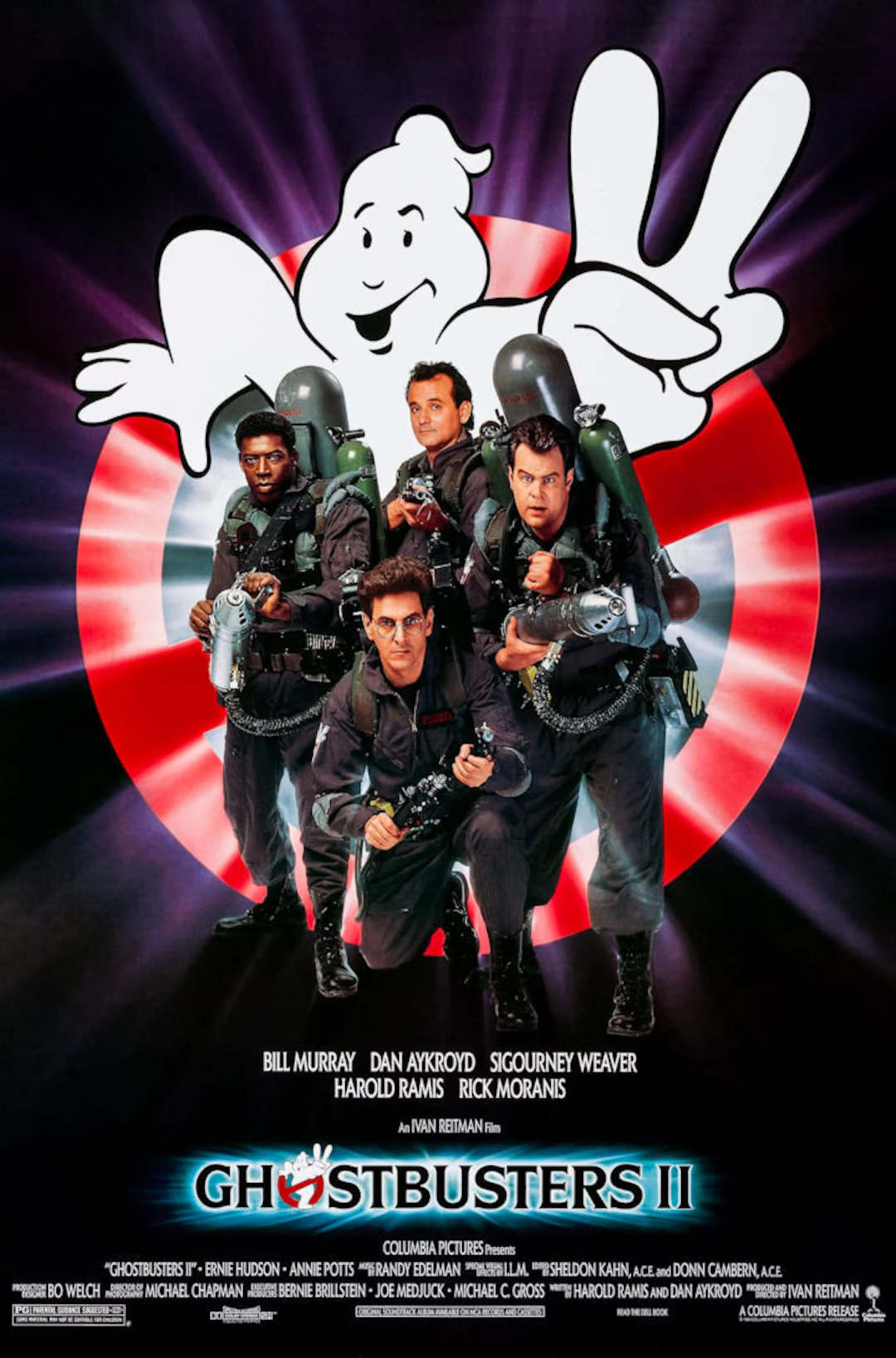
The setup
Ghostbusters II arrives five years after the first film and asks what happens when the city turns sour. It dresses collective gloom in pink slime, brings back the same team under Ivan Reitman’s direction, and quietly hands Bill Murray’s Dr. Peter Venkman a straighter, more domesticated plotline. Watch it as a fizzy monster-comedy or as a movie about town-wide grumpiness — either way, Venkman is where it lands.
THE MOVIE
Dr. Peter Venkman is still the reason this movie works
You know the set-up before the special effects arrive: Ghostbusters II opens with a curt title card — Five years later — and promptly tells you the team are no longer the city’s triumphant eccentrics. Lawsuits and an injunction have shoved them into a quieter life. That legal hangover is important because it gives the sequel something to push against; the Ghostbusters aren’t just chasing ghosts, they’re trying to get back to relevance.
And what they chase is oddly specific. The film turns the city’s bad temper into a physical thing — a reservoir of pink ectoplasmic slime under New York that feeds on negative emotions. It’s brilliant in a dopey way: resentment as a plotting device, goo as social commentary. When gloom is an actual river, the cleanup becomes a civic problem, not just a job for nerds with proton packs.
Which brings us to the human hinge: Bill Murray’s Dr. Peter Venkman. Reitman directs, Murray returns, and the film wants Venkman to be less of a wisecracker on the run and more of a man trying to be steady — partly because his story is tied into Dana Barrett’s subplot. That slight settling-down keeps the movie tethered; when the effects threaten to float off, Venkman brings it back to the people.
THE SETUP
The idea that sets Ghostbusters II in motion
The engine of the film is simple and oddly theatrical: the city is leaking a kind of emotionally charged ectoplasm. It’s viscous, pink, and can be dressed up to do things — energise objects, animate odd appliances and generally make life more inconvenient for New Yorkers.
Early gags demonstrate the rule: small charges of feeling produce small, silly effects (a dancing toaster is one of the film’s clearer demonstrations). That rule is important because the movie then scales it. If a toaster can shimmy from hurt feelings, an entire museum painting can become a plausible threat when the slime and spirits conspire.
The story also picks up the characters five years on, with the Ghostbusters hamstrung by legal and public-relations trouble. They’re no longer the instant heroes of the last film; they’re professionals with limits, which changes how they respond when something supernatural reappears.
And the main supernatural hook is suitably theatrical: a centuries-old villain, Vigo the Carpathian, uses his painted portrait in a Manhattan museum as the focus for an attempt at a come-back. That combination — a civic problem of corrosive negativity plus a classic villain looking for a body to move into — is what sends the team back into action.
THE CHARACTER
Why Dr. Peter Venkman matters
Bill Murray returns as Dr. Peter Venkman, and the film leans into a quieter corner of the character. He’s less on the run and more enmeshed in ordinary relationships — the domestic stuff that a sequel about civic malaise benefits from. You can feel the script nudging him toward steadiness because the threats in this movie are collective, not merely personal.
That integration with Dana Barrett’s subplot matters because it changes the stakes. Venkman’s interest isn’t only professional curiosity or comic detachment; there’s a tethering to someone else’s life. It brings a repeatable franchise beat — the hero’s return to action — into a more grown-up register.
Because the sequel continues the same principal characters and creative team, Venkman’s changes don’t read as a continuity fluke. They’re a deliberate move within the same world: the team has aged, their public status has shifted, and the movie asks what heroes do when their city’s problem is essentially emotional.
That’s why Venkman matters here. He’s the person who turns the film’s kooky ideas into something recognisably human. The slime is silly. The painting is melodramatic. Venkman is the thread that keeps the comedy readable and the stakes felt.
THE PERFORMANCE
Why Norbert Grupe's performance matters
The role of Vigo — credited with involvement in supporting physical performance elements — is not merely a painting with words. The production gave the part physicality, which the credits reflect by naming Norbert Grupe in connection with those elements.
That credit signals how the filmmakers treated Vigo: as a figure who needed more than a voice or a prop. Physical performance elements were part of making the villain read as present in the museum and, later, as an active threat.
Saying Grupe is credited for those elements is simply to note that the movie invested in the materiality of its antagonist. Vigo’s menace is built from several production choices that required a human presence alongside other techniques.
In short, the credit isn’t trivia; it’s a hint that Vigo was constructed as a physical component of the film’s supernatural machinery rather than only a static image.
UNDER THE SURFACE
Ghostbusters II has more on its mind than the plot suggests
On the surface it’s a monster-comedy: spectres, slime, a museum villain. Underneath, the movie is preoccupied with negative emotion becoming something you can trip over. That idea — that bitterness, resentment and civic malaise can pool and do physical damage — runs through every gag and set-piece.
That pool of negativity pushes the film toward a civic argument. The problem isn’t an individual villain alone; it’s a city’s mood. The solution, then, leans on collective action. The Ghostbusters’ work is less about a solo heroic act and more about cleaning up a public problem that has to be addressed on multiple fronts.
There’s also a maturity thread. The main characters are no longer carefree adventurers; parenthood, responsibility and the small dullnesses of adult life figure into how they react. The sequel repeats and riffs on the beats that made the first film successful, but it does so through a lens that asks what happens when the same gang have to behave like adults.
So the movie is both a genre exercise and a social joke: slime as metaphor, spectacle as civic therapy, and old beats re-run with the weight of grown-up obligations.
THE FILMMAKING
How Ghostbusters II was put together
There’s a practical logic behind the movie’s varying scales: Bo Welch is credited as production designer and the shoot mixed on-location work in New York with soundstage work in Los Angeles. That blend lets the film move between intimate, domestic scenes and the broader public set-pieces it needs.
Shooting partly in the city gives the public sequences a different weight than anything stagebound could deliver. Conversely, the soundstage work allowed the filmmakers to build weird, controlled environments — think museum interiors and the subterranean spaces tied to the slime — that a location couldn’t accommodate easily.
Those decisions matter because the film’s impulse is to treat small character moments and large crowd sequences as equals. You need both a believable museum and an enactable big public moment, and the production choices reflect that balancing act.
In short: the mixture of locations and studio control is a deliberate way of letting the comedy breathe while still staging spectacle.
PRACTICAL EFFECTS
The effects work that gives Ghostbusters II its physical personality
The film leaned into things you could touch. Instead of reusing the old ambulance, the production built an expanded Ecto-1 — an Ecto-1A — which gives the sequel a slightly different, upgraded vehicle presence on screen.
The slime itself was a hands-on affair. Production used methylcellulose-based mixtures in differing thicknesses and colours to create the river-of-slime effects, and sometimes added metallic "diamond dust" to get a shimmering finish on camera. That’s a very literal example of craft trying to make a ridiculous idea visually convincing.
Big practical moments required people and mechanics: exterior sequences called for many extras, staged slime pours and physical props for the subway/ghost-train beats. Those scenes were built with bodies and machines interacting, not just composited images.
For the more uncanny Vigo moments, miniature sets and optical compositing were used, and the production tested several approaches to getting the villain out of his painting during post-production. The result is a mixture of tactile goo, staged crowds and composited weirdness.
PURE 80S
Ghostbusters II could not belong to any other decade
This is a late-80s studio sequel in almost every meaningful sense. It was produced as part of an era when franchises were being explicitly built out — tie-in soundtracks, merchandising and video games were part of the strategy. That commercial thinking shaped choices on screen: the film wants to be widely consumable.
That intent shows up in the look and feel of its effects choices. The slime is bright and toyetic, designed to register in marketing as well as in the film itself. The movie’s family-friendly spectacle is a product of mainstream studios trying to broaden the audience for effects-driven comedies at the time.
It’s also simply a straight sequel: the same principal characters and creative team returned from the 1984 original, which anchors the film as a continuation rather than a reboot or a reinvention.
Seen like this, Ghostbusters II is very much a picture of its moment — commercially minded, broadly aimed and unabashed about turning a joke into a marketable visual motif.
THE LEGACY
Why Ghostbusters II still matters
Part of the reason Ghostbusters II still turns up in conversations is simply continuity: it’s the canonical 1989 sequel, with the principal cast and creators back in place. That makes it an undetachable chapter of the franchise’s public story through the 1990s and beyond.
The film’s afterlife also lives in the way the franchise has been sold and re-sold — licensed video games, comics and anniversary box sets have kept the sequel available alongside the original. It’s not the cornerstone of the series, but it’s part of the package people revisit.
There was also a commercial side to its visibility: the soundtrack produced a commercially successful single, 'On Our Own' by Bobby Brown, which charted highly at the time and gave the film a moment in the pop charts separate from critical debate.
Put together, those commercial threads and the simple fact of being the official sequel are what keep Ghostbusters II in circulation — not necessarily because every critic loved it, but because it’s woven into the franchise’s continued market presence.
THE VERDICT
Does Ghostbusters II still hold up?
Short answer: yes — with caveats. If you come for the cast returning, for a sequel that makes the city’s mood literal, and for a slightly more grown-up Venkman, it delivers. The film starts by reminding you the Ghostbusters aren’t in the clear: five years on, lawsuits have forced them into a reduced role, which gives the sequel a defensible reason to reposition the team.
The central conceit — a citywide pool of negative energy expressed as pink slime that can charge objects and escalate to larger threats — remains a delightfully daft engine. It lets the movie move from small comic beats (a toaster that dances) to full-scale public set-pieces; late additions such as the underground ghost-train and the Washington Square Arch sequence widen the scale and make the finale feel big.
Vigo’s painted threat and the film’s attempt to make the villain more than a canvas gives Ghostbusters II an old-fashioned, pulpy danger — even to the point of a plot strand involving a child as a target for possession. Contemporary reviewers were mixed, but some singled out supporting comic turns (notably Peter MacNicol’s Janosz and the chemistry around Rick Moranis) as bright spots amid the debate.
So should you watch it? If you expect the exact magic of the first film you’ll be disappointed — this is a different beast: more communal, more literal, and more interested in responsibility than in the pure oddness that made the original a phenomenon. If you want a sequel that tries to be thoughtful while still splashing around in pink goo, it’s worth an evening. It’s a messy, occasionally brilliant bother of a film — and Venkman keeps it human when the slime wants to take over.
Share this movie
Keep watching
More movies from the 80s
1986
Jumpin' Jack Flash
Jumpin' Jack Flash: our relationship with technology and freedom, and why this 1986 movie still matters.
Read our take →
1987
RoboCop
A murdered cop rebuilt as a product — RoboCop still asks who gets to sell justice.
Read our take →
1983
Christine
Obsession, adolescence and a car that won't let go.
Read our take →