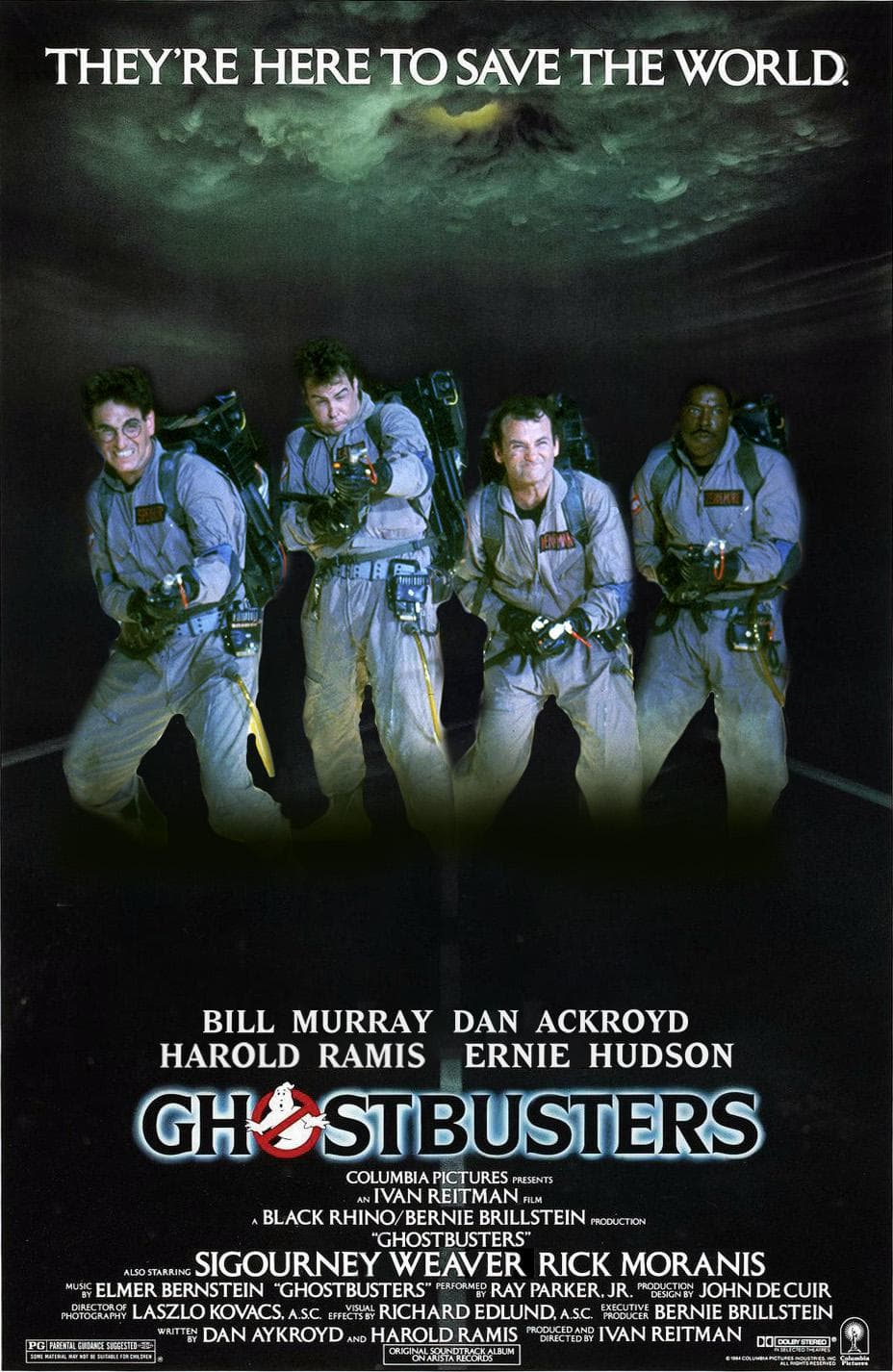
The setup
Ghostbusters isn't just about slime and set-pieces; it's about a trio of out-of-work parapsychologists who turn their textbook research into a business and discover that friendship — and a bit of cheek — will get you farther than credentials alone. Directed by Ivan Reitman, the film pairs supernatural spectacle with a working-class, entrepreneurial energy that still crackles on the screen.
THE MOVIE
Dr. Peter Venkman is still the reason this movie works
Ghostbusters starts with a simple, stubborn idea: three university parapsychologists who lose their academic footing decide to set up shop as commercial ghost-busters. It turns an embarrassing career detour into the premise for a business — and, more importantly, a comedy about people who have learned to hustle together.
At the centre of that hustle is Dr Peter Venkman, the sardonic, streetwise frontman whose attitude — equal parts charm and cheek — steers much of the film's humour and interpersonal friction. Venkman isn't the gravitas; he's the personality the picture leans on when the weirdness starts piling up.
Ivan Reitman directs the whole thing with an eye for pace and comic set-ups, keeping the movie lean and focused enough to let both the supernatural set-pieces and the friendship-driven jokes land within its 105-minute runtime.
THE SETUP
The idea that sets Ghostbusters in motion
The film's premise is very straightforward: three Columbia parapsychologists — Venkman, Ray and Egon — lose their funding and reinvent themselves as private ghost-exterminators. That pivot supplies the movie with a practical engine: client work, advertorial hustle and improvised gadgetry.
What begins as small domestic hauntings — the library spook, the odd apartment phenomena — is handled as routine cases before the stakes expand. The story smartly scales from local nuisance to something apocalyptic: an interdimensional force and its followers making New York the battleground.
Structurally, Ghostbusters keeps returning to a handful of story mechanics — investigation, scientific paraphernalia (think psychokinetic meters, proton packs, the containment unit) and even a basic advertising push — to move the plot from one episode to the next without losing comic momentum.
That confidence to treat paranormal investigation like a small-business operation lets the movie balance its set-pieces with character moments: the practicalities of running a franchise become part of the jokes and the action.
THE CHARACTER
Why Dr. Peter Venkman matters
Peter Venkman is the film's front-of-house operator: he sells the service, flirts with clients and deflects awkwardness with a line. Bill Murray plays him, and the character exists on a kind of comic currency — charm traded for credibility.
Venkman works as the group's human interface. Ray and Egon bring the nerdy convictions and the devices; Venkman brings the quick talk and the willingness to make a spectacle of the enterprise when necessary. That mix of temperaments is what makes the team feel like an actual business rather than a punchline.
Because Ghostbusters is as much about friendship and teamwork as it is about ghosts, Venkman's role is partly pragmatic: he channels the group's public face and — when the film needs a laugh or a deflection — supplies it.
Across the story and into the sequel, Venkman remains the personality who can both sell an idea and live with the consequences when things get out of hand. That precariousness is what keeps him interesting.
THE PERFORMANCE
Why Bill Murray's performance matters
Contemporary reviewers noticed something useful about Murray's presence: his deadpan delivery and the way he anchors a scene's tone became a steady reference point for the rest of the film.
That steadying effect matters in a movie that constantly switches between domestic comedy, low-budget entrepreneurship and outright supernatural set-pieces. Having a performer who can make the absurd feel conversational gives those tonal jumps somewhere to land.
Murray's approach also lets other characters play straighter. When Venkman quips, Ray and Egon can double down on technical earnestness or bewildered sincerity, and the contrast supplies a lot of the comedy.
Put simply: the film needed a comic anchor, and contemporary reaction singled out Murray's presence as supplying that anchor — a reason the jokes and the eerie bits could coexist without collapsing into chaos.
UNDER THE SURFACE
Ghostbusters has more on its mind than the plot suggests
On the surface it's a comedy about catching spooks. Underneath, it’s a film about a tiny team holding together against increasing disorder — friendship and teamwork are the glue that makes the whole thing plausible.
There’s a neat tug between scepticism and belief that runs through the movie. The leads are scientists of a sort, constantly measuring and testing, but the world insists on producing phenomena their instruments can’t contain. That friction creates both tension and humour.
The film also wears its commercial instincts on its sleeve. Turning ghost-busting into a service — complete with advertising and a public-facing logo — makes the movie as much about entrepreneurship as it is about the supernatural.
And because the disturbances quickly spill into civic life, Ghostbusters becomes a picture about spectacle in the city: how private weirdness becomes public drama, and how a small company can get swallowed up by the consequences.
THE FILMMAKING
How Ghostbusters was put together
On paper the crew looks conventional: László Kovács is credited as the cinematographer and Sheldon Kahn and David E. Blewitt on the editing. Those names point to a production that relied on experienced technicians to stitch its odd mix of comedy and effects into a coherent feature.
The practical effect work and the stage-heavy shoot required a filmmaking approach that kept scenes readable while the cameras negotiated puppetry, miniatures and creatures. That balance — comedy that doesn't get lost under spectacle — is partly the film's construction challenge.
Reitman's direction keeps a steady tempo: scenes are set up, the device (or joke) is introduced and the actors push it through to payoff without lingering on exposition.
The result is a film that reads like a tight comedy with big-idea flourishes — technically put together so audiences can follow both the laughs and the mayhem.
PRACTICAL EFFECTS
The effects work that gives Ghostbusters its physical personality
The film's supernatural life is mostly achieved with hands-on techniques: miniatures, puppetry, stop-motion, rotoscoping and cel animation all contribute to the creatures and the citywide spectacle.
Key figures are realised in creature suits and mechanical rigs. The hotel apparition — the figure later nicknamed 'Slimer' — was performed in a foam‑rubber suit with mechanical facial elements and filmed with varying frame-rate techniques to get the right motion.
The Stay Puft Marshmallow Man likewise combined suit work and miniature photography; the marshmallow residue in the climactic sequence was simulated with large quantities of shaving-cream-like material during tabletop work and compositing.
Richard Edlund and his team led these effects under a tight schedule, which meant multiple techniques had to be blended to get the principal supernatural figures onscreen in time for the final cut.
PURE 80S
Ghostbusters could not belong to any other decade
Released in the summer of 1984, Ghostbusters neatly exemplifies the mid-80s tendency to fuse effects spectacle with mainstream comedy — a family-friendly blockbuster that still lets the weird stuff be weird.
Its New York setting, a bold 'No Ghosts' public campaign and a very singable title song placed the movie squarely in the media world of the mid-1980s, where pop visibility and marketing were part of a picture's life from day one.
The film's expansion into toys, an animated series and eventually a sequel demonstrates how it was built to live beyond the cinema: franchise-building was already in motion around the property by the late 1980s.
Those factors make Ghostbusters feel of its era not because of nostalgic flourishes, but because it trades in a particular 1980s logic — spectacle, mass marketing and cross-media ambition — that the movie exploits for laughs and scale.
WATCHING IT NOW
What has aged — and what hasn't
At its heart Ghostbusters is about a small team that gets themselves into bigger trouble than they sold on the pamphlets. That friendship and teamwork still reads clearly: the film keeps the group's bond central even when the set-pieces grow absurd.
Because the story foregrounds the Ghostbusters' switch from discredited academics to public-service entrepreneurs, the movie's pleasures are often character-driven rather than spectacle-driven — and those interpersonal dynamics are less vulnerable to ageing than any single visual trick.
Some of the novelty of the effects now reads as craftsmanship from another age, but the emotional throughline — three people who learn to depend on each other while running a business that shouldn't exist — remains tidy and persuasive.
In short: the central relationship dynamics still give the film a spine. That is what helps it continue to play for modern audiences.
THE LEGACY
Why Ghostbusters still matters
Ghostbusters' original song and visual effects were recognised by the industry soon after release: the film received Academy Award nominations in both those categories, and its music earned additional awards abroad.
The picture quickly developed a life beyond the cinema: it directly produced a 1989 sequel and an animated series that kept the characters in circulation for years, and merchandising helped the imagery travel into shops and TV.
The film's central imagery — the 'No Ghosts' emblem and its character-driven promotional identity — became widely used across toys, games and tie-ins, which kept the film present in the popular imagination long after its theatrical run.
That commercial afterlife is part of why the movie remains a reference point: it wasn't merely a successful film for a season, it was built to be sold and re-sold into other formats.
THE VERDICT
Does Ghostbusters still hold up?
Yes — if you're after a film that balances warm teamwork, gag-driven comedy and unapologetic spectacle. The story of three parapsychologists who turn entrepreneurially to ghost-busting gives the film a narrative spine: client work, escalating hauntings and an eventual citywide crisis keep the stakes moving.
The movie's mix of investigative gadgetry, the containment-business routines and a public-facing advertising push makes the escalation believable: small cases become big problems because the team is running a service in a city that refuses to stay tidy.
Bill Murray as Peter Venkman supplies the comic nucleus you need for those tonal flips. Contemporary reviewers noted his deadpan presence as central to the film's tone, and that steadiness helps the juxtaposition of banter and supernatural set-pieces land without collapsing into a mess.
So should you watch it now? Absolutely — if you want a tight 105-minute picture where friendship and entrepreneurial gumption trundle into the extraordinary. It's not flawless, but it still feels like a clever trade-off: a small, scrappy team versus the big strange world outside their office.
Share this movie
Keep watching
More movies from the 80s
1986
Jumpin' Jack Flash
Jumpin' Jack Flash: our relationship with technology and freedom, and why this 1986 movie still matters.
Read our take →
1987
RoboCop
A murdered cop rebuilt as a product — RoboCop still asks who gets to sell justice.
Read our take →
1983
Christine
Obsession, adolescence and a car that won't let go.
Read our take →