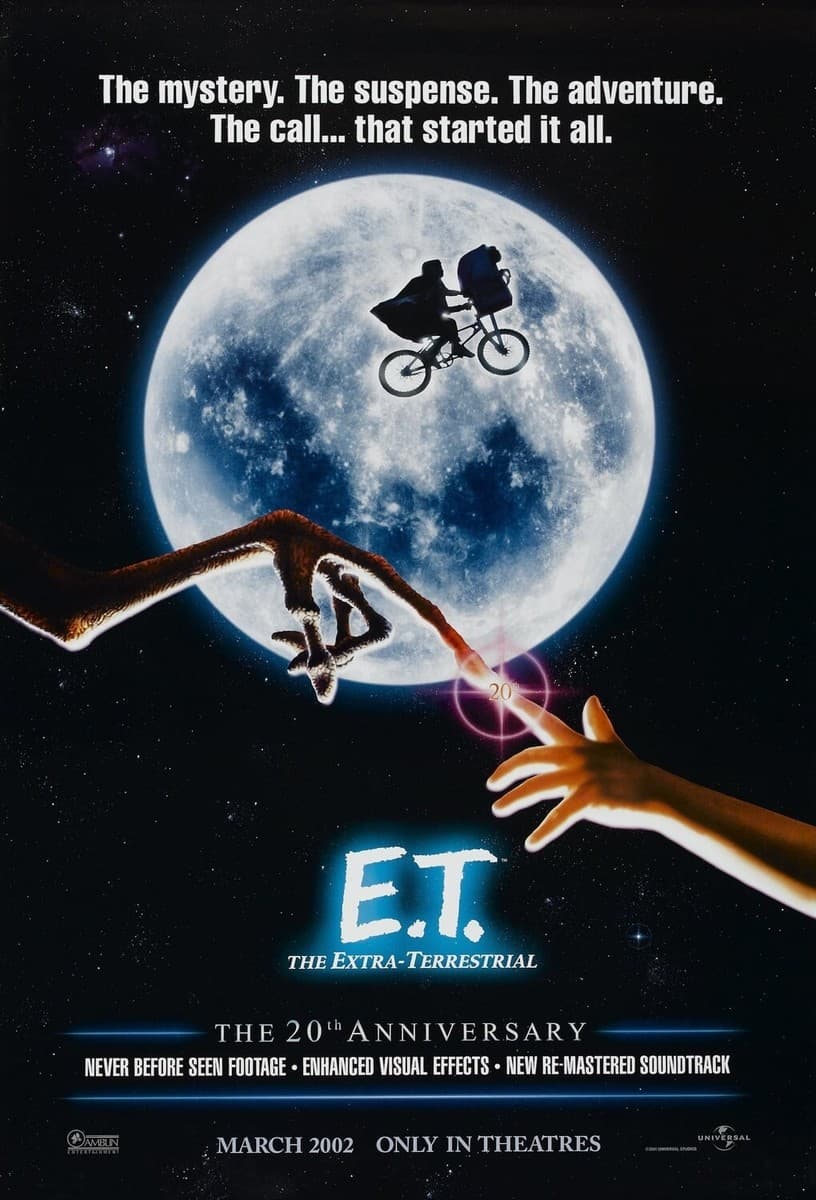
E.T. the Extra-Terrestrial
A story about a lonely boy, a stranded stranger and the small, uncanny bravery of childhood.
The setup
If you remember one image from E.T., it’s rarely the spaceship. It’s Elliott — a ten-year-old who finds something impossibly strange in the woods and decides, quite simply, to look after it. Steven Spielberg built a whole summer-movie world around that basic selfish-but-true impulse: a child wanting family, and everything that follows when someone answers that need.
THE MOVIE
Elliott Taylor is still the reason this movie works
People talk about E.T. for the flying bikes and the glowing finger, but the film would fall apart without Elliott. He’s the lens: a lonely ten-year-old who discovers a stranded visitor in the woods and decides to keep it hidden. That simple, stubborn decision turns an encounter with alien botanists into a story about wanting connection.
Spielberg gives us Elliott’s world as the place that matters — the suburban spaces, the childhood rituals — and then upends it by introducing something that refuses to fit. The bond that grows between a desperate boy and an outsider is what makes the picture more than a neat piece of cinematic trickery.
It helps that the film knows the emotional stakes it’s after. From the child’s viewpoint to John Williams’s score, everything pushes toward the same thing: convincing us that this strange creature belongs with Elliott — at least for as long as the story allows.
THE SETUP
The idea that sets E.T. the Extra-Terrestrial in motion
At its core the film asks a tidy, irresistible question: what happens when a child finds something the grown-ups don’t understand? Elliott answers by hiding and caring for the visitor, and the film’s central tension is born from that single choice.
From there the story arranges a series of credible, child-led responses: improvised nursing, teaching the newcomer bits of human life, and trying to solve the logistical problem of getting it home. Those small, domestic measures make the emotional stakes feel immediate — this is about saving something you’ve come to love, not staging a military thriller.
That balance — private, almost secret care versus the outside world of authorities and adults — is what keeps the plot moving without flattening it into a simple chase-movie. It’s still a family film, but it treats children as resourceful actors rather than plot decorations.
The practical demands of bringing the creature to life are part of why the setup works on screen; suit performers and multiple models were used so the alien could behave believably in close, pillow-and-bedroom moments.
THE CHARACTER
Why Elliott Taylor matters
Elliott isn’t just the child who finds E.T.; he’s the emotional thermostat of the film. His loneliness and the wish for family connection are what make him act the way he does — and they make the audience root for him.
That matters because the alien itself is essentially an outsider who invites empathy. Elliott’s willingness to care for something fragile and baffling turns a sci‑fi conceit into a story about belonging. Without that human centre, the rest would be spectacle with nowhere to land.
The family around Elliott — his brother who acts as a protective foil, the younger sister, the single mother — all shape how believable his choices feel. The film’s coming-of-age elements sit in that domestic context: friendship across difference, and the small rites that nudge a boy toward growing up.
Put simply: Elliott is the film’s human wager. Everything worth remembering in E.T. is measured from him outward.
THE PERFORMANCE
Why Henry Thomas's performance matters
Contemporary criticism singled out Henry Thomas’s work as unusually natural and affecting for a child performer of the era.
That reaction matters because the film depends on believable small moments: a boy’s private fear, his stubborn secrecy, the slow thawing of companionship. If the central child hadn’t registered as genuine, the rest of the film would feel staged.
So even if you come for the spectacle, it’s those human beats that make the spectacle mean something.
UNDER THE SURFACE
E.T. the Extra-Terrestrial has more on its mind than the plot suggests
On the surface it’s a science‑fantasy about a lost visitor. Underneath it’s a film about childhood imagination and the way children make sense of loneliness. Everything the story asks — teach, tend, hide, help go home — is rooted in those plain human responses.
It’s also about uneven friendships: a tiny human and an utterly different being forming a bond that depends on patience, curiosity and care. That inequality is crucial; the mystery and vulnerability of the alien pull Elliott into a role he wouldn’t otherwise have had to play.
Family and belonging thread through the picture. Elliott’s actions are driven by wanting a fuller sense of home, and the family around him provides the emotional contours against which the friendship can grow.
Finally, there’s a steady empathy for the outsider. The film invites viewers to imagine being the one who doesn’t fit, and then asks what kindness would look like. That simple ethical pivot is what gives the movie its emotional reach.
THE FILMMAKING
How E.T. the Extra-Terrestrial was put together
A lot of the film’s feeling comes from where the camera sits. The production team deliberately framed scenes from a child’s height — the camera often low to the ground — so ordinary rooms and streets feel bigger and stranger to adult eyes. That decision keeps us inside the children’s experience.
Interior bedroom scenes were lit with soft diffusion through muslin, producing a warm, gentle look that suits private moments between a boy and an impossible guest. The lighting choices help make those scenes feel intimate rather than theatrical.
Those practical, visual choices — camera height, set decisions and lighting — are why the film consistently reads as a child’s story, even through big set pieces. It’s filmmaking that makes the emotional logic feel earned.
PRACTICAL EFFECTS
The effects work that gives E.T. the Extra-Terrestrial its physical personality
Carlo Rambaldi built a family of physical models rather than a single creature; different puppets handled different facial expressions and movements. That patchwork approach meant the alien could register small, intimate gestures as well as broader motions.
Because no one model could do everything, the team also used a wearable suit for many close interactions. Small‑person performers alternated in that suit depending on what a scene needed, which helped the alien feel present in the same space as the children.
On a larger scale, Industrial Light & Magic supplied forced‑perspective neighbourhood plates, forest miniatures and effects supervision for the mothership and composited shots. Those optical techniques let the film move between intimate kitchen scenes and genuinely otherworldly moments.
Even the creature's breathing and heartbeat were mechanical simulations, and the voice work combined human recordings with processed animal sounds to make E.T. sound neither human nor cartoonish but convincingly other.
PURE 80S
E.T. the Extra-Terrestrial could not belong to any other decade
E.T. opened at the end of May 1982 at Cannes and then arrived in US cinemas for the summer season in June. That timing pitched it squarely as a family event — a movie meant to be seen together during a season built for crowd-pleasing fare.
It also belongs to the era of director-led production banners: Spielberg’s Amblin Entertainment produced the picture with Universal handling distribution. That model — filmmakers packaging their own projects at scale — was becoming a defining feature of early‑80s Hollywood.
The film’s DNA is of the moment: a science‑fantasy made with a mainstream appetite for wonder and emotional clarity. Released in 1982, it sits neatly in the decade’s mix of spectacle and intimate storytelling.
And while it’s a Spielberg picture, it’s also Melissa Mathison’s screenplay at work: a simple conceit turned into a family story with enough heart to carry the larger apparatus.
WATCHING IT NOW
What has aged — and what hasn't
Certain production decisions around the film’s home releases have prompted debate: a 2002 anniversary edition introduced a few digital changes that many viewers preferred not to keep, and subsequent releases have tended to restore the original theatrical version.
Beyond the technical quibbles, the core story — children improvising care, teaching an outsider human things, and attempting to reunite it with its ship — still lands because it’s about basic human responses rather than trendy effects.
The film remains a family picture in the truest sense: it’s shaped around relationships between children, their siblings and their mother, and those dynamics continue to be relatable.
Where it ages more clearly is in how tightly it ties sentiment to spectacle; modern viewers might notice the construction more readily, but the emotional throughlines about friendship and belonging still read as straightforward and affecting.
THE LEGACY
Why E.T. the Extra-Terrestrial still matters
The film’s recognition has a practical side: it picked up multiple major awards and institutional acknowledgements, including Academy Awards in musical and technical categories. Those honours underline the care taken in both sound and score.
Technically, the picture is often discussed for its mix of animatronics, suit performances and ILM composites; the physical and optical work — plus John Williams’s score — are repeatedly cited when people look back at how 1980s family blockbusters were made.
There’s also the catalogue of home‑release conversations. The original theatrical edition and a digitally altered 20th‑anniversary special edition both circulated; the 2002 changes provoked public discussion, which kept attention on how the film should be presented to new audiences.
Ultimately, the legacy is twofold: it’s a technical reference point for certain kinds of effects and scoring, and it’s a reminder that big emotional bets can be placed on small, believable human choices.
THE VERDICT
Does E.T. the Extra-Terrestrial still hold up?
Yes — and not because of nostalgia alone. The film’s central promise is simple and it keeps that promise: a lonely boy finds a stranded visitor, cares for it, and tries to send it home. That everyday protectiveness drives the story more than any single set piece.
The child-first presentation — camera choices, domestic detail, the small improvisations children make to care for a creature — still reads as honest. It’s why the emotional beats work: they’re rooted in believable child behaviour rather than adult sentimentality.
Technical changes in later releases have sparked debate, but the core elements that make the film move — the relationship between Elliott and the outsider, the siblings’ role, John Williams’s score and the physical creature work — remain intact and persuasive.
If you’re wondering whether to watch it now: if you want a film that places a genuine, unshowy faith in childhood curiosity and kindness, E.T. still delivers. It’s a movie that asks you to side with a child who does the brave, small thing — and it earns your company while you do.
Share this movie
Keep watching
More movies from the 80s
1986
Jumpin' Jack Flash
Jumpin' Jack Flash: our relationship with technology and freedom, and why this 1986 movie still matters.
Read our take →
1987
RoboCop
A murdered cop rebuilt as a product — RoboCop still asks who gets to sell justice.
Read our take →
1983
Christine
Obsession, adolescence and a car that won't let go.
Read our take →