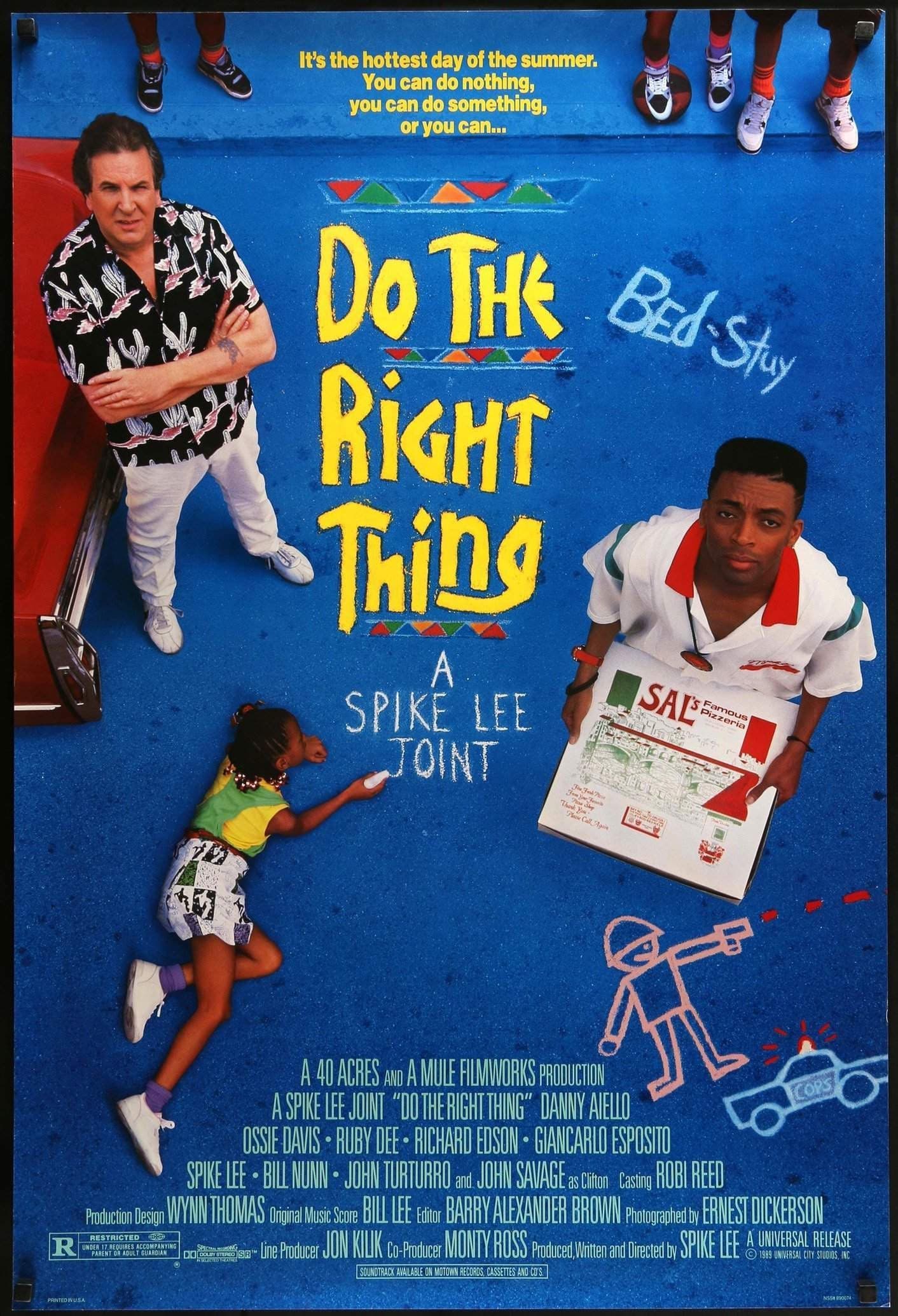
Do the Right Thing
A day on one Brooklyn block that still asks the same uncomfortable question: what does 'doing the right thing' actually look like?
The setup
Do the Right Thing puts you on a single sweltering block in Bedford‑Stuyvesant for one day and never lets you look away. It’s Spike Lee’s argument about race, responsibility and music as a kind of civic language—centred on Mookie, a young Black pizza deliveryman stuck between a job, a family and a neighbourhood on edge. Thirty‑plus years on, that tension is exactly why the film still feels urgent.
THE MOVIE
Mookie is still the reason this movie works
Put simply: Do the Right Thing is a day in a life—one hot day—on a single block in Bedford‑Stuyvesant, Brooklyn. That tightness is its power. The movie doesn’t try to show everything about a city; it chooses one street and sits there until you start to feel the heat.
At the centre is Mookie, a young Black pizza deliveryman played by Spike Lee, juggling shifts at Sal’s Famous Pizzeria with a complicated relationship and the everyday responsibilities of fatherhood. He’s not a symbol so much as a person forced to make small, practical choices inside bigger, dangerous systems.
Around him the film lines up ordinary antagonisms—racial friction, local pride, music that means more than background noise—and then turns the volume up. Public Enemy’s Fight the Power was written for the film and becomes an anthem that keeps pulling the neighbourhood into argument and action.
THE SETUP
The idea that sets Do the Right Thing in motion
The film threads a few simple motifs through a packed day: an enormous boombox blasting Public Enemy, the repeated Love/Hate spiel, a neighbourhood simmering under a relentless heat. Those motifs keep nudging characters into sharper and sharper confrontations.
At its spine is a local dispute that grows out of those everyday tensions. What begins as arguments over respect, music and representation in a small business escalates because the neighbourhood’s grievances are not isolated—they’re cumulative.
Those accumulated tensions reach a breaking point when a violent encounter with the police becomes the film’s climactic event. The police incident then sparks a destructive public reaction on the block, and everything the film has been building toward comes into raw, public view.
The setup works because the movie stages the pressures rather than explaining them away: small moments add up until a single flashpoint pulls the whole community into judgement and consequence.
THE CHARACTER
Why Mookie matters
Mookie is the film’s human fulcrum. Spike Lee plays him, yes, but the point isn’t authorship; it’s that Mookie is convincingly in the middle—of a job, of a household, of loyalties that pull in different directions.
He’s earning a living at Sal’s Famous Pizzeria, where the owner genuinely sees his shop as a neighbourhood institution and treats some employees like family, even while those same relationships expose latent racial attitudes. That contradiction gives Mookie little room for clear moral choices.
Outside work he has a complicated relationship with his girlfriend and the responsibilities of fatherhood, which keeps his decisions anchored in the practical rather than the purely ideological. He’s a guy who’s got to choose between paycheques and principles and the film makes you feel how messy that is.
Because the story refuses to reduce Mookie to a mouthpiece, he ends up being where the film’s arguments land. He moves through the block, he hears the music, he sees the grievances — and the audience sees the neighbourhood through him.
THE PERFORMANCE
Why Danny Aiello's performance matters
Danny Aiello’s turn as Sal is one of the parts of the film that attracted awards attention: his portrayal earned an Academy Award nomination for Best Supporting Actor. That nomination flags the role’s prominence in the picture and how central Sal’s presence is to the neighbourhood’s dynamics.
Sal is positioned as the owner who believes his pizzeria is part of the block’s fabric, and the performance’s recognition reflects how the character sits at the heart of the conflict—pride, ownership and the uncomfortable ways affection and prejudice can coexist.
Mentioning the nomination isn’t a substitute for watching; it’s a signal that the role carries dramatic weight within the movie’s ecosystem. The pizzeria isn’t just a set piece, it’s where community and confrontation meet.
UNDER THE SURFACE
Do the Right Thing has more on its mind than the plot suggests
On the surface you can describe the film as a neighbourhood drama; under the surface it’s a set of conversations about race and everyday racism. Small slights, jokes and assumptions circulate casually until they’re not casual anymore.
Closely tied to that is the film’s insistence on police violence and public accountability as an unavoidable subject. The story’s climactic police encounter forces characters—and by extension the audience—to confront who is held responsible when a community erupts.
There’s also a persistent question of community and responsibility: who protects whom, who speaks for whom, and how moral clarity becomes almost impossible when everyone’s stakes are different. The film prefers the trouble of ambiguity to the comfort of tidy answers.
Finally, music and cultural symbols do more than decorate the setting. The boombox and its anthem function as public language; they’re a way characters assert identity and demand to be heard. The soundtrack becomes argument.
THE FILMMAKING
How Do the Right Thing was put together
One of the clearest production decisions is how the block itself was treated as an active character. Production designer Wynn Thomas deliberately shifted the street’s palette toward intense reds and oranges so the day feels oppressively hot—an almost physical pressure on the neighbourhood.
That amplified colour scheme isn’t a piece of showy decoration; it feeds the movie’s logic. When everyone is sweating and tempers are frayed, the heightened palette makes that emotion visible and immediate rather than abstract.
There’s also the obvious imprint of Spike Lee’s early filmmaking style. The movie’s choices—what it focuses on and how it stages local argument—helped establish the approach Lee would keep returning to in his next projects.
Put together, those production decisions keep the film specific: it feels like one place, one day, and that specificity is what lets its broader questions land with force.
PURE 80S
Do the Right Thing could not belong to any other decade
Do the Right Thing arrived in 1989 into a New York that was still arguing loudly in public about race and urban violence. Spike Lee has said the film was influenced by late‑1980s incidents such as the Howard Beach attack, and contemporary coverage framed the picture inside those ongoing controversies.
That placement gives the film a particular relationship to its moment: it’s not nostalgia for the 80s, it’s a direct response to the decade’s headlines and civic debates. The movie speaks with the urgency of someone trying to join that public conversation.
It also sits with other late‑80s and early‑90s urban dramas that foreground Black youth and racially charged violence; those films are frequently discussed together in histories of American urban cinema, which helps explain why Do the Right Thing often appears in the same company as those contemporaries.
So while the movie feels of its time, it does so because it was made into a conversation piece about the moment it was born into—not because it’s wearing a dated costume.
THE LEGACY
Why Do the Right Thing still matters
There are concrete markers that show the film didn’t disappear into the archives. It earned two Academy Award nominations—one for Spike Lee’s screenplay and one for Danny Aiello’s role as Sal—recognitions that underline how the film was taken seriously from the start.
In 1999 the Library of Congress selected the movie for preservation in the National Film Registry, describing it as culturally, historically or aesthetically significant. That’s an institutional way of saying the film is worth keeping around for future audiences.
The soundtrack also helped secure its afterlife. Public Enemy’s Fight the Power was conceived and recorded for the movie at Spike Lee’s request and became closely identified with both the picture and the era’s hip‑hop activism, which keeps the film embedded in musical as well as cinematic conversations.
More recently, the Criterion Collection supervised a 4K restoration with new supplementary material, a clear signal that curators and cinephiles still find the movie worth revisiting and recontextualising.
THE VERDICT
Does Do the Right Thing still hold up?
Yes—Do the Right Thing still holds up, because it is less interested in handing you answers than in making you live inside a series of hard questions for two hours. It places you on a single block in Bedford‑Stuyvesant for one sweltering day and asks you to judge moments that rarely arrive with clean moral labels.
The film’s central argument plays out through familiar elements: Mookie, a man balancing a job at Sal’s with family duties; a neighbourhood dispute over the absence of Black faces on a pizzeria wall that escalates into broader tensions; Radio Raheem’s boombox and Love/Hate rhetoric that keep forcing the issue into the open; and a violent police encounter that precipitates a public and destructive reaction.
Those are heavy things to stage in a two‑hour picture, and Do the Right Thing keeps them human-sized by staying in the neighbourhood rather than trying to grandstand. Spike Lee wrote, produced, directed and starred in it, and the film’s focus—on people who are living those contradictions day to day—gives its arguments weight.
If you care about how cinema handles race, responsibility and the messy business of community accountability, this is a film still worth watching. It won’t give you neat moral satisfaction, but it will make you sit with the question—and that, in this case, is exactly the point.
Share this movie
Keep watching
More movies from the 80s
1986
Jumpin' Jack Flash
Jumpin' Jack Flash: our relationship with technology and freedom, and why this 1986 movie still matters.
Read our take →
1987
RoboCop
A murdered cop rebuilt as a product — RoboCop still asks who gets to sell justice.
Read our take →
1983
Christine
Obsession, adolescence and a car that won't let go.
Read our take →