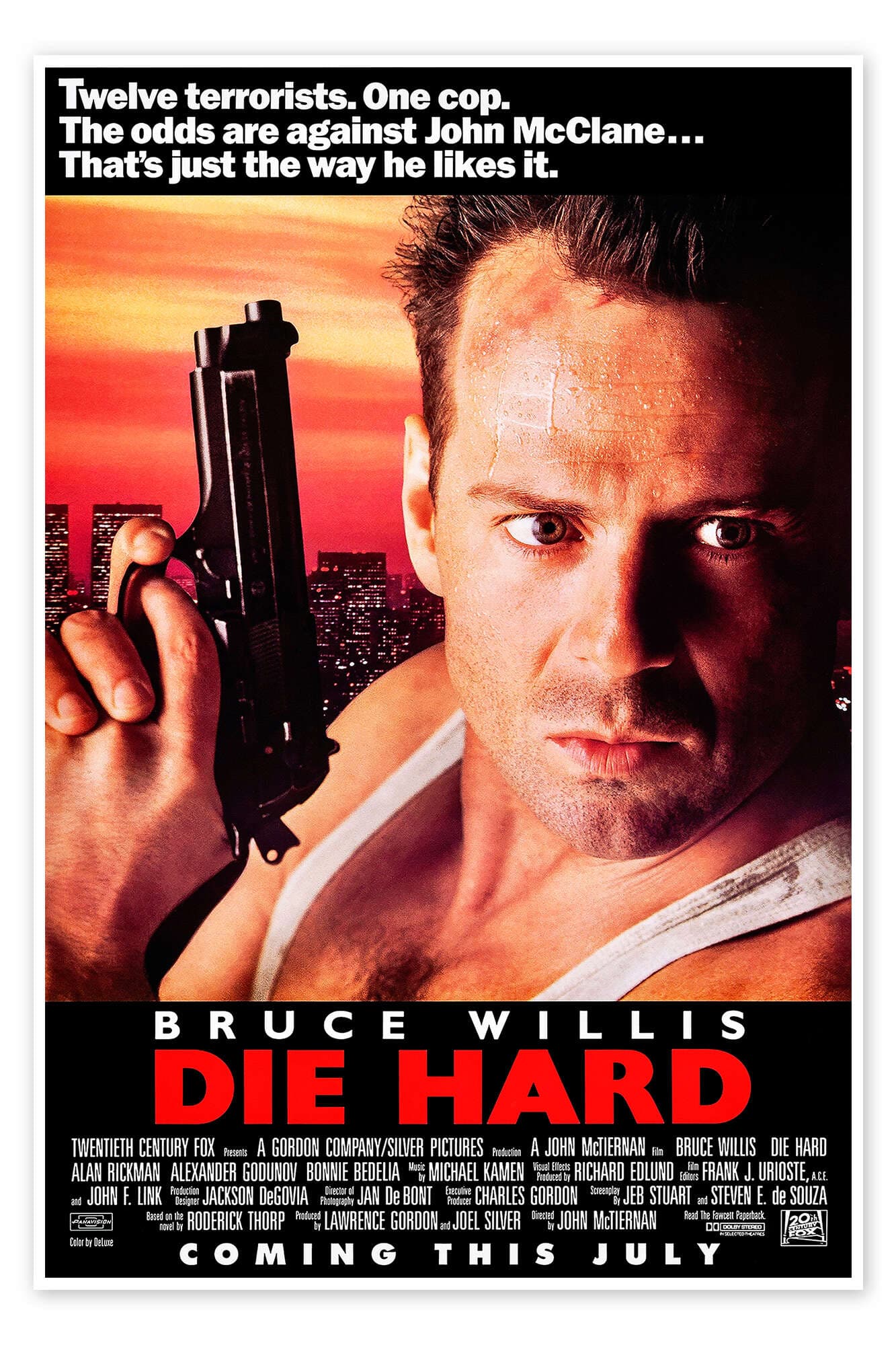
The setup
Die Hard still reads like a love letter to a particular kind of action movie: small, sharp, and unshowy. Its engine is simple — a New York cop flies to Los Angeles to see his estranged wife at her company's Christmas Eve party, and the building gets taken over — and John McTiernan mostly lets that idea run. The result is an action thriller that keeps asking you to care about one stubborn, ordinary man in an extraordinary situation.
THE MOVIE
John McClane is still the reason this movie works
Talk about Die Hard and people will mention explosions, a high-rise, and a very English villain. All true. But what keeps the film from being just a glossy set-piece parade is the fact its centre is a recognisably ordinary bloke with a very specific private problem.
Bruce Willis’s John McClane isn’t in Los Angeles for heroics — he’s there to see his estranged wife at her company’s Christmas Eve party. That personal thread gives every rooftop chase and claustrophobic corridor a quiet emotional tug: he isn’t only fighting criminals, he’s trying to put a marriage back together.
John McTiernan directs the whole thing with a clarity that favours momentum and set-up over needless cleverness. The premise — an everyday cop up against a professional criminal operation in a single building — is so clean it makes the movie feel both immediate and relentless.
THE SETUP
The idea that sets Die Hard in motion
The set-up is brilliantly economical: John McClane, an NYPD detective, goes to Los Angeles to visit his estranged wife at her office Christmas party. You know the rest of the genre beats will follow — but the film earns them by keeping the human detail front and centre.
When a group of heavily armed criminals seizes the Nakatomi Plaza and takes the party guests hostage, McClane is the one person on the inside who can move and act without the bureaucracy that ties other agencies up in knots.
That isolation — a lone cop inside a single building against a coordinated team — turns each small escape and improvisation into a meaningful step. The premise lets the movie alternate between close, tactile jeopardy and the broader cat-and-mouse game running through the office levels.
You leave the setup knowing exactly what the stakes are: lives, a marriage and the wits of an ordinary detective stretched to the limit.
THE CHARACTER
Why John McClane matters
John McClane matters because he’s not a superhero in a tailored costume; he’s a working cop whose private life has collided with his job. That separation from his wife is not window-dressing — it supplies his motive and makes his choices feel urgent rather than performative.
Bruce Willis plays McClane, and the film keeps returning to the fact that this is an everyman — someone who thinks and reacts like a cop who’s seen the streets, not a proselytising action figure. His problems are domestic as well as physical, which keeps the audience rooted in something recognisable even amid the gunfire.
The movie also uses supporting characters to turn up the pressure around McClane. A flirtatious colleague, a prying TV reporter and bureaucratic police types complicate his ability to act, and those escalations make his improvisations feel both necessary and clever.
In short: McClane matters because the film refuses to let spectacle swallow character. He’s the reason you want the bad guys caught — not because they’re evil in the abstract, but because stopping them would mean he has a shot at fixing his life.
UNDER THE SURFACE
Die Hard has more on its mind than the plot suggests
At face value Die Hard is an action-thriller about stopping a heist. Under the surface it’s about a particular brand of heroism: the everyman who has to become resourceful because systems around him fail or bungle the job.
Estrangement and reconciliation are quietly threaded through the film. McClane’s attempts to save hostages double as attempts to prove he still belongs in his wife’s life — that private emotional current lifts the stakes above a generic rescue mission.
The film also stages competence against bureaucracy. McClane’s improvisation contrasts with the pomp and politicking of outside law enforcement, so the movie routinely rewards craft and grit over procedure and press conferences.
And yes, the Christmas backdrop matters: it’s a familiar time, a heightening of family expectation, which makes the disruption feel both unsettling and oddly appropriate for a story about re-connection.
THE FILMMAKING
How Die Hard was put together
One reason Die Hard feels so immediate is the camera work. Jan de Bont’s photography foregrounds hands-on, kinetic movement — handheld and tracking approaches that put you in the middle of tight spaces and moving chases rather than observing them from a polite distance.
That kinetic impulse is matched by editing that keeps the pace taut without sacrificing clarity. The film’s cutting earned industry recognition, including an Academy Award nomination for Best Film Editing, which tells you the shape of the movie was taken seriously.
McTiernan’s direction consistently privileges momentum and clarity over flashy distraction: you’re never left wondering what’s happening, only caught up in how it plays out.
All of this adds up to a film that feels engineered to pull you along. The technical choices serve the story’s tension rather than competing with it.
PRACTICAL EFFECTS
The effects work that gives Die Hard its physical personality
Die Hard’s sense of physical danger comes partly from how it was built. Exterior and building-damage shots used miniatures and optical compositing, practical techniques that make the skyscraper feel like a real, vulnerable place.
The film’s most famous vertical moment — the antagonist’s fall — combined on-set stunt work with blue-screen compositing: the actor was dropped against an airbag and a background plate was composited in post. It’s a practical-and-optical hybrid that sells the peril without asking us to suspend disbelief too wildly.
Stunt rigging and carefully coordinated practical stunts are used throughout, with performers and camera setups engineered to capture close-up high falls and action beats in a convincing way.
Those choices ground the action. When things go wrong in Nakatomi Plaza you sense the physical consequences, which makes the smaller moments — a wounded cop clambering through ducts, for example — feel earned.
PURE 80S
Die Hard could not belong to any other decade
Die Hard landed in 1988 at a moment when action cinema was looking for new shapes. Its confined-location focus and emphasis on a believable, everyman lead helped steer the genre away from invincible larger-than-life heroes toward more contained, gritty scenarios.
The film sits next to other late-80s action work by the same director — John McTiernan had made Predator a year earlier — and together those movies helped define a late-decade approach that favoured practical set-pieces and muscular storytelling.
That shift isn’t merely stylistic. By shrinking the battlefield to a single building and making the protagonist essentially human and fallible, Die Hard changed what an action movie could ask of an audience.
It’s very much a product of its time in its filmmaking choices and its appetite for lean, efficient thrills — but those choices also helped the film set a template that other films would follow.
THE LEGACY
Why Die Hard still matters
Die Hard’s afterlife is concrete. It spawned multiple sequels released over the years and established John McClane as a recurring presence rather than a one-off creation.
Institutional recognition followed: the film was selected for preservation in the U.S. Library of Congress National Film Registry, which flags it as having cultural, historical or aesthetic significance.
Elements of the film — particularly the figures of John McClane and Hans Gruber — have regularly turned up on lists and discussions about memorable screen characters and villains, which helps keep the movie in critical conversation.
Perhaps most importantly, Die Hard’s structural premise and tone helped popularise the idea of the lone hero in a confined location, a format that many later action films would adopt and adapt.
THE VERDICT
Does Die Hard still hold up?
Yes. Die Hard’s central promise — an ordinary detective trapped inside a skyscraper, improvising his way through an organised criminal operation — still delivers. Much of the movie’s tension comes from McClane’s physical isolation and the clever asymmetry between him and a larger, better-armed group.
The film balances spectacle with human detail: McClane isn’t only trying to stop a heist (the criminals’ true plan involves stealing bearer bonds from the company vault) — he’s also trying to fix his life. That private motive keeps the action honest.
External obstacles such as police procedure and inter-agency rivalry add texture; they stop the film from becoming a one-note gunfight and make McClane’s improvisations feel necessary rather than stylish flourishes. The presence of a grounded outside contact — Sgt. Al Powell — gives McClane a human counterpoint that matters when the bullets stop flying.
So if you’re wondering whether to watch it today: watch it for the confident premise, for the way a single building becomes a battlefield, and for the film’s insistence that violence and heroism can still be personal. Die Hard is an action movie that never forgets it started with a marriage and a plane ticket.
Share this movie
Keep watching
More movies from the 80s
1986
Jumpin' Jack Flash
Jumpin' Jack Flash: our relationship with technology and freedom, and why this 1986 movie still matters.
Read our take →
1987
RoboCop
A murdered cop rebuilt as a product — RoboCop still asks who gets to sell justice.
Read our take →
1983
Christine
Obsession, adolescence and a car that won't let go.
Read our take →