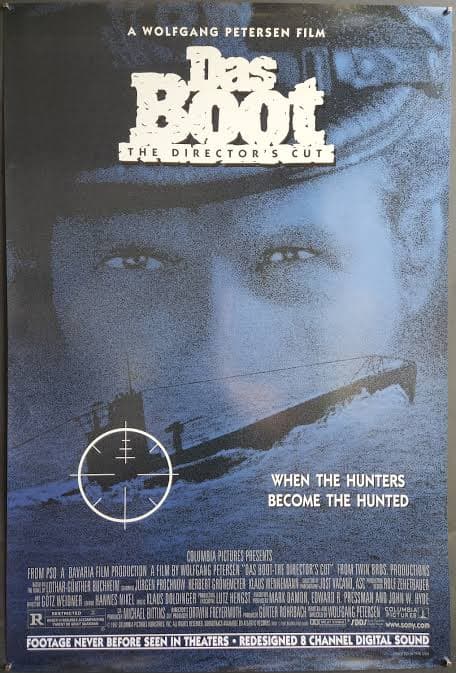
The setup
If you remember one thing from Das Boot, make it the captain. Not metaphorically — the film actually hands the boat’s emotional weight to a man whose decisions set the tempo for everyone crammed below decks. Wolfgang Petersen’s U-96 drama is less about grand battle scenes and more about how command, routine and the squeeze of the metal hull shape people.
THE MOVIE
Der Alte is still the reason this movie works
Das Boot doesn’t begin with a hero’s entrance. It begins with a machine — a U‑boat — and a man who has to make it sing. The film follows the crew of U‑96 on a combat patrol in the North Atlantic, and from the opening minutes it’s obvious who’s setting the mood: Der Alte.
Der Alte is presented as the experienced, controlling captain whose decisions govern tactics and morale. That isn’t a throwaway character detail; it’s the organising principle of the picture. When the boat leaves port and the routine of naval life meets sudden mortal danger, you’re watching a command style in action.
All of this sits inside a tight, specific filmmaking package — a German-language drama from 1981 directed by Wolfgang Petersen, built around claustrophobia, professional duty and the human cost of mechanised naval warfare. It runs long enough to live with these people; long enough for the pressure inside the hull to become its own character.
THE SETUP
The idea that sets Das Boot in motion
Keep it simple: a German U‑boat goes to sea. The narrative tracks the crew of U‑96 on a perilous Atlantic patrol in 1941 and the practical emergencies that puncture daily life — convoy engagements, depth‑charge barrages, damage control and the tricky Gibraltar passage.
What makes the setup work is the film’s insistence on procedure. Much of the drama comes from watching crews perform routine tasks with precision, then seeing those routines threatened by sudden external violence. Survival, not glory, becomes the thing everyone is arguing over.
That contrast — steady competence versus random mortal danger — is where the film mines tension. The story gives you enough operational detail to care about the crew’s decisions, and then asks whether professional skill is enough when luck and the sea intervene.
Cinematically, the setup favours immersion over spectacle. Petersen stages sequences so the boat itself feels like the battleground: the danger is often offscreen, but its effects are never far from what the men must do next.
THE CHARACTER
Why Der Alte matters
Der Alte isn’t a heroic novel‑type with a stirring speech. He’s the sort of captain whose presence rearranges the small, practical choices beneath him. The film makes that explicit: his decisions determine tactical moves and, crucially, the men’s morale.
Because the U‑boat is so compressed — physically and narratively — leadership doesn’t feel abstract. Orders are immediate and their consequences are immediate. When Der Alte speaks, the boat responds; that dynamic gives the film its forward motion.
The movie also gives us a point of view to measure him against: a young Leutnant Werner who watches and learns. That pairing lets the captain be both a force and an example, which makes him memorable in a way that goes beyond rank or poster poses.
In short, Der Alte matters because he turns chain of command into character. The film’s drama often arises from how his steadiness — or stubbornness — either steadies the crew or exposes them to risk.
THE PERFORMANCE
Why Jürgen Prochnow's performance matters
Contemporary coverage singled out Jürgen Prochnow’s central presence as a key element of the film’s focus. Critics repeatedly noted that the captain anchors the picture — not by showmanship, but by providing a single, stable centre around which the chaos of the ocean can revolve.
That kind of anchor is valuable in a film that spends so much of its time in cramped spaces and emergency situations. A steadying figure gives the audience someone to read tactically: when he decides, we can judge how risky the decision is.
Because the movie foregrounds procedure and consequence, the visible effect of the captain’s presence matters as much as any line of dialogue. Reviews recognised this: Prochnow’s appearance functions as the film’s organising touchstone.
So the performance matters less as star turn and more as a pivot. It’s the difference between a boat full of interchangeable faces and a crew that reacts to an actual personality at the top.
UNDER THE SURFACE
Das Boot has more on its mind than the plot suggests
On the surface it’s a survival story; beneath that it’s about living inside a system. Claustrophobia isn’t just physical — it’s also social. Men packed into steel have no private life, so solidarity and professional duty become the only currencies.
Camaraderie here is functional. It’s forged by routine and necessity: fixing a pump, manning a station, keeping a watch. The film treats those everyday mechanics of crew life as morally significant because they decide who survives when disaster comes.
There’s also a steady note about the human cost of mechanised warfare. The boat is a machine, and the crew are cogs whose lives are measured against tonnage and targets. The movie lets you feel how impersonal systems make personal losses inevitable.
Finally, moral ambiguity creeps in where orders meet conscience. In a chain of command, the captain’s choices ripple down, and the film is fascinated by that ripple — by how routine obedience can be both necessary and troubling.
THE FILMMAKING
How Das Boot was put together
A large part of the movie’s personality comes from how it was shot. Cinematographer Jost Vacano developed camera methods and stabiliser techniques to glide through the length of the submarine set, producing long interior tracking shots that make the cramped spaces feel lived in rather than stagey.
Production design matched that ambition. The team reconstructed a life‑size U‑boat interior on studio stages, consulting the novel’s photographs and technical sources to create a workmanlike environment where men would actually be able to do their jobs.
Taken together, the fluid camera work and detailed sets do something simple but effective: they turn a studio build into a place you’d believe the crew spent weeks in. The film’s technical craft was noticed at the time — it earned multiple award nominations.
That technical reputation helped the film travel beyond German screens, signalling that Petersen and his collaborators could marry document-like realism to tense drama without losing dramatic focus.
PRACTICAL EFFECTS
The effects work that gives Das Boot its physical personality
Das Boot’s sea life is built from physical craft. The production used multiple replicas: a life‑size internal set for cluttered, close‑quarters scenes; an exterior mock‑up for port and surface work; and scale models for underwater and sea‑surface photography.
The team relied on special‑effects photography with scale models — reported examples included large scale pieces for convincing composites — and controlled tank work to sell the boat at sea when a full exterior wasn’t practical.
There was also a clever practical compromise: a conning‑tower mock‑up placed in a studio water tank for surface shots that didn’t require showing the whole hull. Those choices let the film blend studio control with believable marine imagery.
In short, the movie’s physical effects are pragmatic: built to support performance and atmosphere rather than to call attention to themselves. The result is a tactile look that keeps you inside the world rather than admiring the trickery.
PURE 80S
Das Boot could not belong to any other decade
Released in 1981, Das Boot arrived at a moment when large‑scale war pictures and ambitious international cinema were finding audiences again. It wasn’t a nostalgic curio — it was a contemporary German film staking a claim on the global stage.
Its combination of technical craft and dramatic seriousness did more than win awards; it helped open doors. The film’s commercial and critical success in West Germany and abroad paved the way for Wolfgang Petersen to move into major international work later in the decade.
The movie’s visibility was boosted by festival and academy attention as it crossed to U.S. theatres in early 1982, so it functioned both as a national film and as a statement that German filmmaking could play on a large, international canvas.
That mix of national storytelling and international ambition feels very early‑80s: serious filmmaking, technically accomplished, and ready to travel beyond its language and borders.
THE LEGACY
Why Das Boot still matters
Part of Das Boot’s afterlife is plainly practical: the film received six Academy Award nominations, including for direction and cinematography, which secured its reputation beyond German audiences.
That reputation encouraged Petersen to revisit the material in later forms — he supervised a longer Director’s Cut in 1997 and the film’s footage was repackaged in television versions, so the picture has several canonical shapes viewers can choose from.
The property itself expanded into new audiovisual projects decades later, demonstrating that the original material still had narrative room to breathe and be reinterpreted.
And those studio‑built sets haven’t vanished into the archive: interior props and displays found their way into exhibits, where the film’s production craft remains a touchstone for German film heritage.
THE VERDICT
Does Das Boot still hold up?
Yes — but on its own terms. Das Boot’s central pleasures are patient and specific: long, sustained onboard sequences that make the submarine’s confined environment the engine of tension, and a focal point provided by the young Werner to help the audience measure the action.
If you want spectacle or a grand heroic sweep, this isn’t the film for you. If you want to feel how professional routine, chain of command and sudden external danger collide — and you’d like to watch a captain’s decisions actually change people’s fates — then it still delivers.
The movie’s technical craft — Vacano’s interior camera work, detailed studio sets, and the practical model and tank work — all serve a consistent dramatic purpose. That unity of intent is why Prochnow’s captain and Petersen’s direction still feel coherent today.
So watch it for the pressure, the procedures and the people shoved into a metal tube. Das Boot remains worth seeing because it remembers to care about the small things that make survival possible, and about the heavy choices that arrive when those small things break.
Share this movie
Keep watching
More movies from the 80s

1986
Jumpin' Jack Flash
Jumpin' Jack Flash: our relationship with technology and freedom, and why this 1986 movie still matters.
Read our take →

1987
RoboCop
A murdered cop rebuilt as a product — RoboCop still asks who gets to sell justice.
Read our take →

1983
Christine
Obsession, adolescence and a car that won't let go.
Read our take →