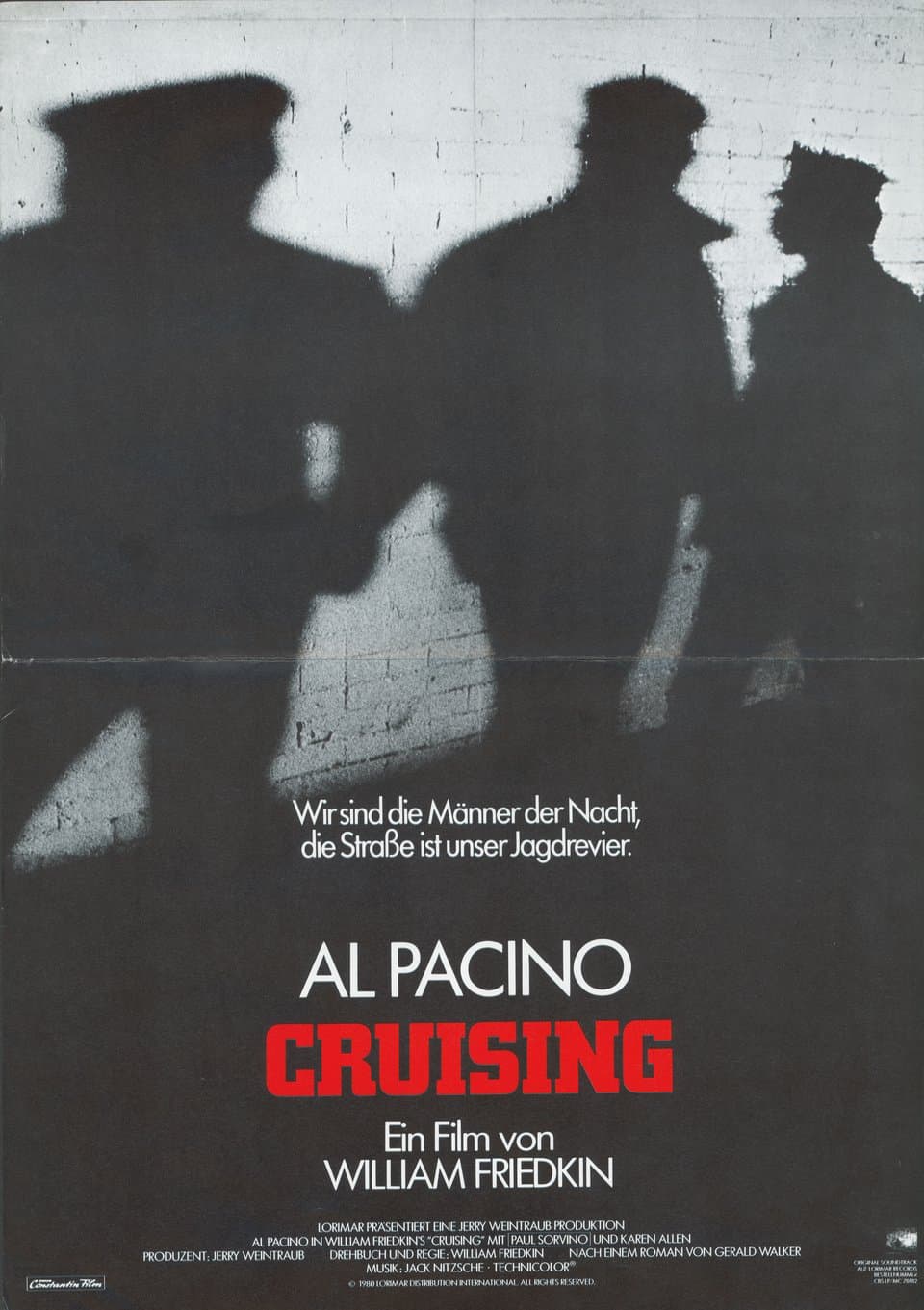
Cruising
Undercover, unsettled and uncomfortably watchable — Steve Burns is why you should look again.
The setup
Cruising is the sort of film that insists you pay attention to a single man while the city's margins hum around him. William Friedkin sends a young cop into New York's leather and S&M bars to catch a brutal killer, and the movie lives or dies by how you feel about that assignment — and about the man carrying it. Revisited now, it's a prickly, sometimes fascinating piece of work that raises questions as loudly as it answers them.
THE MOVIE
Detective Steve Burns is still the reason this movie works
Cruising throws you straight into an uncomfortable professional gamble: a young NYPD patrolman is picked to go undercover in the city's gay leather and S&M bars to track a serial killer. It's not a cosy assignment, and the movie doesn't pretend it is.
The case begins with bodies — dismembered parts found in the Hudson — and the police decide Burns is the right man because he physically resembles the victims. That personal match turns the investigation into something intimate, and not in a good way: Burns has to become part of the night world he's been sent to police.
William Friedkin directs, Al Pacino plays Detective Steve Burns, and the picture's production and release were noisy affairs — protests from gay-rights activists and multiple submissions to the ratings board led to edits before it opened in 1980. All of which is to say: this is a film that arrived already charged, and Burns sits at the centre of that charge.
THE SETUP
The idea that sets Cruising in motion
At its most basic, Cruising is a procedural with its feet in a nightlife subculture: a police hunt for a killer who is targeting men tied to certain West Village bars. The hook is mechanical and mean — a body count and a trail — but it gives the film a firm engine.
What changes the engine into a tense drama is Burns's position. He's not an anonymous investigator. He is chosen in part because he looks like the victims, and that likeness forces the assignment into a personal register.
So the film splits its time between standard police work — lineups, questioning, surveillance — and Burns's immersion in the scenes he's been ordered to infiltrate. That tension between method and immersion is where the movie's energy comes from.
Cruising never forces a neat emotional verdict. Its structure keeps Burns's interior life deliberately ambiguous, which means the set-up asks you to sit with uncertainty rather than handing you easy explanations.
THE CHARACTER
Why Detective Steve Burns matters
Steve Burns isn't memorable because of clever lines or a flashy backstory. He matters because his personal situation is the premise made human: a young patrolman whose resemblance to the victims turns him into bait.
That physical match is a storytelling shortcut that comes with cost. The assignment isn't abstract; it presses on his private life and changes the terms of his ordinary relationships.
Nancy, Burns's girlfriend, exists to show that cost. Her role as the domestic counterpoint — the person outside the night world — highlights how the operation's secrecy and strain ripple into everyday life.
Put simply: Burns is the movie's hinge. The plot operates around him, and his movement between the street, the bars and home is what turns a procedural into something more disquieting.
THE PERFORMANCE
Why Al Pacino's performance matters
Contemporary reviewers pointed to Al Pacino as the engine of Cruising, noting his committed and intense presence at the film's centre. That observation is worth repeating: the movie's dramatic effect is tied closely to how much screen time and focus Burns receives.
Crucially, the film leaves Burns's inner life ambiguous. Critics noticed that tension — Pacino is central, but the character's feelings are not spelled out for the audience.
That ambiguity and the attention paid to Burns by reviewers are connected. When a film deliberately withholds a clear psychological map, the performer becomes the place the audience tries to read.
So even if you don't agree with every choice the movie makes, it's fair to say that Pacino's centrality is a reliable reason people keep watching — he is the visible point around which the film's uncertainties revolve.
UNDER THE SURFACE
Cruising has more on its mind than the plot suggests
Undercover identity is the film's obvious intellectual lift: what happens to a person who's paid to pretend? Burns's gradual immersion forces the audience to ask whether the job changes him, and if so, how much of the change is work and how much is real.
Those questions sit beside a more fraught set of concerns about othering and representation. From the earliest stages of production, critics and activists argued that the film problematised or distorted depictions of gay communities — a debate that followed the movie into release.
Voyeurism and surveillance are baked into the premise. The police gaze is literal here: Burns watches, is watched, takes notes and learns how to perform a version of himself. That watching is not neutral; it's a power dynamic the movie keeps returning to.
Finally, the film refuses to ignore violence against marginalised communities. The murders that trigger the plot are not abstract crimes; they are attacks on a specific group, and the film's atmosphere is coloured by the ethical questions that raises — about policing, protection and complicity.
PRACTICAL EFFECTS
The effects work that gives Cruising its physical personality
On the credit roll you'll find a name devoted to special make-up effects. That billing tells you something straightforward: the production used practical make-up to shape the film's physical reality.
Practical make-up credits suggest a hands-on approach to the film's more graphic moments rather than leaving everything to suggestion. It's a production choice that helps the movie feel grounded in bodies and places, rather than purely conceptual.
In a film where the discovery and treatment of victims drives the plot, that practical attention to the visible details contributes to the picture's texture.
All of which is to say: the work of a special make-up artist is a small but notable piece of Cruising's on-screen personality.
PURE 80S
Cruising could not belong to any other decade
Cruising was shot at the turn of the decade and released in 1980, which matters because it places the film directly in the moment it depicts: New York's late-1970s nightlife and a string of real, unsolved killings provide the backdrop.
That immediacy gives the movie a documentary urgency. It's not a distant period piece looking back at a scene; it was made while the story it takes from the headlines was still very much alive.
Friedkin adapted the story from a 1970 novel and wrote the screenplay himself, so the film carries a deliberate throughline from reportage to dramatic reconstruction — an approach that suited the era's appetite for gritty police narratives.
It opened in February 1980 in Los Angeles and New York, which is to say it landed at the cusp of a new decade but remained rooted in the anxieties and night-life economies of the 1970s.
THE LEGACY
Why Cruising still matters
Cruising arrived under a cloud of controversy and it has never entirely shaken off that history. The protests staged during production and release kept attention on the film's portrayals long after the credits rolled.
The movie's contentious reputation meant it turned up in later discussions about LGBT representation in Hollywood; notably, it was discussed in the 1995 documentary that examined how gay characters have been handled on screen.
In recent decades the film has been revisited through home-video releases and archival restorations — soundtrack and 4K work that suggests there is a continuing curiosity about the picture and what it represents.
That legacy is mixed. Cruising matters because it forces conversations about representation, policing and the ethics of storytelling; whether those conversations cast the film in a good light is still a debate.
THE VERDICT
Does Cruising still hold up?
Short answer: yes, but with a rider. If you're watching for the way a film interrogates undercover identity and the cost that kind of work can exact, Cruising still has teeth. The plot — a manhunt built from forensic work and night-life surveillance — gives the film a procedural backbone, and the story's real pull comes from Burns becoming more and more caught between two worlds.
Al Pacino's centrality is not trivia. Contemporary reviewers singled out his committed, intense presence as central to the film's dramatic effect, and the movie deliberately keeps Burns's internal life ambiguous. That combination makes Burns an absorbing screen figure: you watch him to try to understand what the film refuses to explain.
But the viewing experience is complicated by the film's representational baggage. The production's protests and the cuts required during the rating process are part of the movie's history; they matter to how we watch it now, because the ethical questions the film raises off-screen are the same ones it raises on-screen about policing, surveillance and violence against marginalised communities.
So go in ready to be provoked. Watch for the procedural detail, watch for the tightrope Burns walks, and watch with an awareness that this is a difficult film whose value is tangled up with the controversies it stirred. It's not comfortable viewing, and it shouldn't be; it's better when it makes you uneasy rather than pretending otherwise.
Share this movie
Keep watching
More movies from the 80s
1986
Jumpin' Jack Flash
Jumpin' Jack Flash: our relationship with technology and freedom, and why this 1986 movie still matters.
Read our take →

1987
RoboCop
A murdered cop rebuilt as a product — RoboCop still asks who gets to sell justice.
Read our take →

1983
Christine
Obsession, adolescence and a car that won't let go.
Read our take →