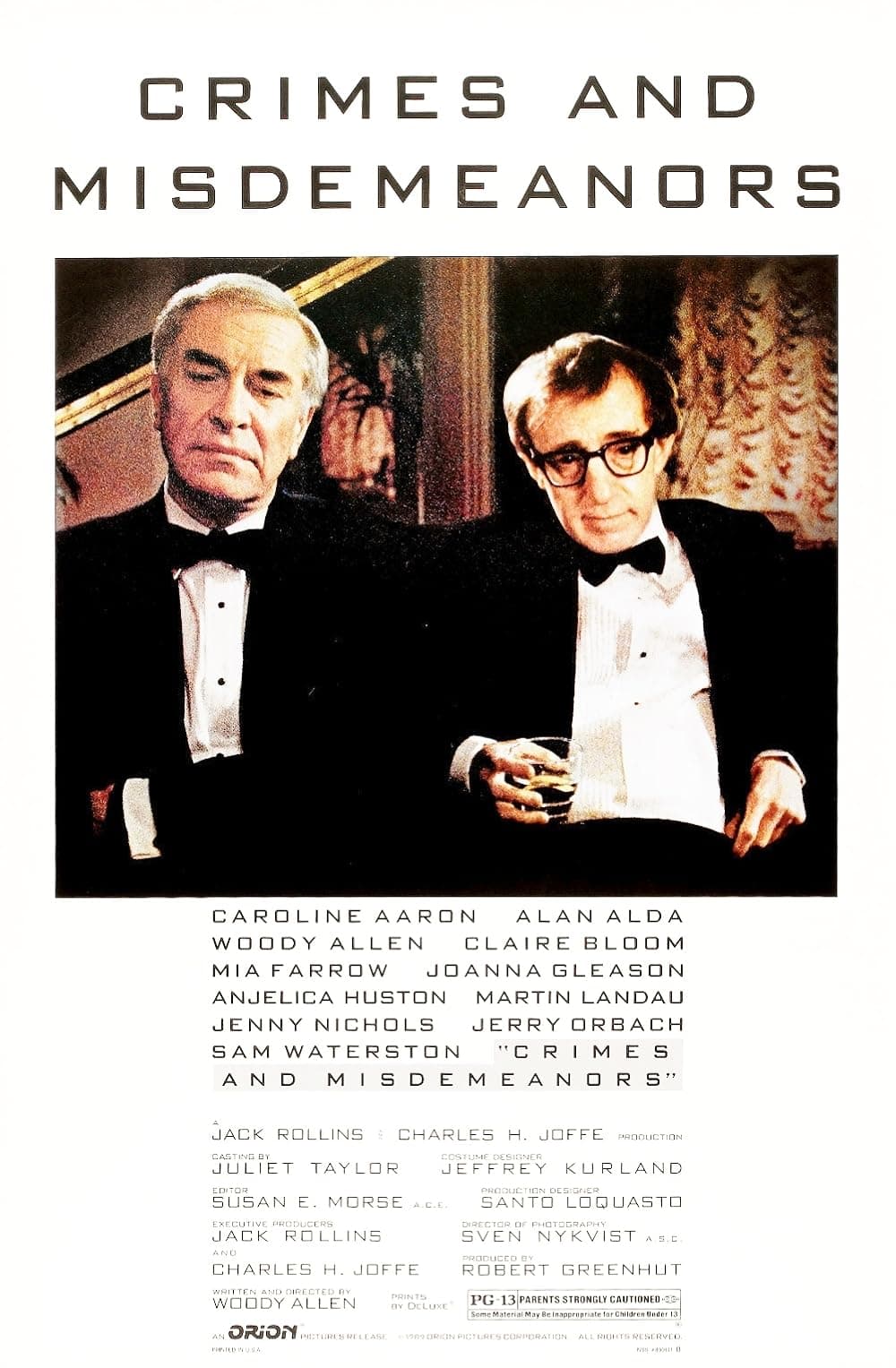
Crimes and Misdemeanors
A genteel New York morality play where privilege meets decision — and conscience is the loudest character.
The setup
Crimes and Misdemeanors keeps turning up in conversations because it stages a very particular question: what happens when a comfortable life meets an impossible choice? Woody Allen splits the film between a high-stakes moral drama and a smaller, comic story about a filmmaker’s personal frustrations. The result feels like two very different movies arguing with each other, and that argument is precisely the point.
THE MOVIE
Judah Rosenthal is still the reason this movie works
Talk to anyone who remembers Crimes and Misdemeanors and you’ll probably end up talking about Judah Rosenthal. He’s the wealthy eye doctor at the heart of the film’s darker strand, the man whose private mess threatens the tidy life he’s built and forces a decision no one wants to admit they understand.
Woody Allen cuts this with a second, lighter story about Cliff Stern, a documentary-maker tangled in romantic and career frustrations. That intercutting — high-stakes moral crisis versus small-scale professional and romantic irritation — is the film’s engine. The contrast sharpens every choice the characters make.
What keeps the movie alive is the moral tug-of-war at its centre: conscience and guilt pushing against social fear and pragmatic self-interest. It’s not just a tale of wrongdoing; it’s a study of why comfortable people suddenly act as if they have everything to lose.
THE SETUP
The idea that sets Crimes and Misdemeanors in motion
At its most basic the film runs two stories in parallel. One follows Judah Rosenthal, a wealthy ophthalmologist whose long-term affair becomes a threat to his family life. The pressure on him escalates until he faces a decision with real moral weight.
The other thread follows Cliff Stern, a documentary-maker whose problems are more domestic and professional: unrequited love, career resentment and the small humiliations of trying to get by. It’s a comic counterpoint to Judah’s darkening plot.
That pairing — a public, almost legal feeling crisis for the privileged man and a private, comic struggle for the working artist — lets the film test the same ethical questions at different social levels. One story feels like a moral thriller; the other reads more like a social comedy.
The setup works because the two tones keep bumping into each other. When a philosophically charged dilemma sits next to ordinary career envy, you start to notice how small, everyday choices stack up into larger ethical consequences.
THE CHARACTER
Why Judah Rosenthal matters
Judah isn’t memorable because he’s flamboyant. He’s memorable because his problem is the kind that quietly eats at a life built on respectability. He’s a man trying to protect family, reputation and social standing when an ongoing affair threatens to undo all of it.
The stakes for Judah are social as much as personal: what terrifies him is the scandal, the loss of position, the practical fallout on the life he’s bolted together. That’s what turns a private wrong into a public panic.
Because his dilemma forces a pragmatic calculation — preservation of social standing versus moral choice — Judah’s storyline becomes a compact thought experiment on guilt and hypocrisy. The film makes you sit in the same room as those calculations and feel their cold logic.
Finally, Judah’s narrative supplies the moral pressure that reframes the rest of the film. Without that escalating crisis, the comic bits about career and romance would feel smaller; with it, the whole movie keeps circling the consequences of choice.
THE PERFORMANCE
Why Martin Landau's performance matters
Contemporary critics singled out Martin Landau’s turn as Judah Rosenthal, and that attention translated into an Academy Award nomination for Best Supporting Actor.
Put plainly: the role was evidently seen as central to the film’s moral seriousness, and Landau’s casting and reception underline how Judah carries the dramatic weight of the piece.
That nomination is a useful guide for viewers approaching the film today — it signals the part of Crimes and Misdemeanors that critics found most arresting at the time.
Whether you watch for the ethical puzzle or for the way the serious thread keeps the rest of the film honest, Landau’s credited role is the hinge that holds the darker story together.
UNDER THE SURFACE
Crimes and Misdemeanors has more on its mind than the plot suggests
On the surface it’s about affairs, threatened families and career frustrations. Below that, the film repeatedly returns to guilt and conscience: how people live with what they’ve done, or don’t live with it at all.
There’s also moral ambiguity everywhere—no neat answers, just people weighing ethical choices against pragmatic self-interest and social consequences. That tension between doing the right thing and doing the thing that preserves your life is the movie’s moral heartbeat.
Hypocrisy sits close to the surface. The prosperous characters are insulated in ways that let them treat ethics as an expense to be managed rather than a responsibility to be shouldered.
Faith and doubt creep through the film as well: the narrative keeps asking whether there is a system — spiritual or social — that can deliver punishment or consolation, and it resists tidy moral bookkeeping in favour of messy human outcomes.
THE FILMMAKING
How Crimes and Misdemeanors was put together
Sven Nykvist was the cinematographer, and his photographic approach gives the film a restrained, classical look that plays the material seriously rather than showily.
The production design is by Santo Loquasto, and the movie was shot in New York City, with locations that include the Waldorf Astoria and Tavern on the Green — choices that help anchor the story in recognizable social spaces.
Susan E. Morse edited the film, and that editing keeps the two narratives in close conversation; the cuts are what make the moral thread and the comic thread feel like parts of the same argument.
Taken together, those craft choices — measured photography, considered production design and tight editing — frame the film as a carefully assembled piece where tone and content are in steady dialogue.
PURE 80S
Crimes and Misdemeanors could not belong to any other decade
Released in October 1989, the film arrives at the tail end of Woody Allen’s late-1980s run, a period critics treated as a high point for how he balanced comedy and seriousness.
It sits naturally next to films like Hannah and Her Sisters in that late-80s conversation: the same writer-director voice weaving moral observation into ensemble storytelling.
That timing matters because the film feels like a synthesis of Allen’s two tempos — the ironic, urbane comedy and the weightier ethical drama — a synthesis very much of that moment in his career.
Seen this way, Crimes and Misdemeanors reads as an end-of-decade statement: smart, morally interested, and comfortable shifting tone when the material asks for it.
THE LEGACY
Why Crimes and Misdemeanors still matters
The film landed awards-season recognition: it earned three Academy Award nominations, including one for Martin Landau, and it appeared on year-end lists, which signalled genuine critical regard at the time.
That attention hasn’t been random; the film’s insistence on ethical questioning — conscience, punishment and the insulation of the prosperous — gives critics something to return to when they want to talk about Allen’s moral imagination.
Later commentary keeps drawing lines back to Crimes and Misdemeanors when discussing Allen’s work about moral luck and private transgression, which is why films that revisit those themes are often placed in its conversation.
Put simply: the film’s reputation rests on its seriousness of purpose as much as its craft, so it continues to be a reference point when the subjects it raises come back into view.
THE VERDICT
Does Crimes and Misdemeanors still hold up?
Yes — but with a clear rider. The movie works today if you come for the ethical push-and-pull rather than a tidy resolution. Its architecture deliberately sets a grave moral thread against a lighter, comic one and keeps the two in productive tension.
Judah Rosenthal’s story is the film’s fulcrum: a privately dangerous decision driven by fear of scandal, family protection and pragmatic self-interest. That plotline forces the film to ask uncomfortable questions about guilt, conscience and what punishment looks like for the well-off.
At the same time Cliff Stern’s comic, character-driven subplot — unrequited love and professional frustration — gives the film a human, everyday counterpoint. The structure places both narratives in parallel so the movie examines ethical questions at different social levels rather than closing like a conventional thriller.
If you want a compact, well-made moral drama with a wink of comic sympathy, this is still worth watching. It runs 104 minutes, was written and directed by Woody Allen, and carries the period confidence of an auteur comfortable with tone-shifts — which is exactly why its questions still bite.
Share this movie
Keep watching
More movies from the 80s
1986
Jumpin' Jack Flash
Jumpin' Jack Flash: our relationship with technology and freedom, and why this 1986 movie still matters.
Read our take →
1987
RoboCop
A murdered cop rebuilt as a product — RoboCop still asks who gets to sell justice.
Read our take →
1983
Christine
Obsession, adolescence and a car that won't let go.
Read our take →