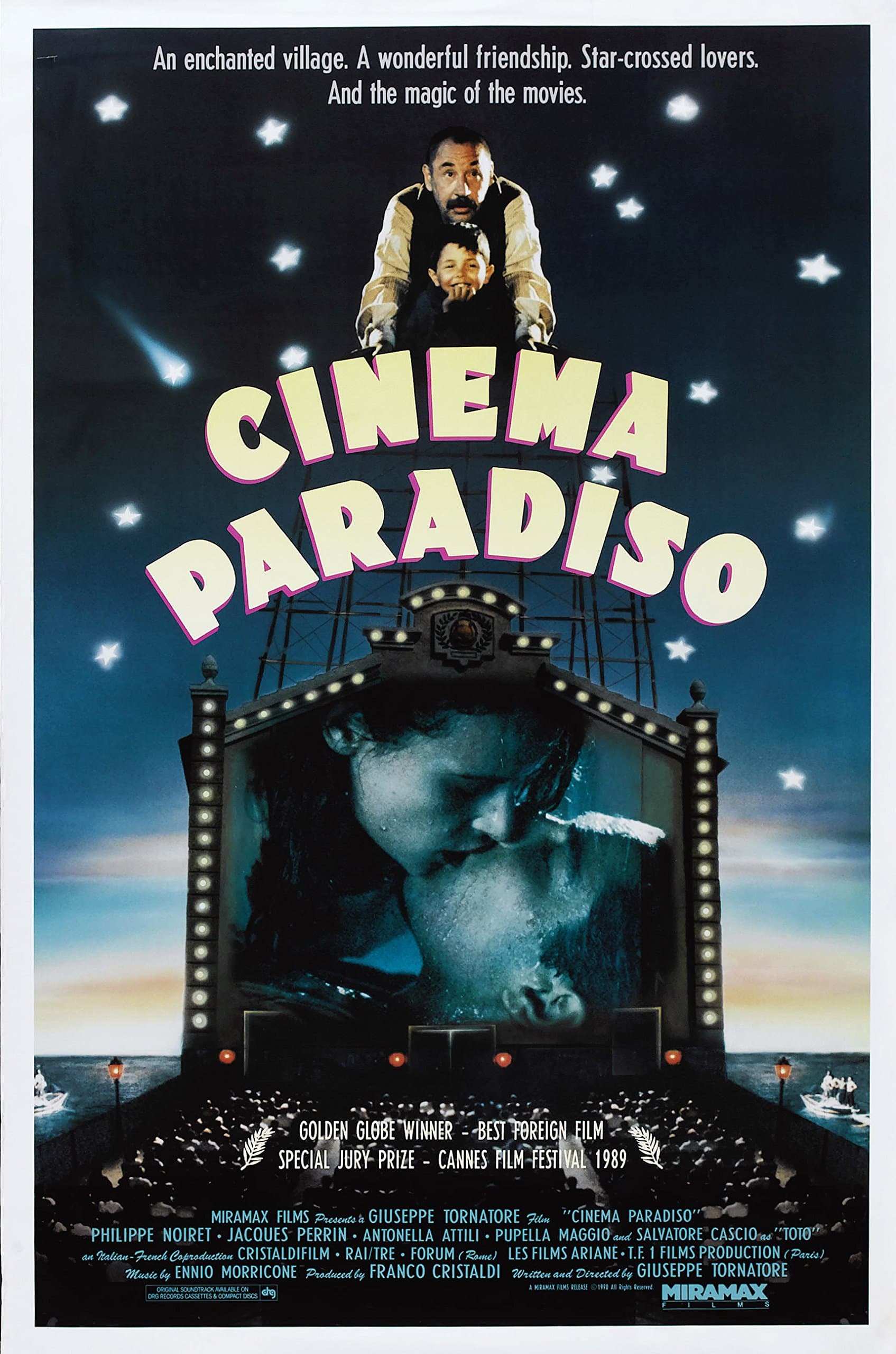
Cinema Paradiso
A love letter to mentorship, the little reels that keep memory alive, and the reason we go to the pictures.
The setup
Salvatore 'Totò' Di Vita returns to his Sicilian hometown and finds, in a funeral and a packet of film fragments, the map of a life. Cinema Paradiso is as much about how one man learned to look as it is about what he watched.
THE MOVIE
Salvatore 'Totò' Di Vita (adult) is still the reason this movie works
Cinema Paradiso tells the story backwards and forwards at once: an adult filmmaker, Salvatore Di Vita, returns to his native Sicilian village for the death of Alfredo and remembers, in long flashback, how he became the man he is. That frame—memory summoned by loss—gives the film its particular tone, equal parts rueful and affectionate.
As a boy, Totò discovers the local picture house and is taken under the wing of Alfredo, the projectionist who teaches him the craft and, more quietly, how to love films. Alfredo’s practical lessons—how to thread film, how to keep the projector running—become the apprenticeship of a vocation and, for Salvatore, the scaffolding of a life.
Giuseppe Tornatore directed the film, which was released in 1988 and runs (in its commonly screened Italian theatrical cut) for 155 minutes. That running time is only part of the story: Cinema Paradiso exists in several official versions, which matters for how modern viewers first meet Salvatore’s life.
THE SETUP
The idea that sets Cinema Paradiso in motion
At heart the film is a coming-of-age told as a recollection. Adult Salvatore’s return to the village frames long flashbacks that follow him from curious child to teenage projectionist and, eventually, to a filmmaker whose life was shaped in that little cinema.
One recurring device is a packet of film reels Alfredo has secretly rescued—the kissing scenes cut by the town’s censors. Those fragments are not a gag; they are a physical reminder of what cinema once showed the town and what the town, in turn, tried to erase.
There’s also a quietly painful adolescent thread: Salvatore’s thwarted romance with Elena, which the film treats as both personal longing and a window on the town’s social limits. That relationship helps explain why Salvatore ultimately feels pulled between loyalty to home and the desire to leave.
Alfredo’s role ties these threads together. He saves Salvatore from a projection-room fire and later, after losing his sight, passes the projection duties to him. It’s the sort of apprenticeship that makes vocational love indistinguishable from personal affection.
THE CHARACTER
Why Salvatore 'Totò' Di Vita (adult) matters
Salvatore as an adult is the film’s anchor—he’s literally the one doing the remembering. That slot matters because Cinema Paradiso isn’t content to show how a boy fell in love with cinema; it wants to show how that love arranged the rest of his life.
His arc carries a tension many of us recognise: devotion to a craft versus the tug of the wider world. The cinema gives him identity, community and a job; it also contains the social smallness he needs to escape. That push-and-pull is what keeps him interesting even when the plot moves through long stretches of memory.
Around him, the village is voiced through a cast of familiar figures—the priest who enforces cuts, Spaccafico the local, the projectionist’s wife and Salvatore’s mother—so that the cinema feels less like a location and more like the emotional centre of town life.
Jacques Perrin is credited as playing the adult Salvatore, the man who returns and takes up the story: a figure whose past and present are braided together by what he learned at Alfredo’s side.
UNDER THE SURFACE
Cinema Paradiso has more on its mind than the plot suggests
Nostalgia threads the film. It isn’t nostalgia for nostalgia’s sake but for a vanished communal experience: a town that gathered in the dark to be moved together, to laugh and to learn. The rescued reels of cut kissing scenes are the film’s shorthand for what those communal viewings once contained and what censorship tried to deny.
Mentorship is another deepest current. Alfredo is not only a fixer of machines; he’s a teacher of a trade and, by example, a way to approach the world. The handover of the projector is, in effect, a passing on of values and sight—how to keep things running and how to pay attention.
Memory and loss complicate the sweetness. The whole story is a remembrance sparked by Alfredo’s death, which forces Salvatore to reckon with what he owes to the past and what he has allowed himself to leave behind.
Finally, there’s a neat bit of cinematic self-reflection: a film about films that uses real film reels as plot objects to ask what cinema holds on to and what it discards. It’s a tidy mirror trick—films about films that make you think about what it means to look.
THE FILMMAKING
How Cinema Paradiso was put together
Cinema Paradiso is a film that leans on craft credits you can point to: Blasco Giurato is listed as director of photography, Andrea Crisanti as production designer and Mario Morra handled the principal editing. Those names are the skeleton of how the film was assembled.
Editor Mario Morra’s work is particularly relevant because the film exists in multiple officially released cuts. The way those cuts rearrange or restore sequences changes how much memory and backstory the audience receives on first viewing, so editing here isn’t just technical—it’s narrative architecture.
The existence of a longer director’s version and shorter international cuts means that the film’s pacing and emphasis can vary quite dramatically between releases. That’s a filmmaking choice with real consequences: what gets kept or trimmed changes who we feel close to and why.
Giuseppe Tornatore’s role as director and writer frames those choices; the names attached to the credits remind you that Cinema Paradiso was built by filmmakers conscious of how material might be shaped for different audiences.
WATCHING IT NOW
What has aged — and what hasn't
The film’s frame device—the adult filmmaker returning to town and telling his story in flashback—still reads neatly for modern viewers. Memory as a structuring principle is a familiar storytelling move, and Cinema Paradiso uses it to let emotion arrive gradually rather than all at once.
One practical issue for today’s audience is version choice. Some international theatrical releases removed the adult-Elena material, while later restorations and home-video editions have restored longer cuts. Which version you watch affects how resolved certain threads feel.
The village’s ensemble of local characters—figures like the bill-sticker Attacchino—helps the film land as a community portrait rather than a single-man biopic. Those secondary roles keep the social texture intact and make the cinema feel like the town’s emotional hub.
All told, the story’s reliance on memory, mentorship and a physical archive of film fragments gives it durable, human bones: the particulars of distribution may shift what you see first, but the central setup remains easy to connect with.
THE LEGACY
Why Cinema Paradiso still matters
Cinema Paradiso’s awards history is part of why it keeps turning up in conversations: it won the Academy Award for Best Foreign Language Film and shared the Special Grand Prix of the Jury at Cannes. Those honours don’t guarantee longevity, but they make sure the film continued to be seen and screened after its first run.
The film also received multiple BAFTA Awards, recognitions that underline how international audiences and institutions responded to its screenplay and music as well as to some of its younger cast.
There is also a textual afterlife in the form of the longer director’s version released later. Restorations that returned excised material give viewers a different shape of the story and an invitation to reconsider what the film means when it keeps more of its past.
All of this is to say Cinema Paradiso remains a film people return to because its storytelling—anchored by Salvatore’s life and Alfredo’s mentorship—rewards repeated attention and different cuts reward new readings.
THE VERDICT
Does Cinema Paradiso still hold up?
Yes—if you want a film that treats cinema itself as a subject, and one that locates a life in apprenticeship and memory, Cinema Paradiso still holds up. The structure—an adult filmmaker returning and speaking through long flashbacks—gives the movie a humane rhythm that survives different edits and viewing habits.
Salvatore’s devotion to cinema, his appetite for curiosity, and the friction between staying and leaving are recognisable tensions that don’t feel dated. Alfredo’s role as mentor—saving him from a projection-room fire, passing on the projector and with it a way of working—remains the emotional hinge of the story.
Be mindful of versions. The experience of the film can change depending on whether you watch the commonly screened 155-minute cut or one of the longer restorations that add back material (including adult-Elena scenes removed from some international releases). If you’re watching for the fullest sense of the story, seek a restoration that restores what was trimmed.
In short: watch it. Cinema Paradiso isn’t simply a period piece or an elegy for a vanished practice; it’s a careful study of how mentorship, memory and small communal rituals shape who we become. And it rewards anyone who cares about how a life can be seen through the films it loved.
Share this movie
Keep watching
More movies from the 80s
1986
Jumpin' Jack Flash
Jumpin' Jack Flash: our relationship with technology and freedom, and why this 1986 movie still matters.
Read our take →
1987
RoboCop
A murdered cop rebuilt as a product — RoboCop still asks who gets to sell justice.
Read our take →
1983
Christine
Obsession, adolescence and a car that won't let go.
Read our take →