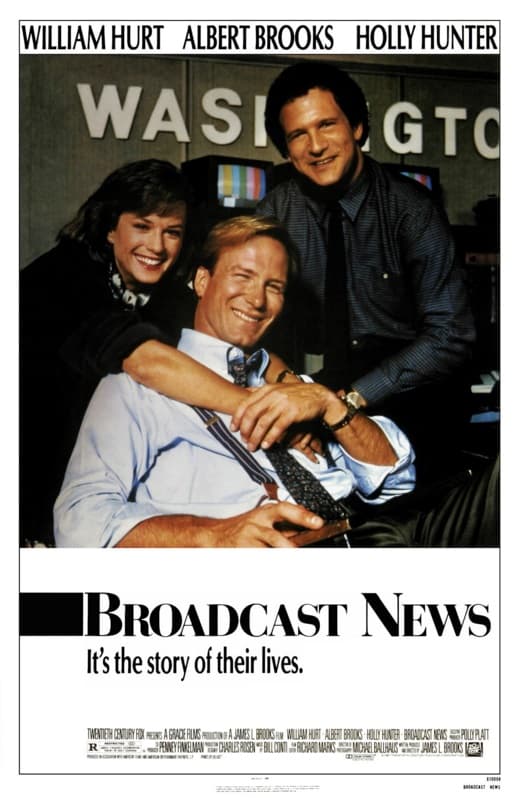
Broadcast News
A newsroom rom‑com that prefers arguments to punchlines — and Tom Grunick makes those arguments pay.
The setup
Broadcast News is James L. Brooks’s rom‑com set inside a television newsroom, and it’s less interested in tidy jokes than in the small, noisy human fights that happen when ambition and image collide. At the centre of all that friction sits Tom Grunick — the telegenic anchor whose rise forces everyone to choose what they care about.
THE MOVIE
Tom Grunick is still the reason this movie works
Broadcast News makes a simple, clever bet: set a romantic comedy inside a working newsroom and let professional arguments do the emotional heavy lifting. That triangle — Jane Craig the driven producer, Aaron Altman the cerebral reporter, and Tom Grunick the magnetic new anchor — supplies both the laughs and the pressure.
James L. Brooks frames the film as a rom‑com with newsroom machinery in the background: it’s about who gets the story, who gets the job, and who gets the person. The workplace isn’t just a set; it’s where taste and tactics collide.
Jane is written and staged as the engine of that collision — intensely focused on standards and prone to private vulnerability. Put another way: the film’s domestic dramas always have a byline.
THE SETUP
The idea that sets Broadcast News in motion
At its most basic, the film places a professional love triangle inside a real newsroom, and then lets the mechanics of television journalism push and pull the characters. Jane is the producer who holds editorial standards; Aaron is the thoughtful reporter; Tom is the fresh face recruited for his presentation.
Brooks stages the movie as a romantic comedy — so personal decisions are always tangled with career moves. That choice keeps the stakes intimate even when the film is discussing industry trends.
You don’t need a full plot recap to see how the premise works: control rooms, on‑air earpiece coaching, studio sets — these practical elements turn up at dramatic moments, and one live‑anchor sequence becomes a real turning point for a character.
The setup succeeds because it makes work feel like life. Professional choices have private consequences, and vice versa.
THE CHARACTER
Why Tom Grunick matters
William Hurt plays Tom Grunick, the handsome, affable anchor parachuted into the network because he presents well on camera rather than because he’s an old‑school reporter.
That casting choice is the film’s pressure valve. Tom’s presence forces a debate everyone at the station already has but avoids: is television supposed to reward how a story looks or how it’s reported?
Tom isn’t a villain. He’s the clean surface that reveals what the newsroom really values. His rise makes the film ask a blunt question — do viewers get truth, or a version of truth polished for ratings?
That question is part of why the movie received attention at awards time, with acting nominations among its seven Academy Award nods.
THE PERFORMANCE
Why Albert Brooks's performance matters
Albert Brooks’s Aaron Altman is the film’s conscience and its pressure point. Contemporary and later coverage singled out one sequence — the so‑called 'flop sweat' on‑camera meltdown — as a standout beat.
That moment is repeatedly cited because it does two jobs at once: it’s a comic, uncomfortable display and a clear demonstration of what newsroom pressure looks like when ambition meets humiliation.
The scene’s prominence in discussion was reflected in awards season: Brooks earned one of the film’s acting nominations, which kept attention on how the movie dramatizes career anxiety.
Whether you find the moment funny or painful, it’s the sort of character set‑piece that turns a newsroom debate into personal drama.
UNDER THE SURFACE
Broadcast News has more on its mind than the plot suggests
Style versus substance is the film’s obvious hook: the screenplay keeps returning to the contrast between reporting driven by editorial rigour and a growing premium on telegenic presentation.
Layered under that are questions about professional ambition and its costs. People in the film make choices that trade private comfort for career advancement, and those trades score the emotional beats.
Gender and workplace dynamics are also in the frame. Jane’s role as the intensely professional producer exposes how a newsroom (and its promotions) measures different people differently.
Finally, there’s an ethical thread about televised news: the story doesn’t just show spectacle, it asks whether spectacle is changing what news should be.
THE FILMMAKING
How Broadcast News was put together
Michael Ballhaus shot the film and Richard Marks edited it; Bill Conti supplied the musical score. Those are tidy credits, but they also tell you this is a professionally assembled, studio‑scale picture rather than something rough‑hewn.
Production design matters here because the newsroom is nearly a character — sets were constructed in renovated office space and at Wolf Trap stage facilities to give the film a believable working environment.
The technicians and designers weren’t aiming for glamour. They built a functional world where on‑air earpieces, control rooms and live broadcasts could plausibly drive dramatic moments.
Taken together, the filmmaking choices keep the viewer grounded in the daily grind of television news, which is exactly where Brooks wants the drama to live.
PURE 80S
Broadcast News could not belong to any other decade
Brooks developed the screenplay after attending the 1984 Democratic National Convention and researching a news industry that was changing fast. That research roots the film in a specific moment of late‑80s media anxiety.
The story engages with industry shifts of the period — a rising emphasis on presentation, the early growth of cable and increasing corporate pressures — which are woven into the plot’s dilemmas.
Released in 1987, the film reads as a document of that media moment: it captures a newsroom learning to value appearance alongside, and sometimes above, reporting rigour.
That timing gives the movie its particular taste. It’s not nostalgia for style; it’s a portrait of an industry in transition.
THE LEGACY
Why Broadcast News still matters
The film was taken seriously on its release: it earned seven Academy Award nominations, including Best Picture and major acting nods for its three leads.
It was also named Best Picture for 1987 by the New York Film Critics Circle — respectable proof that critics thought it was saying something worthwhile about work and television.
Its afterlife has been curated carefully: a director‑approved, high‑definition restoration and Criterion release with commentary, a documentary, deleted scenes and an alternate ending keeps the conversation alive.
Beyond awards and releases, the film tends to turn up on critics’ and journalists’ lists of notable journalism films — people still return to it when they want a smart depiction of the late‑80s newsroom.
THE VERDICT
Does Broadcast News still hold up?
Yes — if you want a film that stages its arguments instead of lecturing. At its heart Broadcast News is about choices: between looking like news and doing the work of it; between career gain and private cost. That triangle — Jane, Aaron and Tom — keeps those choices dramatic rather than abstract.
Brooks deliberately frames this as a romantic comedy inside a newsroom, and the screenplay keeps tightening the contrast between reporting rigour and telegenic presentation until the characters have to act. Practical newsroom mechanics — control rooms, earpiece coaching, a live‑anchor crisis — make those moments feel lived‑in and consequential.
There are trophies and restorations to point at, yes, and one unforgettable Aaron Altman ‘flop sweat’ moment that still gets talked about. But the film’s real strength is how it lets ordinary professional pressures become personal tests.
So should you watch it today? If you’re curious about a late‑80s portrait of television news that still argues — convincingly — about what news should be, absolutely. Watch it for the newsroom fights; stay because the argument is still interesting.
Share this movie
Keep watching
More movies from the 80s
1986
Jumpin' Jack Flash
Jumpin' Jack Flash: our relationship with technology and freedom, and why this 1986 movie still matters.
Read our take →
1987
RoboCop
A murdered cop rebuilt as a product — RoboCop still asks who gets to sell justice.
Read our take →
1983
Christine
Obsession, adolescence and a car that won't let go.
Read our take →