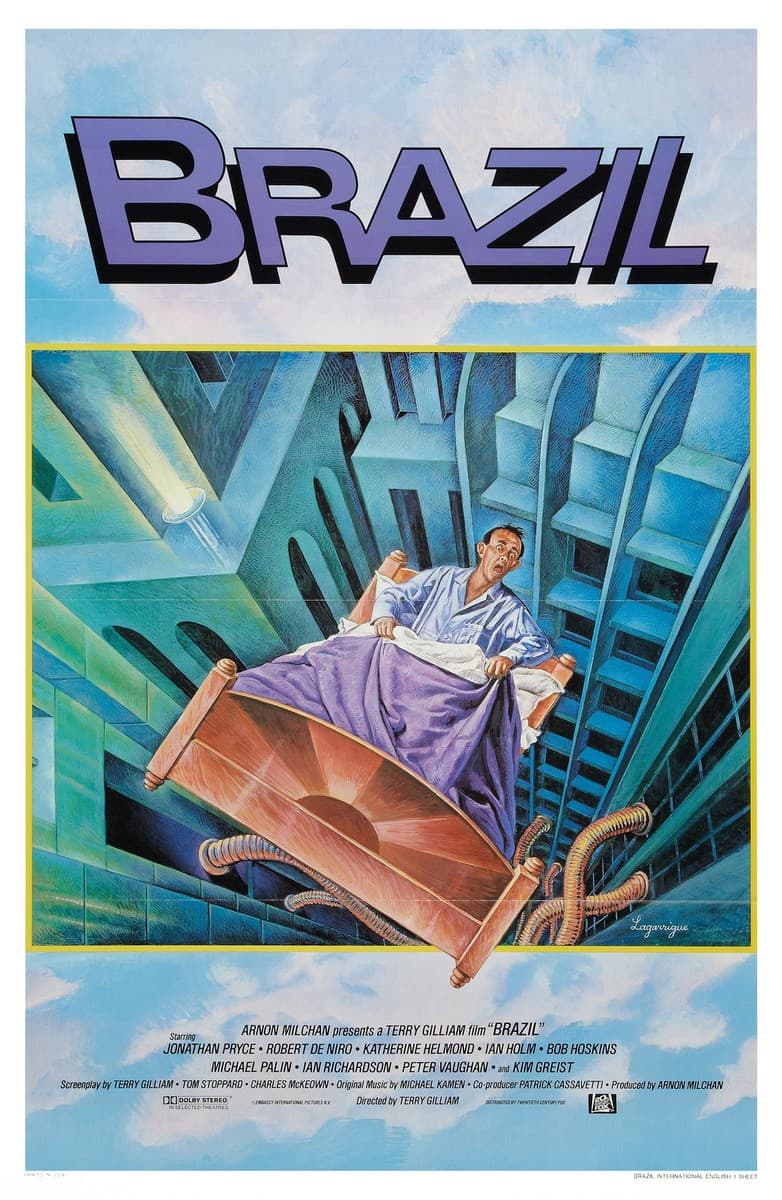
The setup
There are dystopias that scare you and dystopias that make you laugh until you wince. Brazil belongs to the latter category, a world where an ordinary civil servant's private fantasies are the only way he keeps himself sane. It's Sam Lowry who makes the film worth revisiting: his longing, his flights of fancy and his small acts of rebellion sit at the film's emotional and comic centre.
THE MOVIE
Sam Lowry is still the reason this movie works
If you remember one thing about Brazil it should be this: it’s a movie anchored to a daydreamer. Sam Lowry is a low-level Ministry of Information clerk whose life lives more vividly inside his head than out of it, and the film hangs on that particular kind of longing — romantic, cinematic, stubbornly private.
What drags Sam out of his neat, imagined set-pieces is not an exotic plot twist but a stupid, bureaucratic mistake — a misprinted arrest order that sends officials after the wrong man. That clerical error is the practical engine of the story, and Gilliam uses it to show how paperwork and misfired systems can wreck ordinary lives.
Terry Gilliam made Brazil in 1985 as an oddball mixture of noir, sci‑fi and satire; it runs long, it is elaborate, and it gives Jonathan Pryce’s Sam Lowry a whole career's worth of daydreams to live in. The contrast between those private fantasies and the grim, officious world he inhabits is what keeps the film electric.
THE SETUP
The idea that sets Brazil in motion
The movie starts from an economical but clever premise: Sam is a man doing a small, anonymous job inside a monstrous bureaucracy. His real life is made tolerable by elaborate fantasies — the kind of filmic rom-com heroics he can only allow himself in his head.
Everything in Sam’s workplace runs through paperwork and retrieval systems. Misprints, frozen files and procedural checks are not background details; they’re the nuts and bolts that cause the story’s trouble. That insistence on the humdrum mechanics of administration turns mundane errors into catastrophic events.
The mistake that knocks the plot out of its peg is a typographical/computer error that leads to the wrongful detention of an innocent man. From there the film pivots: a private obsession becomes public danger, and Sam is dragged deeper into an institutional machine that mistakes the ordinary for the treacherous.
You don't need a blow‑by‑blow of every scene to see why the setup works. It’s tidy, cruel and slightly ridiculous — a perfect match for Gilliam’s appetite for mixing the absurd with the everyday.
THE CHARACTER
Why Sam Lowry matters
Sam Lowry isn’t a heroic type. He’s a clerk who prefers movie-star fantasies to confrontation, and that private life of images is the movie’s most human touch. His longing for escape and for a romantic ideal tells you everything you need to know about why he acts — or spends his life avoiding action.
Because his fantasies are so specific, they become a measuring stick. When the world forces him into actual choices, we can see the difference between who Sam wants to be and who the system will allow him to become. That tension keeps him watchable even when the plot tilts into madness.
The people around Sam underline those choices. Jack Lint is the socially successful friend who knows the system from the inside and whose loyalties complicate Sam’s attempts to break free. And a brief but pivotal figure — the mysterious handyman Harry Tuttle — arrives like a real‑world contradiction to the Ministry’s rules.
Jonathan Pryce plays Sam Lowry; the film is arranged so that Sam’s private cinema and his public life talk to each other constantly. That conversation is what gives the whole thing a human pulse beneath the satire.
UNDER THE SURFACE
Brazil has more on its mind than the plot suggests
On the surface Brazil is a darkly comic dystopia; beneath that surface it’s a film about what bureaucracy does to people. The movie treats paperwork and information systems as forces capable of slicing up identity and dignity, and it delights in tracing how a single administrative hiccup becomes moral ruin.
Escape is the other half of the picture. Sam’s daydreams are not mere visual flourishes; they’re the mechanism by which he claims interior life back from a world that insists on filing, labelling and processing everything. Fantasy here is resistance, not mere whimsy.
Mistaken identity and the state’s readiness to identify 'terror' where none exists are recurring pressures. That paranoia — the neat confidence of institutions that say they know you better than you know yourself — is what turns small errors into life‑altering crises.
Gilliam also takes aim at consumerist complacency and the satire of administration. The film’s jokes and outrages often land in the same place: how systems convince people to accept indignity as normal and status as the solution.
THE FILMMAKING
How Brazil was put together
A lot of Brazil’s personality comes from its physical decisions. The production deliberately favours a retro‑futurist, handcrafted look — a world that feels built by people who believe their own procedures — and Norman Garwood is credited as the production designer who steered that aesthetic.
Roger Pratt is credited as director of photography, and the film leans on stylised, often expressionistic compositions to separate dream from reality. The camera isn’t neutral here; it helps you understand when Sam is slipping into private cinema and when the Ministry’s world closes in.
Julian Doyle is credited as editor, and you can feel the film’s construction in the way sequences jump between fantasy and office life. Those cuts are not just technical flourishes; they’re the structural device that lets the movie live in two tonal registers at once.
The industry noticed the craft: Brazil picked up Academy Award nominations for Best Original Screenplay and Best Art Direction, which reflects how much thought went into both the story’s architecture and its physical design.
PRACTICAL EFFECTS
The effects work that gives Brazil its physical personality
Brazil’s world feels tactile because it is tactile. The production relied on miniatures, model work and optical techniques rather than contemporary computer imagery, which gives many sequences a handmade, slightly overworked charm.
That handcrafted approach isn’t just nostalgia; it helps sell the film’s idea of a bureaucratic machine assembled out of human parts. Models and optical compositing create a sense that the city and its devices have been cobbled together by officials who prefer form over human function.
Home‑video supplements and documentary material included with later releases document how heavily the film leaned on practical methods. Those behind‑the‑scenes accounts make clear the production’s commitment to tangible effects rather than digital shortcuts.
The effect is a world that feels purposefully manufactured — an environment where the artifice matches the satire.
PURE 80S
Brazil could not belong to any other decade
Brazil arrived in 1985 at a moment when filmmakers and audiences were comfortable with politically tinged science fiction and retro‑futurist imagery. That moment made Gilliam’s blend of satire, fantasy and dystopia feel timely rather than merely eccentric.
The film’s well‑publicised clash with its American distributor also reads like an 80s story — a decade when studio-commercial pressures often collided with directors’ ambitions. The dispute over the U.S. release became part of the film’s public life and coloured how audiences first encountered it.
Because the picture looks and thinks like an 80s art‑house SF film, it sits naturally among other politically minded movies of the decade. That context helps explain why critics and viewers kept returning to it as a distinctive, if unruly, example of 80s filmmaking.
All of which is to say: the film’s style, its controversy and its themes are products of the era, and knowing that history helps you watch it with an ear for what it was arguing against in 1985.
THE LEGACY
Why Brazil still matters
Part of the film’s afterlife is institutional: it received Academy Award nominations for Best Original Screenplay and Best Art Direction, and it has been subject to restorations and special home‑video editions that keep it in circulation.
The story of its production and distribution has also become part of its mythology. Jack Mathews chronicled the director–studio clashes, and documentary material on later releases picked over that public battle — the sort of real‑world row that keeps conversations alive long after initial screenings.
Those clandestine screenings and the support of critics during the U.S. dispute are often remembered when the movie’s history is discussed. The controversy helped frame Brazil as both an object of art and an example of commercial friction.
Between the awards recognition, restorations and the distributor saga, Brazil has remained a film many film people and institutions revisit — not simply for its images but for its place in cinema’s talk about artistic control.
THE VERDICT
Does Brazil still hold up?
Yes — but with a clear rider. If you are drawn to films that mix satire and fantasy, and you enjoy a protagonist whose inner life tells you more than his outward acts, Brazil remains a gripping watch. The central setup is simple and enduring: a clerk who escapes into elaborate fantasies finds himself entangled in the consequences of a typographical/computer error that sends the state after the wrong person.
What keeps it compelling is the way the film repeatedly intercuts Sam’s fantasy sequences with his bureaucratic reality. That contrast is the movie’s structural engine: the daydreams aren’t decorative, they’re the film’s way of measuring what the system takes away — agency, tenderness, choice.
The cast of characters around Sam matters, too. Jill Layton is both the woman of his dreams and a real person whose attempts to correct the Ministry’s mistake put her in danger. Jack Lint’s insider position complicates loyalties, while the arrival of Harry Tuttle provides an outside, disruptive force to the Ministry’s machinery. Even the obsessively material Mrs. Ida Lowry helps show what conformity looks like in this world.
So watch it for the tone and the ideas. It’s long, it’s particular, and it insists on its own view of reality and fantasy. If you want a tidy, buttoned‑down allegory, this isn’t it. If you want a film that makes you laugh, cringe and think about how a misprinted form can ruin a life — then yes, Brazil is still worth the trip.
Share this movie
Keep watching
More movies from the 80s
1986
Jumpin' Jack Flash
Jumpin' Jack Flash: our relationship with technology and freedom, and why this 1986 movie still matters.
Read our take →
1987
RoboCop
A murdered cop rebuilt as a product — RoboCop still asks who gets to sell justice.
Read our take →
1983
Christine
Obsession, adolescence and a car that won't let go.
Read our take →